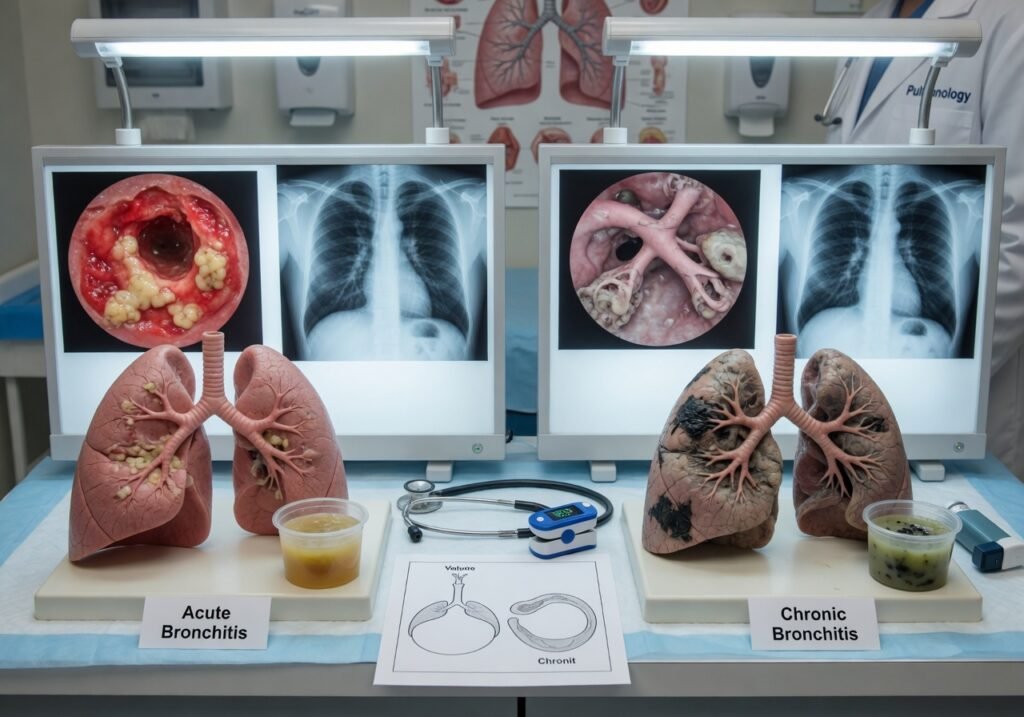
Most people think bronchitis is basically a bad cold that settles in your chest, something that clears up in a few weeks with rest and fluids. That’s dangerously incomplete. A 34-year-old accountant I saw last month had coughed for eight weeks straight, convinced it was acute bronchitis that just wouldn’t quit. When she finally came in, pulmonary function tests showed she’d actually developed early-stage chronic obstructive pulmonary disease from undiagnosed years of secondhand smoke exposure at home. The real story behind bronchitis isn’t a simple viral infection—it’s about whether your airways are inflamed temporarily or permanently scarred, and that distinction changes everything about treatment.
Key Facts About Bronchitis
- Acute bronchitis affects approximately 5% of adults annually in the United States, according to CDC respiratory health surveillance data, though actual rates may be higher since many cases never reach medical attention.
- Chronic bronchitis, classified as COPD, impacts roughly 16 million Americans with diagnosed disease and millions more undiagnosed, per NIH estimates.
- Viral infections cause 90% of acute bronchitis cases, with rhinovirus and influenza accounting for the majority, yet antibiotics are prescribed in up to 75% of cases unnecessarily.
- Smokers develop chronic bronchitis at rates 15 times higher than never-smokers, with risk increasing after just 10-15 pack-years of exposure.
- Recovery from acute viral bronchitis typically spans 3-4 weeks, though the persistent cough can linger 8 weeks or longer in 25% of patients.
Understanding What Happens Inside Your Airways
Your bronchi are the main highways your lungs use to move air in and out. Think of them less like pipes and more like living tissue constantly adjusting to protect you. When bronchitis develops, the cells lining these airways become inflamed—they swell, produce excess mucus, and lose some of their ability to clear debris effectively. That’s where the cough comes from. It’s not random irritation; your body is desperately trying to clear an obstruction that shouldn’t be there.
Here’s what separates acute from chronic: acute bronchitis is this process happening acutely, usually triggered by a virus your immune system will eventually defeat. Your airways will return to normal. Chronic bronchitis, by contrast, represents permanent changes to those airways. The cells don’t bounce back. They stay inflamed, they keep producing excessive mucus, and they lose ciliary function permanently. This is why a smoker with chronic bronchitis will have a productive cough every single morning for decades—it’s not something they caught; it’s architectural damage.
What Actually Causes Bronchitis—And Why Some Risk Factors Matter More Than Others
Viral infections drive acute bronchitis, primarily influenza, parainfluenza, rhinovirus, and respiratory syncytial virus. You can’t really prevent being exposed to these; they’re everywhere during fall and winter months. What you can control is your susceptibility and what happens afterward.
Chronic bronchitis develops almost exclusively from chronic inhalation of irritants. Cigarette smoke tops the list, but here’s what gets overlooked: occupational dust and chemical exposure rivals smoking in developing countries and certain industries. Welders, grain handlers, and textile workers develop chronic bronchitis at alarming rates independent of smoking status. Environmental pollution in areas with poor air quality also contributes significantly, which is why chronic bronchitis rates are higher in industrialized regions with air quality problems.
One factor most articles completely miss—gastroesophageal reflux disease, or GERD. Chronic acid reflux irritates the airways directly and increases susceptibility to both acute viral bronchitis and accelerates chronic bronchitis progression. I’ve had patients whose bronchitis improved dramatically once we treated their reflux aggressively with omeprazole and lifestyle modifications. The connection exists because your esophagus and trachea are neighbors; what happens in one affects the other.
What Bronchitis Actually Feels Like Day-to-Day
Acute bronchitis usually begins like any viral illness—malaise, maybe a sore throat, fatigue. Then the cough arrives. It’s typically dry at first, which drives people crazy because there’s nothing to expectorate. Within a few days to a week, it becomes productive: you’re hacking up phlegm that’s clear, white, or slightly yellow. The cough is worse at night when you’re lying flat, and it disrupts sleep continuously.
Patients describe it as exhausting. You might cough for 30-second stretches that leave your chest sore and your throat raw. Some people develop mild chest discomfort that feels muscular rather than cardiac. Shortness of breath occurs in maybe 30% of acute cases, usually mild. Fever, if present at all, is generally low-grade and resolves within a few days while the cough persists.
With chronic bronchitis, the pattern is relentless. Mornings are particularly bad—productive cough first thing after lying flat all night. The phlegm is often thick and harder to clear. Shortness of breath worsens with exertion. Patients notice they can’t climb stairs the way they used to, or they run out of breath talking on the phone. Recurrent respiratory infections become common because the damaged airways are vulnerable to secondary bacterial infections.
Early warning signs people miss: a change in cough character (dry cough becoming productive, or vice versa), cough that disrupts your work multiple times per day, and cough lasting beyond three weeks. These warrant evaluation rather than watchful waiting.
How Bronchitis Gets Diagnosed
Here’s what actually happens when you come to my office: I listen to your lungs with a stethoscope and hear crackles or wheezing—those abnormal sounds traveling through the bronchi. I ask when the cough started, whether you had recent cold symptoms, and whether you smoke. For uncomplicated acute bronchitis, that’s often sufficient.
Chest X-rays aren’t routinely necessary for acute bronchitis unless I suspect pneumonia (persistent fever, focal crackles, shortness of breath). The biggest diagnostic mistake is ordering a CXR routinely when clinical examination suffices. That said, if you’re coughing for more than three weeks or you have risk factors for COPD, we should get a chest X-ray and consider spirometry.
Spirometry is the test that actually matters for differentiating chronic conditions. It measures how much air your lungs can hold and how quickly you can expel it. This test reveals whether you have chronic bronchitis or early COPD before you’re obviously symptomatic. Sputum samples rarely help unless we suspect something unusual like tuberculosis or resistant organisms.
The criteria for acute bronchitis are straightforward: productive or nonproductive cough lasting less than three weeks, viral symptoms preceding it, and no pneumonia on examination or imaging. Chronic bronchitis diagnosis requires daily productive cough for at least three months per year, for two consecutive years, with obstruction confirmed by spirometry.
Treatment That Actually Works
For acute viral bronchitis, here’s the truth nobody wants to hear: there’s no magic treatment because antiviral medications don’t work for most respiratory viruses. Treatment is supportive. Acetaminophen or ibuprofen handles the discomfort. Honey—specifically ingesting a spoonful—has modest evidence for cough suppression in adults. Dextromethorphan, the ingredient in Robitussin, shows weak benefit at best, and guaifenesin (Mucinex) helps if you’re dehydrated, but most people don’t need it.
Cough suppressants containing codeine are sometimes prescribed and provide better relief than dextromethorphan, though they carry drowsiness and addiction concerns with prolonged use. Short-term use of albuterol inhalers can help if wheezing is present, though routine inhaler use in uncomplicated acute bronchitis doesn’t accelerate recovery.
Antibiotics? This is where we make a crucial mistake repeatedly. I’d estimate 50-60% of acute bronchitis patients receive unnecessary antibiotics, particularly amoxicillin or azithromycin. They don’t help viral infections, and they contribute to antibiotic resistance. The only exception is if you develop secondary bacterial pneumonia, which is clinically distinct from simple bronchitis.
Chronic bronchitis treatment is entirely different. Inhaled corticosteroids like fluticasone and long-acting bronchodilators like tiotropium form the backbone. Many patients use combination inhalers containing both. Ipratropium, an anticholinergic agent, helps some patients. Phosphodiesterase-4 inhibitors like roflumilast reduce exacerbations in certain patients. Pulmonary rehabilitation—supervised exercise training combined with education—improves outcomes measurably.
Managing Bronchitis in Daily Life
Stay hydrated throughout the day, not because it’s generic advice, but because dehydration thickens mucus and makes coughing harder. Drink until your urine is pale. Room humidification helps, particularly at night; a cool-mist humidifier reduces nighttime cough more effectively than hot steam.
Sleep position matters. Propping yourself up with extra pillows reduces the cough reflex compared to flat sleeping because it reduces postnasal drip and the tendency for secretions to pool in your throat.
Avoid respiratory irritants actively. If you have acute bronchitis, ask family members not to smoke indoors. If you have chronic bronchitis, consider air purifiers if you live in areas with poor air quality. Avoid strong cleaning chemicals and perfumes that trigger bronchial irritation.
Exercise matters for chronic bronchitis—regular aerobic activity actually improves bronchial clearance over time through mechanical and neurological mechanisms. Start slowly; walking 20-30 minutes daily provides real benefit.
Monitor your sputum color. Clear or white means viral. Yellow or green raises concern for secondary bacterial infection requiring evaluation. Increasing volume of sputum in someone with chronic bronchitis suggests exacerbation.
Prevention: What Actually Reduces Your Risk
For acute bronchitis, the influenza vaccine reduces risk, though not to zero—vaccinated people still contract bronchitis but often with less severity. The COVID-19 vaccine provides similar modest protection against respiratory viral illness generally. Hand hygiene works but less dramatically than marketing suggests; most transmission happens through air, not hand contact.
For chronic bronchitis, smoking cessation is the only intervention with level-one evidence showing it slows disease progression. Quitting today doesn’t reverse existing damage, but it stops additional damage. Lung function decline drops from 60 milliliters per year in smokers to 10-15 milliliters annually in ex-smokers.
Occupational exposure reduction requires workplace modifications—ventilation improvements, dust masks, or career changes in severe cases. Environmental exposure reduction means considering relocation if you live in areas with chronic air quality problems, which is impractical for most people but worth noting.
Frequently Asked Questions
Acute viral bronchitis is contagious for the first 3-5 days when viral shedding is highest, though some transmission continues for up to 10 days. Chronic bronchitis isn’t contagious—it’s a structural lung condition, not an infection. If you have acute bronchitis, distance yourself from others during the early phase, particularly vulnerable populations like elderly relatives or young children.
Only when bacterial pneumonia develops—characterized by persistent fever above 101°F, focal crackles on examination, and infiltrate on chest X-ray. Simple bronchitis, even if the sputum turns yellow or green, doesn’t require
Sources & Medical References
HealthTopics.com articles are based on peer-reviewed medical research and guidance from the NIH, CDC, and WHO. See our editorial policy for full sourcing standards.