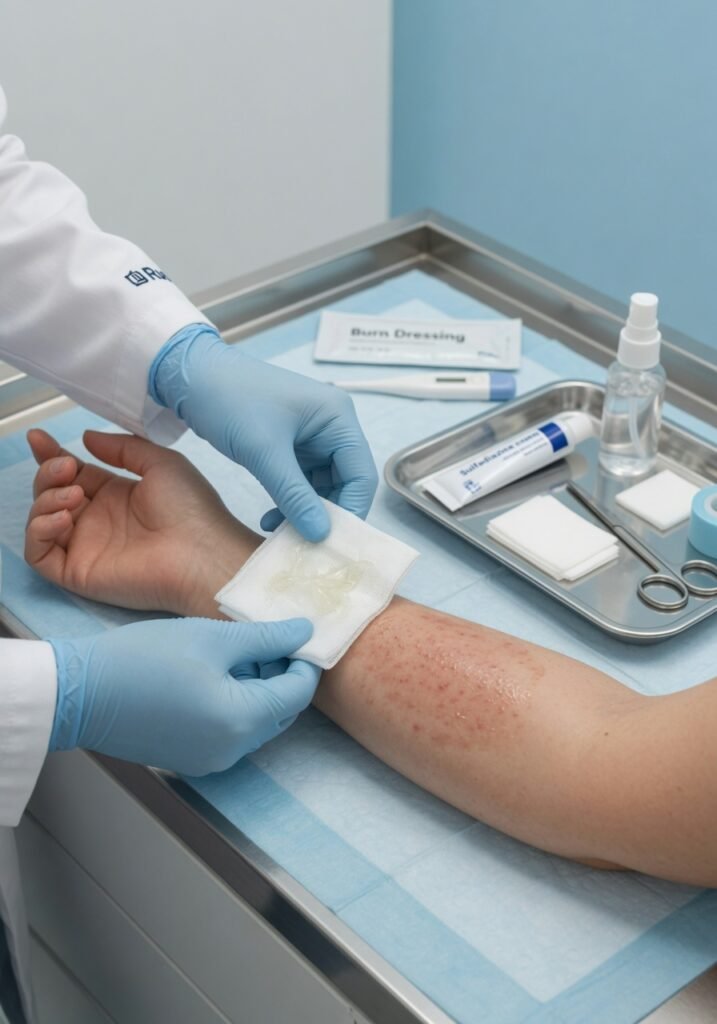

Burns: First Aid Treatment for All Degrees
Studies from the National Institutes of Health show that roughly 40% of people who suffer thermal burns at home apply ice directly to the wound within the first five minutes—a practice that can actually deepen tissue damage and increase scarring. Sarah, a 34-year-old accountant, learned this the hard way when she splashed boiling water on her forearm while making tea. By the time she reached the emergency department fifteen minutes later, ice-induced vasoconstriction had extended her initial partial-thickness burn into deeper tissue layers. Her experience represents a critical gap in public knowledge about burn first aid—knowing what not to do matters as much as knowing what to do.
Key Facts About Burn First Aid
- The “rule of nines” determines severity: head and neck account for 9% of body surface area, each arm 9%, chest and abdomen 18%, each leg 18%, and the back 18%, with assessment critical within the first 24-48 hours.
- According to CDC data, approximately 486,000 Americans require medical treatment for burns annually, with 40,000 requiring hospitalization and 3,275 deaths occurring from fire and burns in 2021.
- Cool water immersion (15-20°C) applied for 10-20 minutes halts the burn process by stopping heat conduction into deeper tissues, but ice or extreme cold causes vasoconstriction that paradoxically worsens damage.
- First-degree burns involve only the epidermis and heal without scarring in 7-10 days; second-degree burns penetrate the dermis and require 2-3 weeks; third-degree and fourth-degree burns destroy full thickness and require surgical intervention.
- Inhalation injury accompanies 20-30% of significant burns and kills more patients than the burn itself in the acute hospital phase due to airway compromise and toxic gas exposure.
Understanding How Burns Damage Tissue
Think of your skin as a three-layer cake: the frosting-thin epidermis on top, the thick spongy dermis below it, and the foundational subcutaneous tissue underneath. When heat applies to this structure, it doesn’t simply burn through evenly like a blowtorch on wood. Instead, heat travels downward progressively, and the deeper the heat penetrates, the more permanent scarring becomes. The body’s inflammatory response compounds this—in the first several hours after injury, swelling increases pressure within tissue compartments, potentially causing additional damage to cells that initially survived the thermal injury. This process, called “progressive tissue necrosis,” explains why some burns get worse over the first 12-24 hours despite the heat source being removed.
Causes and Risk Factors for Burns
Scalding from liquids causes approximately 75% of pediatric burns, while flame burns account for about 20% of adult hospitalizations. Kitchen environments pose the highest residential risk—cooking surfaces, boiling water, and steam injure more people than any other single location. But here’s what emergency physicians see that surprises most patients: age matters in ways people don’t anticipate. Elderly individuals with decreased sensation from peripheral neuropathy or diabetes often don’t react quickly enough to escape heat, turning a brief contact into a serious injury. Similarly, young children lack the coordination to withdraw from heat sources, and their thinner skin reaches dangerous depths more rapidly.
One frequently overlooked risk factor is medication-induced photosensitivity. Certain antibiotics like doxycycline and trimethoprim-sulfamethoxazole, along with thiazide diuretics, make skin dramatically more susceptible to severe sunburns that behave like thermal burns. Someone taking these medications can suffer a deep second-degree sunburn after just 20 minutes of midday exposure, something they’d normally survive without serious injury.
Signs and Symptoms You Actually Experience
Most people recognize immediate pain and visible redness, but burns progress beyond the obvious. A first-degree burn—think sunburn intensity—stings immediately and skin appears bright red without blistering. You’ll notice the discomfort peaks around 24-48 hours, then gradually subsides. Second-degree burns are dramatically different: pain comes with visible blistering, and the area feels profoundly tender to even light touch. The skin appears mottled pink and red, sometimes with whitish areas. A critical detail many sources miss: if you have a large second-degree burn and don’t experience pain, it’s actually a bad sign suggesting nerve damage that indicates a third-degree component.
Third-degree burns feel deceptively painless initially because the burn destroyed the nerve endings themselves. The skin appears white, leathery, or charred—essentially, dead tissue. You’ll notice it doesn’t blanch (turn white) when pressed, and the sensation is absent. Fourth-degree burns penetrate into muscle and bone, presenting as obviously charred tissue. Beyond the burn site itself, watch for signs of systemic injury: difficulty breathing, hoarseness, or singed nasal hairs suggest inhalation injury requiring immediate hospitalization.
Diagnosis: What Happens at the Hospital
When you arrive at an emergency department with a significant burn, the medical team doesn’t just look at the burned area. They perform what’s called the Parkland Formula assessment—a calculation using your body weight and the percentage of body surface area burned to determine fluid requirements for the first 24 hours. This prevents the most dangerous complication: burn shock from losing too much fluid into swollen tissues. They’ll also perform a detailed history about the burn source, as different mechanisms carry different risks. A burn from a house fire triggers inhalation injury protocols. A chemical burn requires identification of the agent. An electrical burn necessitates cardiac monitoring and bloodwork to check for muscle breakdown products (myoglobin) that damage the kidneys.
For smaller burns, depth assessment guides treatment decisions. Healthcare providers use clinical appearance, blanching response, and sensation testing. Eschar (the dead tissue layer) is examined—how thick is it, and does it require surgical removal? For extensive burns, photography and occasionally imaging help track progression. The diagnosis isn’t just about what happened; it’s about predicting what will happen and preventing complications before they occur.
Treatment Options Based on Burn Severity
First-Degree Burns
Cool water immersion for 10-20 minutes stops progression. Ibuprofen 400-600 mg every 4-6 hours addresses pain and inflammation—the anti-inflammatory component matters here, not just analgesia. Topical agents like aloe vera provide some pain relief, though evidence for accelerated healing is modest. Most important: avoid further sun exposure. These burns heal without scarring in 7-10 days with basic care.
Second-Degree Burns (Partial-Thickness)
The approach depends on size. Small burns under 2% body surface area can be managed in outpatient settings with daily wound care using topical silver sulfadiazine (Silvadene) cream or newer agents like mafenide acetate (Sulfamylon). Larger burns require hospital admission. Current evidence shows that non-adherent dressings changed daily with gentle cleansing produce better healing than older approaches using thick antibiotic ointments left in place for days. Pain management typically requires acetaminophen combined with opioids during dressing changes—this isn’t optional, it’s essential protocol. The goal is epithelialization: new skin growing from the wound edges and any remaining skin appendages like hair follicles within 2-3 weeks. If a second-degree burn hasn’t healed in 3 weeks, it’s progressing to scarring and may require skin grafting.
Third and Fourth-Degree Burns
These always require hospitalization and surgical intervention. Within 48-72 hours of injury, surgeons perform escharotomy—cutting through the dead tissue layer—to relieve pressure building beneath and prevent compartment syndrome. Later, skin grafting becomes necessary. The surgical team removes dead tissue and covers the wound with either autografts (skin from the patient’s own body) or temporary biologics like cadaver skin or collagen-based products while waiting for enough healthy skin to harvest. Pain management involves opioid infusions, and infection prevention requires systemic antibiotics if cultures indicate infection—not prophylactically, but when documented.
Practical Daily Management of Burns at Home
For minor burns you’re managing at home, establish a wound care routine: cleanse gently with lukewarm water and mild soap once or twice daily, pat dry, apply topical antibiotic ointment (mupirocin is standard), and cover with a non-adherent dressing. Change dressings every 24 hours minimum. Don’t pop blisters—they protect underlying tissue. If a blister ruptures on its own, trim dead skin gently with clean scissors and continue the routine. Watch the wound edges: if redness spreads beyond the burn boundary, or if you develop pus, fever over 101°F, or increasing pain after day 3, seek evaluation.
Protect healing skin from sun exposure for at least 12 months—new skin lacks melanin and scars extremely easily. Silicone gel sheets applied after the wound closes reduce scarring significantly, particularly on visible areas. Take them seriously: wear them 12+ hours daily for 2-3 months. Compression garments help if scarring becomes raised (hypertrophic). Beyond the wound itself, manage systemic effects: stay hydrated, eat adequate protein to support healing, and address pain proactively rather than waiting until it becomes severe.
Prevention: What Evidence Actually Shows
Smoke alarms reduce fire-related burn deaths by 50% according to NFPA data—simple, powerful prevention. In the kitchen, awareness prevents 70% of scalding injuries: never leave pots unattended, keep pot handles turned inward, and test water temperature before bathing children. For elderly individuals and those with neuropathy, installing anti-scald devices on shower valves limits water temperature to 120°F, preventing the deep scalds that occur with hotter water.
For children, supervised cooking activities with clear safety zones work better than blanket prohibition—kids who understand heat respect it more than those who encounter it unexpectedly. Chemical burns require proper labeling and storage; bleach shouldn’t share a shelf with beverages. Sunscreen alone prevents only about 50% of UV damage; protective clothing, seeking shade during peak hours (10 AM to 4 PM), and avoiding photosensitizing medications when possible address the full spectrum.
Frequently Asked Questions
Should I use ice on a burn?
No. Ice causes vasoconstriction and can deepen the burn. Use cool water (15-20°C) for 10-20 minutes instead. The water should feel cool to your unburned hand, not painfully cold.
When should I go to the emergency department?
Seek immediate care for any third-degree burn, any second-degree burn larger than 2-3 inches, burns on the face/hands/genitals, circumferential burns around a limb or chest, burns from chemicals or electricity, or any burn with difficulty breathing or hoarseness. Inhalation injury is the real killer.
Do I need antibiotics for a burn?
Prophylactic systemic antibiotics aren’t standard for uncomplicated burns. Topical antibiotic creams prevent infection effectively. Systemic antibiotics start only if infection develops, confirmed by culture or clinical progression (spreading erythema, purulence, fever, or failure to heal).
How long
Sources & Medical References
HealthTopics.com articles are based on peer-reviewed medical research and guidance from the NIH, CDC, and WHO. See our editorial policy for full sourcing standards.