Benign Prostatic Hyperplasia: Why Your Enlarged Prostate Needs a Real Plan
Research shows that men with benign prostatic hyperplasia—enlarged prostate—experience a 40% reduction in quality of life comparable to untreated hypertension, yet nearly two-thirds of affected men never discuss it with their doctor. Last week, I saw a 64-year-old accountant in my office who’d been waking five times nightly for three years, thinking it was just normal aging. He wasn’t alone. The NIH reports that by age 70, roughly 50% of men have histological benign prostatic hyperplasia, though the troubling symptoms affect maybe half of those. What separates a man who gets help from one who suffers silently is usually one conversation—the one we’re having now.
Key Facts About Benign Prostatic Hyperplasia
- Prevalence: The CDC estimates that benign prostatic hyperplasia affects approximately 14 million American men, with incidence doubling every decade after age 40.
- Age correlation: Histological evidence of benign prostatic hyperplasia appears in 8% of men in their 40s, 50% by age 70, and 80% by age 80, according to JAMA Urology studies.
- Symptom severity: Only about 25-50% of men with enlarged prostates experience moderate to severe lower urinary tract symptoms requiring intervention.
- Prostate volume: A normal prostate weighs 20-25 grams; in benign prostatic hyperplasia, it can grow to 50+ grams, mechanically compressing the urethra.
- Treatment utilization: NEJM reports that approximately 25% of men with symptomatic benign prostatic hyperplasia eventually require surgical intervention over a 10-year period.
Understanding What Happens Inside Your Prostate
Think of your prostate like a spongy dough surrounding a thin straw. That straw is your urethra—the tube urine passes through. In benign prostatic hyperplasia, the dough rises and expands, squeezing that straw tighter. But here’s what makes this confusing: the size of your prostate doesn’t always match your symptom severity. A man with a 40-gram prostate might have minimal symptoms, while another with 30 grams suffers mightily. Why? Because it’s not just about growth—it’s about where the growth happens and how much the muscle around your urethra contracts.
The actual mechanism involves dihydrotestosterone (DHT), a hormone derived from testosterone. Your prostate cells are sensitive to DHT, and as you age, the balance between cell growth and cell death shifts. The cells accumulate. Additionally, the smooth muscle fibers in your prostate become more reactive—they contract with greater force. This combination of tissue growth plus increased muscle tone creates that strangling effect on urine flow. Some men’s prostates grow slowly over decades. Others seem to suddenly enlarge in their 50s. Genetics plays a role here—if your father had benign prostatic hyperplasia, your risk jumps significantly.
Causes and Risk Factors: What Really Matters
Age is the heavyweight champion of risk factors. You can’t change that. Testosterone is necessary—men who are castrated or on androgen deprivation therapy don’t develop benign prostatic hyperplasia. Family history matters too. If your father or brother had it, expect your own risk to be higher and symptoms to arrive earlier.
But here’s what most articles gloss over: metabolic syndrome carries independent risk. Men with insulin resistance, central obesity, and elevated triglycerides show faster prostate growth and more severe symptoms. A 2022 study in the American Journal of Clinical Nutrition found that men meeting metabolic syndrome criteria had 1.6 times higher risk of moderate-to-severe benign prostatic hyperplasia symptoms. This isn’t just correlation—the inflammatory state associated with metabolic syndrome directly promotes prostate cell proliferation.
Other factors include chronic inflammation (which increases DHT sensitivity), obesity itself (adipose tissue converts testosterone to estrogen, shifting hormone balance), diabetes, and cardiovascular disease. One frequently overlooked factor: certain medications. Decongestants containing pseudoephedrine and anticholinergic medications can worsen urinary retention in men with underlying benign prostatic hyperplasia. If you’ve recently started a cold medicine and your symptoms worsened, that’s worth exploring with your doctor.
Signs and Symptoms: What You’ll Actually Notice
The earliest sign most men catch is nocturia—waking multiple times at night to urinate. You might think you’re drinking too much water before bed. You’re not. You’re noticing your prostate. Next comes hesitancy; you stand there and wait a moment before the stream starts. The flow itself weakens—no longer the forceful arc from your 30s, now more of a gentle trickle. You strain slightly. You feel like you haven’t completely emptied your bladder even after urinating, so you sit back down five minutes later and produce another small amount.
In the daytime, you urinate more frequently. Eight times daily becomes normal for you. If you’re in a meeting or driving, urgency strikes suddenly—not because your bladder is full, but because your nervous system has become hypersensitive to any urine presence. Some men experience incomplete emptying so severe that they develop post-void dribbling; they stand, zip up, walk away, then feel urine leaking into their underwear. This creates a cascade of embarrassment and behavioral changes—they avoid situations, limit fluid intake, wear protective garments.
These early signs often go unreported because men normalize them. Waking twice nightly at 60 seems acceptable. But it’s not. It’s disrupting sleep quality, affecting daytime alertness, and signaling that your lower urinary tract needs attention now, not when you develop a urinary tract infection or urinary retention.
Diagnosis: What the Process Involves
Your doctor should start with a detailed symptom history using the International Prostate Symptom Score (IPSS), a standardized questionnaire that quantifies your symptoms on a 0-35 scale. Anything above 8 indicates at least mild symptoms. This takes five minutes and clarifies severity objectively—no guessing.
A digital rectal exam (DRE) allows your doctor to assess prostate size and consistency. Yes, it’s uncomfortable for maybe 20 seconds. No, it’s not optional if benign prostatic hyperplasia is suspected. You’ll feel rectal fullness and maybe slight pressure. You won’t feel pain if your doctor is competent.
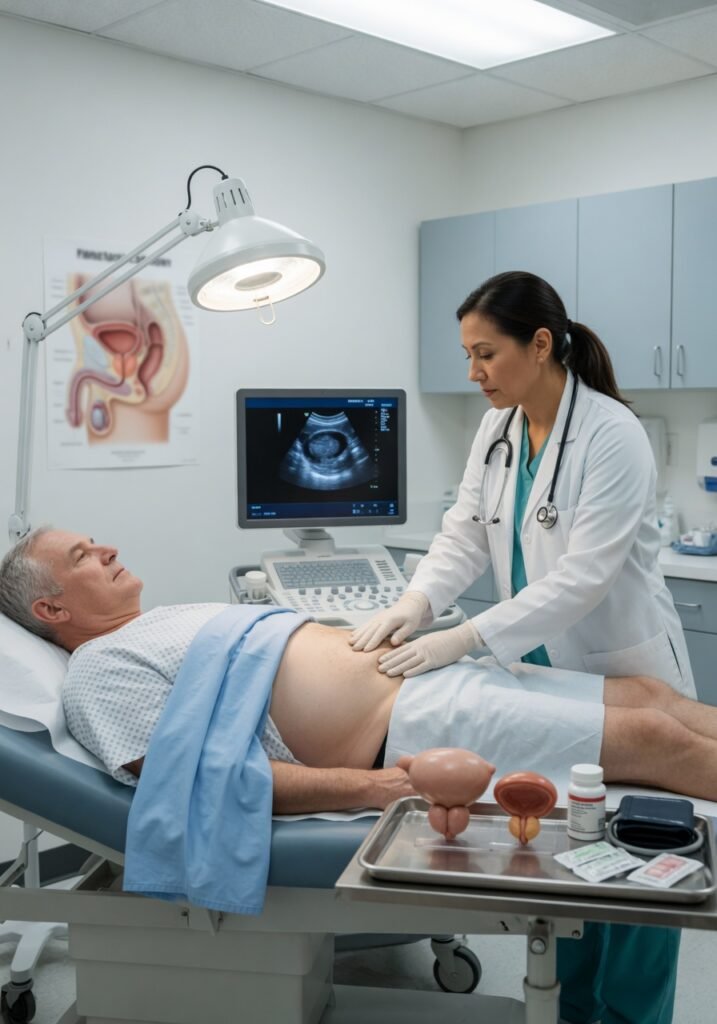
Urinalysis rules out infection or blood in the urine, which would suggest other problems. A post-void residual test measures how much urine remains after you’ve emptied your bladder—done via ultrasound immediately after you urinate. Normal is under 50 milliliters. Above 100 milliliters suggests significant obstruction. A uroflow study measures how fast your urine flows; benign prostatic hyperplasia typically shows flow under 12 milliliters per second.
PSA blood testing deserves mention here. PSA (prostate-specific antigen) is elevated in benign prostatic hyperplasia, but it’s also elevated in prostate cancer. Your doctor may check it, but they’ll interpret it in context. An elevated PSA alone doesn’t diagnose benign prostatic hyperplasia—it’s one piece of the puzzle. Imaging like transrectal ultrasound or MRI happens only if diagnosis remains unclear or if complications develop.
Treatment Options: What Actually Works
Most men start with medication. Alpha-blockers like tamsulosin (Flomax) and alfuzosin (Uroxatral) relax smooth muscle in your prostate and bladder neck, improving flow within days to weeks. You’ll notice better stream strength and less hesitancy. These work regardless of prostate size. They don’t shrink the prostate—they just relax it. Side effects include dizziness (especially when standing quickly) and retrograde ejaculation, where semen enters the bladder during orgasm rather than exiting normally.
5-alpha reductase inhibitors like finasteride (Proscar) and dutasteride (Avodart) actually shrink prostate tissue by blocking DHT production. They take 3-6 months to work but provide long-term relief. The catch: they only help men whose prostates are particularly enlarged (over 40 grams). A man with a 25-gram prostate won’t benefit. These medications cause decreased libido and erectile dysfunction in 5-10% of men—a real consideration for sexually active men.
Combination therapy (alpha-blocker plus 5-alpha reductase inhibitor) is superior to monotherapy for men with large glands. The NEJM landmark study showed this combination reduces the risk of acute urinary retention and need for surgery by nearly 50% over four years.
Behavioral modifications help immediately: timed voiding (urinating on schedule rather than on urge), double-voiding (urinating, waiting, then urinating again), limiting evening fluids, reducing caffeine and alcohol. But they’re not sufficient alone if symptoms are moderate-to-severe.
When medications fail or side effects become intolerable, surgical options exist. Transurethral resection of the prostate (TURP) involves inserting a scope through the urethra and removing obstructing prostate tissue. It’s the gold standard, with 75-85% of men experiencing significant symptom improvement. Complications include retrograde ejaculation (occurs in 50%), erectile dysfunction (5-10%), and rarely, TURP syndrome (hyponatremia from excessive fluid absorption). Newer minimally invasive options like prostatic urethral lift (UroLift) avoid tissue removal but provide less relief. Laser procedures like holmium laser enucleation of the prostate (HoLEP) rival TURP effectiveness with potentially fewer complications but require specialized expertise.
Practical Daily Management: Concrete Strategies
Schedule urination. Don’t wait for the urge. Set times—7 AM, noon, 5 PM, 9 PM—and void then. This prevents your bladder from over-distending and becoming irritable. Limit fluids after 6 PM; this directly reduces nocturia. That means no water, no alcohol, no tea during evening hours. Yes, you’ll feel thirsty. Drink during the day instead.
Reduce irritants. Caffeine stimulates bladder contractions. One cup of coffee becomes two trips to urinate. Cut it in half or eliminate it. Alcohol does the same—it’s a diuretic that irritates bladder tissue. If you drink, do it during the day, not evening.
Pelvic floor exercises matter. Kegel exercises—contracting the muscles you’d use to stop urination mid-stream, holding for three seconds, releasing—strengthen urinary control. Do 10-20 repetitions, three times daily. Over weeks, this improves both urgency and incomplete emptying.
Keep a symptom diary. Record urination times, volumes if possible, and nocturia episodes. This helps you and your doctor objectively track whether medication is working. Subjective memory is notoriously unreliable—people remember the worst night, not the average night.
Prevention: What the Evidence Shows
You can’t entirely prevent benign prostatic hyperplasia if you’re genetically predisposed and live long enough. But you can slow progression and reduce symptom severity. Weight loss if you’re overweight matters significantly. Each kilogram of weight loss correlates with modest improvements in IPSS scores and reduces nocturia. The mechanism isn’t mysterious—obesity drives inflammation and metabolic dysfunction that accelerates prostate growth.
Physical activity of 150 minutes weekly shows consistent benefit. Men who exercise regularly have lower benign prostatic hyperplasia symptom scores than sedentary men. The effect is moderate but real and drug-free.
Dietary patterns: plant-based components matter more than any single nutrient. Lycopene from tomatoes, polyphenols from berries, and