“`html
Does eating gluten cause permanent damage to your intestines, or can your gut heal once you stop?
Marcus, a 34-year-old accountant, spent eight years with chronic bloating, brain fog he couldn’t shake, and alternating diarrhea and constipation before his primary care doctor finally ordered celiac serologies. He remembers thinking, “It’s just bread—how could that actually destroy my intestines?” The answer surprised him: his immune system had been mounting a microscopic war against the lining of his small intestine every single time he ate gluten. Yes, the damage is real and measurable under a microscope. But here’s what gave Marcus hope: most of that damage reverses within months of strict gluten avoidance. Within a year, his intestinal lining typically rebuilds itself completely.
Key Facts About Celiac Disease
- Celiac disease affects approximately 1 in 100 people worldwide according to the NIH, yet an estimated 80% of those with the condition remain undiagnosed in the United States
- The disease requires a genetic predisposition—specifically HLA-DQ2 or HLA-DQ8 genes—but only about 3% of people carrying these genes actually develop celiac disease
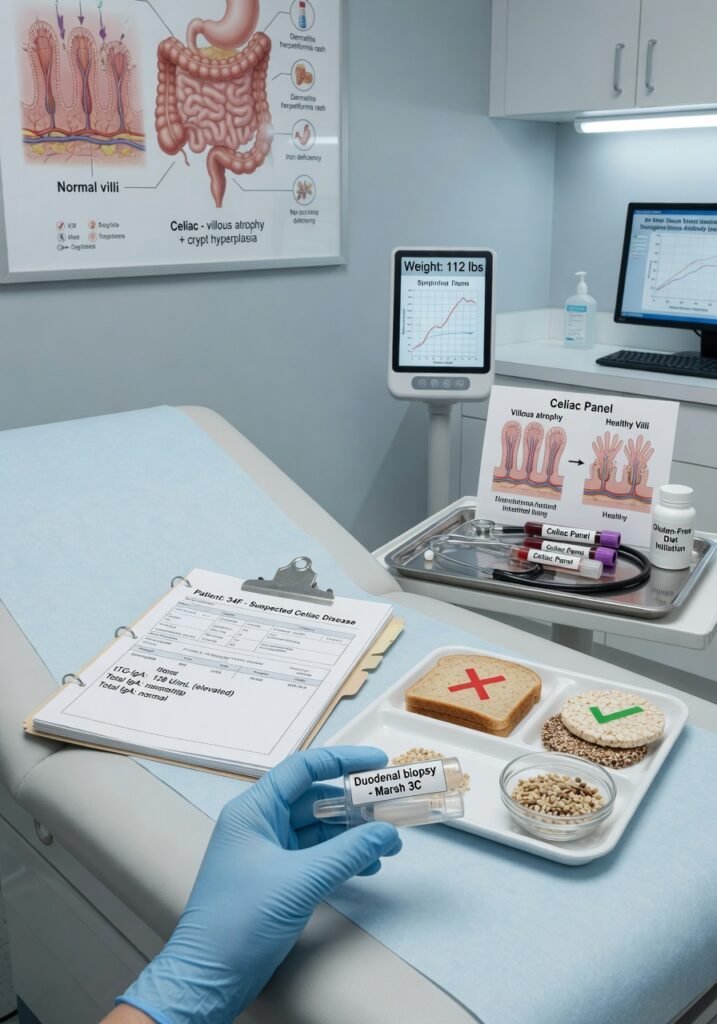
- Intestinal villous atrophy (flattening of the absorption structures) can begin within days of gluten exposure and typically shows measurable healing within 3-6 months of strict gluten avoidance
- Celiac disease increases the risk of developing other autoimmune conditions by 5-10 fold, including thyroid disease, type 1 diabetes, and osteoporosis
- Silent celiac disease—where positive serology and intestinal damage exist without noticeable symptoms—accounts for roughly 40% of all celiac disease cases
Understanding Celiac Disease: What’s Actually Happening Inside Your Body
Think of your small intestine as a selective border checkpoint. Normally, it carefully inspects molecules trying to enter your bloodstream and decides which ones belong. In celiac disease, your immune system has been given faulty intelligence about gluten—a protein found in wheat, barley, and rye. When gluten molecules arrive at this checkpoint, your immune cells recognize a specific part of the gluten protein (called gliadin) as a dangerous invader, like confusing a tourist for a criminal based on their appearance.
Your body launches an immune attack. White blood cells called T-cells infiltrate the intestinal lining and cause inflammation. The fingerlike projections lining your small intestine, called villi, flatten and shrink. Fewer villi means less surface area to absorb nutrients—calcium, iron, folate, fat-soluble vitamins, you name it. This isn’t a simple intolerance like lactose sensitivity, where your body just can’t process a food. This is autoimmune destruction of your own tissue.
The tricky part? The immune response happens at the cellular level. You might not feel noticeably ill for years while this intestinal damage accumulates. Some people develop symptoms within weeks of introducing gluten. Others have positive biopsies and blood tests but feel perfectly fine until screening catches their disease.
Causes and Risk Factors: Why Some People Develop This and Others Don’t
You need two things for celiac disease: the genes and an environmental trigger. The genetic component is straightforward—without HLA-DQ2 or HLA-DQ8, celiac disease essentially cannot develop. But carrying the genes is like having the lock; the environmental key determines whether the disease manifests.
The obvious trigger is eating gluten. Less obvious is timing. Many people develop celiac disease months or years after a major stressor—pregnancy, surgery, infection, or significant psychological stress. Studies show viral infections, particularly rotavirus and enterovirus, may trigger the disease in genetically susceptible people. Your gut microbiome composition might matter too; people with celiac disease often have different bacterial populations, though whether this causes or results from the disease remains unclear.
Here’s the clinical insight most sources miss: the timing of gluten introduction in infants might matter. Research suggests that narrow window between 4 and 11 months of age when introducing gluten—not too early, not too late—may reduce celiac disease risk. But this doesn’t guarantee prevention in someone carrying the genes. Breastfeeding duration appears protective, possibly because breast milk supports a healthier early microbiome.
Type 1 diabetes, thyroid disease, Down syndrome, Turner syndrome, and autism spectrum disorder all carry elevated celiac disease risk. If you have one autoimmune condition, screening for celiac disease makes clinical sense.
Signs and Symptoms: What Patients Actually Report Day-to-Day
The symptom list varies wildly. Some people have classic gastrointestinal complaints—bloating that makes your stomach visibly distended within an hour of eating bread, chronic diarrhea or constipation that doesn’t respond to usual remedies, abdominal cramping that interferes with work. Others describe a feeling that food sits in their stomach undigested for hours.
But here’s what most articles underemphasize: neurological symptoms. Brain fog so thick you can’t concentrate at work. Mood changes including depression and anxiety that don’t respond to typical treatment. Migraines that correlate directly with gluten consumption. One patient described it as “thinking through cotton wool.” Peripheral neuropathy—numbness and tingling in hands and feet—occurs in about 10% of celiac disease patients and sometimes precedes digestive symptoms.
Early warning signs people often miss include unexplained iron-deficiency anemia, particularly in women. Recurrent canker sores in your mouth. Dermatitis herpetiformis, a specific blistering skin rash that itches intensely—if you develop this, celiac disease is almost certainly present. Infertility or recurrent miscarriage before diagnosis. Weak bones or fractures from osteoporosis that seem premature for your age.
In children, failure to thrive, behavioral changes, chronic constipation, or delayed puberty warrant celiac screening. An undiagnosed child might be labeled hyperactive or learning disabled when the real problem is malabsorption affecting brain development.
Diagnosis: What the Process Actually Involves
Diagnosis requires three components, and you need all three—positive blood tests, positive intestinal biopsy, and HLA genetics. You cannot skip the biopsy and call it celiac disease. Here’s the critical detail: you must be eating gluten regularly when tested. If you’ve already gone gluten-free, your blood tests normalize and your intestinal lining begins healing, making diagnosis nearly impossible without a “gluten challenge” (reintroducing gluten for 4-6 weeks to generate positive tests).
Your doctor orders tissue transglutaminase (tTG-IgA) blood test first, often paired with total IgA to rule out IgA deficiency. If these are positive, most gastroenterologists perform upper endoscopy with duodenal biopsies. The pathologist grades intestinal damage using the Marsh classification. Grade 3 (complete villous atrophy) is diagnostic; Grade 2 (partial villous atrophy) usually is too, depending on clinical context. HLA testing confirms genetic susceptibility and has high negative predictive value—if you lack HLA-DQ2 and DQ8, your risk of future celiac disease is essentially zero.
Patients describe the endoscopy as unpleasant but manageable—mild sedation, a thin scope down the throat, tiny biopsies that you don’t feel. Results take 5-7 days. The real challenge is the waiting period: once you suspect celiac disease, your anxiety about every meal intensifies, yet you cannot stop eating gluten without sabotaging diagnosis.
Treatment Options: The Evidence on What Actually Works
Strict, lifelong gluten avoidance is the only treatment. There’s no medication that allows you to eat gluten safely. No enzyme supplement works reliably. Larazotide acetate, which was being studied to potentially “seal” the intestinal barrier, failed to reach clinical effectiveness, so it’s not available.
What does work is meticulous gluten elimination. This means avoiding wheat, barley, rye, and their derivatives. Oats are theoretically safe for most people—they contain avenin, not gliadin—but some patients react to oats anyway, possibly due to contamination or individual sensitivity. Cross-contamination from shared toasters, cutting boards, or cooking utensils matters; a single breadcrumb contains enough gluten to trigger intestinal damage in celiac disease.
Beyond dietary management, treatment addresses nutritional deficiencies and complications. Iron supplementation, vitamin B12 injections or high-dose oral supplements, calcium with vitamin D, and sometimes folate repletion are necessary while the intestine heals. If you have associated osteoporosis, bisphosphonates like alendronate may be appropriate. If you develop secondary lactose intolerance—common because lactase-producing cells get damaged—temporarily avoiding dairy helps, though tolerance usually returns as the intestine heals.
Psychological support matters more than people realize. Celiac disease requires permanent dietary vigilance in a gluten-saturated food environment. Patients report significant stress around social eating, restaurant meals, and family gatherings where food preparation isn’t controlled. Counseling or support groups help with long-term adherence and mental health.
Practical Daily Management: Concrete Strategies That Work
Learn to read labels obsessively. Gluten hides in unexpected places—soy sauce, seasonings, gravies, salad dressings, medications, and supplements. Download a celiac disease app like the CSACI gluten-free app or Finder app that scans barcodes and identifies safe products.
Establish a dedicated gluten-free area in your kitchen. If you share a kitchen with people eating regular bread, assign them their own toaster, cutting board, colander, and cooking utensils. Use separate condiment containers because crumbs on a butter knife cross-contaminate the whole jar.
Find a few reliable restaurants where staff understands cross-contamination risks. Call ahead, talk directly to a manager or chef, not a server. Describe celiac disease as an autoimmune condition where even trace amounts cause intestinal damage—servers are far more cautious than if you just say “gluten sensitivity.”
Join a local celiac disease support group or online community. Shared frustration and practical tips from people living this daily help more than general advice from doctors.
Work with a registered dietitian specializing in celiac disease, ideally a Registered Dietitian Nutritionist (RDN). They can help you navigate nutritional gaps, understand label reading, and develop strategies for your specific lifestyle and food preferences.
Prevention: What Science Actually Shows
If you carry HLA-DQ2 or HLA-DQ8 genes but haven’t developed celiac disease, can you prevent it? The honest answer is: probably not reliably. The genetic component is fixed. The environmental triggers—infections, stress, gut microbiome composition—are largely outside your control. Exclusive breastfeeding for at least 6 months, gradual gluten introduction between 4-11 months of age, and avoiding early infections might reduce risk in your children if they carry the genes, but the evidence is inconsistent.
If you’re at high risk—family history of celiac disease, another autoimmune condition—discuss screening with your doctor. Detecting celiac disease before complications like osteoporosis or neurological damage develop prevents long-term morbidity. This is screening for prevention, not preventing the disease itself.
Frequently Asked Questions
Can you develop celiac disease later in life?
Yes, absolutely. Celiac disease can activate at any age, though the average age of diagnosis is 40-60 years in adults without childhood symptoms. Life stressors, infections, or hormonal changes might trigger disease expression in someone carrying the genes. Your genetic predisposition never changes, but the environmental trigger may
Sources & Medical References
HealthTopics.com articles are based on peer-reviewed medical research and guidance from the NIH, CDC, and WHO. See our editorial policy for full sourcing standards.