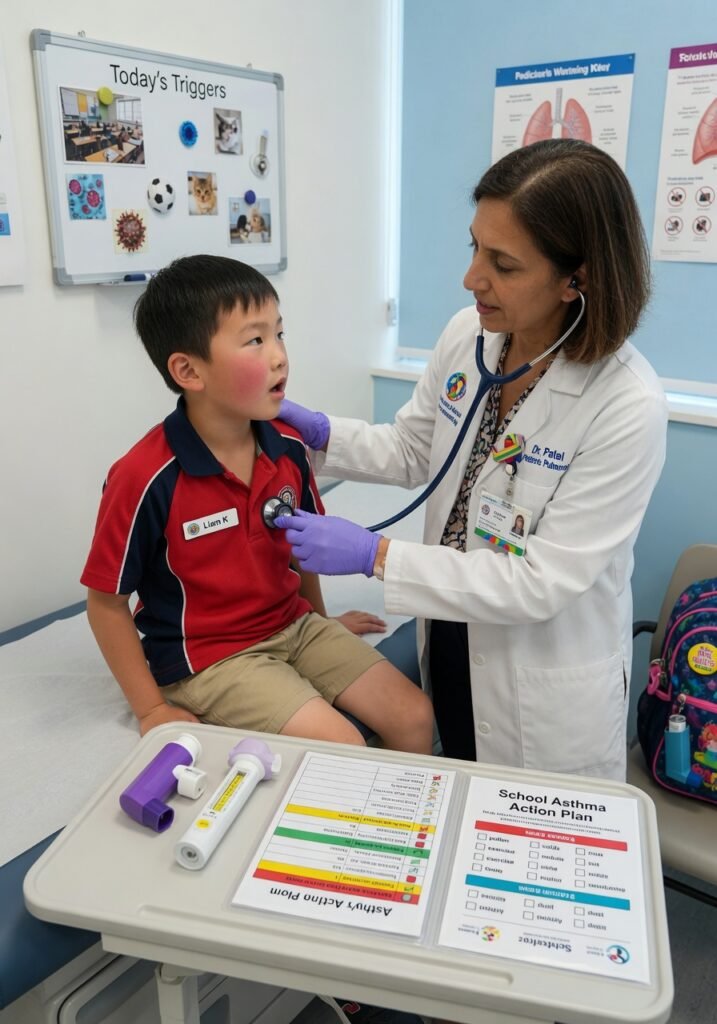
Eight-year-old Marcus developed a persistent cough during fall soccer season that his parents initially blamed on “getting over a cold.” By October, the cough was worse during games, accompanied by wheezing that kept him awake some nights. His pediatrician diagnosed childhood asthma—but here’s what surprised the family: Marcus’s triggers weren’t what they expected. It wasn’t just allergens or cold air. Emotional stress from moving schools the previous month had been driving his symptoms. His parents realized that managing his condition meant addressing far more than inhalers and air filters.
Key Facts About Childhood Asthma
- Asthma affects approximately 6.2 million U.S. children under age 18, according to the CDC’s 2021 data—that’s roughly 1 in every 12 kids.
- Boys are significantly more likely to develop asthma before age 14, with prevalence around 7.3% compared to 5.5% in girls, according to NIH epidemiologic studies.
- Only about 55% of children with asthma have a written asthma action plan, leaving families unprepared when symptoms escalate in school environments.
- Environmental tobacco smoke exposure increases asthma risk by approximately 40% in children without prior asthma diagnoses, per JAMA pediatrics research.
- Peak symptom occurrence in children occurs between September and November, coinciding with back-to-school stress, viral infections, and environmental changes—not just pollen season.
Understanding Childhood Asthma: What’s Actually Happening
When we talk about asthma in children, we’re describing an inflammatory response in the airways—but think of it less like a simple “swelling” and more like a hair-trigger alarm system that’s been set too sensitive. The airways (bronchioles) in a child with asthma are primed to overreact. Something innocuous for another kid—a pet’s dander, cool air, a stressful situation—causes those airways to tighten, produce excess mucus, and swell. This narrowing makes it harder for air to move in and out, which is why you hear the characteristic wheeze or see that grunting, labored breathing.
Here’s what makes childhood asthma different from adult-onset asthma: a child’s lungs are still developing. If childhood asthma isn’t well-controlled, it can actually affect how their lungs grow and develop, potentially causing permanent decreases in lung function. That’s not meant to frighten you—it’s the exact reason early diagnosis and consistent management matter so much. The inflammation isn’t happening just when symptoms appear. It’s ongoing, even on days when your child feels perfectly fine.
Causes and Risk Factors: Beyond the Obvious Triggers
Most parents know about allergens like pollen and pet dander. But here’s what pediatricians see in practice that the standard patient education often misses: viral infections are the single most common asthma trigger in children under 12. Rhinovirus, RSV, influenza—these viruses cause inflammation that lingers for weeks even after the child’s nose has cleared.
The inherited component is substantial. If both parents have asthma, your child has about a 60% chance of developing it. If one parent has it, the risk drops to around 30%. But genetics alone don’t determine destiny. Environmental factors matter enormously: air quality, secondhand smoke exposure, humidity levels, and even the family’s socioeconomic circumstances (which affects access to preventive medications) all play significant roles.
One underappreciated risk factor in children is recurrent sinusitis. Chronic sinus inflammation and drainage can trigger asthma symptoms repeatedly. Some children with asthma improve dramatically once their sinus disease is treated, yet many parents and even some primary care doctors don’t connect these two conditions. Additionally, childhood obesity has emerged as an independent asthma risk factor—not primarily because of exercise limitation, but because excess adipose tissue produces inflammatory cytokines that worsen airway inflammation.
Signs and Symptoms: What You’ll Actually Observe
Your child won’t always wheeze. That’s the first thing to understand. Many children present with a chronic cough—especially at night, during play, or in response to laughing. Some parents describe it as a “barky” cough that doesn’t produce phlegm. Others notice their child gets winded more easily during sports than peers, or complains of chest tightness (“My chest feels funny”) after exertion.
Watch for subtle patterns. Does your child seem to struggle during allergy season or when playing indoors with dogs? Does breathing become labored during emotional moments—not from anxiety, but from the physiological response itself? Retractions (visible indentation of the ribs or neck during breathing) indicate your child is working harder to breathe and warrant immediate attention.
Early warning signs that often get overlooked: frequent upper respiratory infections lasting longer than expected, persistent nasal congestion even without a current cold, or complaints of stomachaches during what seems to be a respiratory illness. Children sometimes can’t articulate what they’re experiencing, so they describe lower chest discomfort as belly pain.
Diagnosis: How Pediatricians Confirm Asthma
There’s no single blood test that definitively proves asthma. Your pediatrician starts with clinical history—detailed questions about symptom patterns, family history, and environmental triggers. Office spirometry (a pulmonary function test where your child breathes into a machine) provides objective data about airflow limitation, though children under 5 often can’t perform this test reliably.
Your doctor might recommend a trial of albuterol bronchodilator inhaler. If symptoms improve significantly after a dose or two, that supports an asthma diagnosis. Sometimes a chest X-ray is ordered to rule out other conditions mimicking asthma, like foreign body aspiration, bronchitis, or cardiac issues.
The diagnostic criteria involves symptoms occurring more than 2 days per week or nighttime awakening more than 2 nights monthly. But here’s where clinical judgment matters: some children have completely asymptomatic periods interspersed with sudden severe exacerbations. That pattern still qualifies as asthma requiring preventive treatment, even though symptoms seem “minimal.”
Treatment Options: Medications and Approaches That Work
Asthma treatment operates on two tracks: quick-relief and long-term control. Albuterol (salbutamol) via metered-dose inhaler is your fast-acting rescue medication. It works within minutes by relaxing airway smooth muscle. If your child is using this more than 2 days per week, that signals inadequate control and the need for preventive therapy.
For ongoing control, inhaled corticosteroids are the gold standard. Medications like fluticasone propionate, budesonide, or beclomethasone are inhaled directly into the lungs in minimal doses—systemic side effects from these low doses are negligible. Many parents worry unnecessarily about growth effects; the evidence is clear that untreated asthma causes far more growth suppression than these medications.
For moderate to severe persistent asthma, long-acting beta-agonists combined with inhaled corticosteroids (like fluticasone/salmeterol) provide extended control. Montelukast, a leukotriene receptor antagonist, helps some children, particularly those with exercise-induced asthma or allergic rhinitis components. Biologic therapies like omalizumab or dupilumab exist for severe eosinophilic asthma in children, though these are reserved for specific phenotypes.
Technique matters tremendously. Most children (and parents) use inhalers incorrectly. A spacer device with a mask for younger children is essential—it increases medication delivery to the lungs from about 10% to 80%. Ask your pediatrician for a demonstration at every visit.
Practical Daily Management: Concrete Strategies for School and Home
Write an asthma action plan with your child’s doctor and give copies to the school nurse, classroom teachers, and any care providers. This isn’t optional paperwork—it’s your child’s safety protocol. The plan should specify: daily controller medications, rescue inhaler use, signs requiring immediate action, and when to call 911.
Identify specific triggers for your child. Keep a simple log for two weeks: note symptoms and what preceded them. You’ll likely spot patterns. If cold air triggers symptoms, have your child wear a scarf over their mouth in winter. If grass triggers symptoms, have them bathe and change clothes after outdoor play.
Coordinate with schools. Your child has the legal right (Section 504 plan or IEP) to access rescue inhalers during the school day without a visit to the nurse’s office. Some children using daily controller medications do better if they take a dose right before gym class or sports practice. Peak flow monitoring at home—measuring how fast your child can exhale—helps detect declining control before symptoms worsen.
Clean HVAC filters monthly. Use HEPA filtration in the bedroom if allergies contribute to asthma. Control humidity between 30-50% (dust mites proliferate above 55%). These aren’t exciting interventions, but consistent environmental control reduces medication needs substantially.
Prevention: What Actually Reduces Asthma Risk
If your child hasn’t developed asthma yet but has risk factors, what prevents it? The evidence shows that breastfeeding reduces asthma risk, though the effect is modest. Delayed introduction of allergens doesn’t prevent asthma—avoiding peanuts to “prevent” peanut allergy doesn’t work, and current guidance actually suggests early exposure may be protective.
Regular physical activity reduces asthma risk in children. Swimming appears particularly beneficial because humid air minimizes airway irritation. Viral infection prevention during infancy (hand hygiene, limiting large group exposure in first few months) reduces the likelihood that severe respiratory infections early in life will trigger asthma development.
If your child has been diagnosed, preventing asthma attacks relies on consistent use of controller medications, not just rescue inhalers. Many parents undertake this backwards—they use albuterol reactively when symptoms appear rather than using daily preventive therapy. Consistent low-dose inhaled corticosteroids prevent inflammation from building up in the first place, which actually reduces rescue inhaler use.
Addressing Emotional and Stress Triggers
Remember Marcus from the beginning? His asthma worsened during the stress of changing schools because psychological stress is a documented asthma trigger. Anxiety and excitement cause hyperventilation and alter airway responsiveness. If your child’s asthma seems to worsen during emotionally intense periods, acknowledge this connection. Teaching children age-appropriate stress management—deep breathing exercises, mindfulness apps designed for kids, consistent routines—genuinely improves asthma control.
FAQ: Questions Parents Actually Ask
Sources & Medical References
HealthTopics.com articles are based on peer-reviewed medical research and guidance from the NIH, CDC, and WHO. See our editorial policy for full sourcing standards.