
Colorectal Cancer: What You Actually Need to Know About Screening and Survival
Most people imagine colorectal cancer as a disease of older adults with obvious symptoms they’d definitely notice. That’s partly why many patients come to my office devastated after a routine screening finds a Stage 2 tumor—they felt completely fine. Meanwhile, some patients spend months with persistent bloating and chalky stools, never suspecting cancer, because they assume their symptoms are just irritable bowel syndrome. The reality sits somewhere in the uncomfortable middle: colorectal cancer develops silently for years in about 40% of cases, yet remains one of the few common cancers we can actually prevent with screening. This article breaks down what happens in your colon, which screening really works, and why survival rates vary so dramatically between people who catch cancer early versus those who don’t.
Key Facts About Colorectal Cancer
- Colorectal cancer is the third leading cause of cancer-related death in the United States, with approximately 52,550 deaths projected in 2024, according to the National Cancer Institute.
- When detected at Stage 1, the five-year survival rate exceeds 90%, but drops to 14% when diagnosed at Stage 4—making early detection genuinely life-saving.
- About 1 in 23 men and 1 in 25 women will develop colorectal cancer during their lifetime, according to CDC epidemiology data.
- Colonoscopy screening can reduce colorectal cancer incidence by up to 76% and mortality by up to 61%, as demonstrated in randomized controlled trials published in NEJM.
- Approximately 15% of colorectal cancers are hereditary, meaning family history screening is critical for relatives of affected patients.
Understanding How Colorectal Cancer Develops
Your colon and rectum are lined with millions of epithelial cells that normally replace themselves every 3 to 5 days. Think of it like a factory assembly line where workers are constantly retiring and being replaced by fresh employees. Now imagine if the quality control department goes offline. A few cells mutate—maybe they develop changes in genes like APC or KRAS—and they don’t die when they should. They divide instead. Over 10 to 15 years, these mutant cells accumulate additional mutations, forming a polyp.
Most polyps never become cancer. But some polyps—particularly adenomatous ones with villous features or dysplasia—have a trajectory toward malignancy. The cells within the polyp lose contact inhibition. They forget their boundaries. Eventually, one of these cells punches through the mucosal basement membrane, invading the submucosa and muscular layers. Now it’s no longer a polyp; it’s cancer. From that point forward, the cancer can spread to regional lymph nodes, then to distant organs like the liver or lungs.
The medical insight most websites skip: proximal colon cancers (right colon) behave differently than distal ones. Right-sided cancers tend to present later because they bleed invisibly into a larger stool volume, whereas left-sided cancers cause obstruction symptoms earlier. This anatomical difference means your screening approach should account for location.
Causes and Risk Factors: What Actually Increases Your Risk
Age remains the dominant risk factor. Incidence rises sharply after age 50, which is why screening starts there for average-risk individuals. But age itself isn’t the cause—it’s how much time your colon cells have to accumulate mutations.
Inflammatory bowel disease, specifically ulcerative colitis and Crohn’s disease, increase colorectal cancer risk roughly 2 to 3 times compared to the general population. The chronic inflammation creates a hostile environment where dysplasia develops faster. Obesity increases risk by about 20% to 30%, largely through insulin resistance and inflammatory pathways. Smoking and heavy alcohol consumption both increase risk, though alcohol’s mechanism remains incompletely understood.
Here’s the risk factor most articles mention only in passing: late-onset type 2 diabetes approximately doubles colorectal cancer risk, independent of obesity. The mechanism likely involves hyperinsulinemia promoting cell proliferation and anti-apoptotic signaling. Diabetic patients on metformin appear to have lower cancer risk than those on insulin secretagogues, suggesting metabolic control matters more than the diabetes itself.
Family history cannot be overstated. About 30% of patients with colorectal cancer have a family history of the disease. Lynch syndrome, an inherited mismatch repair gene mutation, accounts for 2 to 4% of all colorectal cancers but confers an 80% lifetime cancer risk. Familial adenomatous polyposis (FAP) almost guarantees colorectal cancer by age 40 without prophylactic colectomy.
Signs and Symptoms: What Patients Actually Experience
Here’s what I tell patients: if you’re waiting for dramatic symptoms, you might wait too long. Some people have no symptoms whatsoever until cancer is advanced.
When symptoms do appear, rectal bleeding is most common—usually bright red blood on toilet paper or in the bowl, sometimes mixed with stool. Patients often attribute this to hemorrhoids and, frankly, hemorrhoids are incredibly common, which is why people dismiss the symptom. Persistent changes in bowel habits matter more than temporary constipation or diarrhea. I’m talking about weeks of narrower stools, increased urgency, or incomplete evacuation sensations.
Anemia symptoms get overlooked because they’re vague. Fatigue, shortness of breath on minimal exertion, and dizziness might reflect chronic blood loss from a tumor bleeding slowly into the stool. Abdominal pain or cramping, particularly in the lower abdomen or on one side, warrants investigation. Unexplained weight loss over months deserves attention even in the absence of other symptoms. Some patients describe a feeling of never being quite “full” or satisfied after eating—a vague satiety issue that might reflect a tumor mass.
One overlooked early sign: mucus in the stool without blood. Many people think this is nothing, but increased mucus production can signal mucosal irritation from dysplasia or early cancer.
Diagnosis: The Actual Process
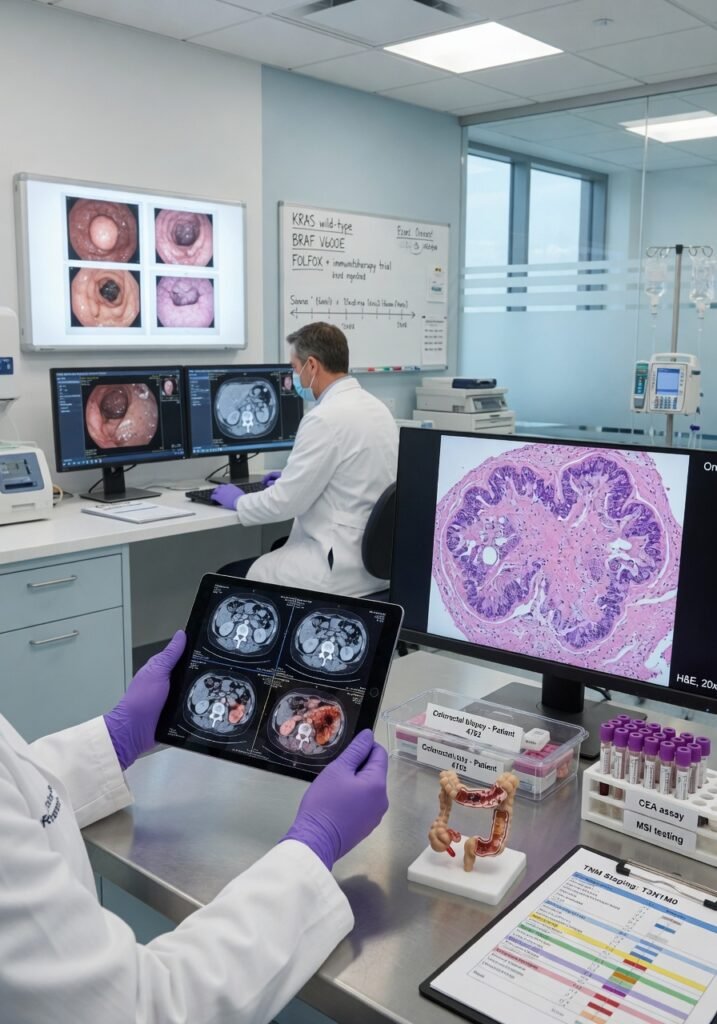
If you have symptoms or abnormal screening findings, your doctor will order a colonoscopy. This procedure takes 20 to 30 minutes. You’re sedated (usually with propofol or midazolam plus fentanyl) while a flexible scope with a camera navigates your entire colon. The gastroenterologist visualizes every inch, looking for polyps, masses, or areas of inflammation. Any suspicious finding gets biopsied. If cancer is found, biopsies determine the histology and grade.
A positive colonoscopy isn’t the end of diagnostics—it’s the beginning. Once cancer is confirmed on pathology, staging requires a CT scan of the chest, abdomen, and pelvis (looking for metastases) and often an MRI of the pelvis for rectal cancers to assess depth of invasion. Some centers use positron emission tomography (PET-CT) for staging, particularly with elevated carcinoembryonic antigen (CEA) levels. Blood work includes a baseline CEA level, which is useful for monitoring treatment response.
Molecular testing has become standard. Your tumor should be tested for microsatellite instability (MSI) or mismatch repair deficiency, BRAF mutations, and KRAS mutations. These findings guide treatment decisions and inform whether immunotherapy might help.
Treatment Options: What Works and When
Treatment depends entirely on stage. For Stage 1 cancers (limited to the mucosa or submucosa), colonoscopic polypectomy or endoscopic mucosal resection might be curative—no further treatment needed. For Stages 2 and 3, surgical resection is the foundation. Your surgeon removes the segment of colon containing the cancer plus surrounding tissue and lymph nodes.
Chemotherapy with 5-fluorouracil (5-FU) plus leucovorin, or modern regimens like FOLFOX (5-FU, leucovorin, and oxaliplatin) or CAPOX (capecitabine and oxaliplatin), follows surgery for Stage 3 disease. The addition of oxaliplatin improves outcomes. Stage 2 patients with high-risk features—poorly differentiated histology, T4 tumors, or MSI-stable tumors—often receive chemotherapy as well.
For rectal cancer specifically, neoadjuvant chemoradiation before surgery often shrinks the tumor and improves resectability, particularly for Stage 2 and 3 disease. This involves concurrent 5-FU or capecitabine with external beam radiation over 5 to 6 weeks.
Metastatic disease (Stage 4) requires systemic chemotherapy. FOLFOX or FOLFIRI (irinotecan-based regimen) are standard first-line options. Targeted therapies matter greatly here: anti-VEGF agents like bevacizumab improve survival when added to chemotherapy. EGFR inhibitors like cetuximab or panitumumab help in KRAS wild-type tumors. For MSI-high or mismatch repair-deficient tumors, checkpoint inhibitors like pembrolizumab or nivolumab produce response rates around 30% to 40%.
The clinical reality: colorectal cancer is chemosensitive but not uniformly curable at Stage 4. Median overall survival with optimal treatment reaches 2.5 to 3 years, with some patients achieving longer remissions. Liver-directed therapy—resection or ablation of isolated hepatic metastases—can occasionally produce cure.
Practical Daily Management During and After Treatment
During chemotherapy, expect fatigue as your dominant complaint. This isn’t ordinary tiredness; it’s a pervasive lack of energy that improves with rest but doesn’t fully resolve until weeks after treatment ends. Manage it by planning activities in the morning when energy is highest and accepting that productivity will be reduced.
Nausea from chemotherapy responds poorly to behavioral interventions alone. Take anti-emetics prophylactically: 5-HT3 antagonists like ondansetron, NK1 antagonists like aprepitant, or newer agents like rolapitant. Start the day before chemotherapy, not after nausea develops.
Mouth sores from 5-FU are painful and prevent eating. Rinse with salt water and baking soda several times daily. Avoid acidic foods and hot beverages. If sores are severe, ask about topical anesthetics or ask your oncologist about dose modifications.
After surgery, walking improves bowel function and prevents blood clots. Start gentle walking within 24 to 48 hours if pain is controlled. Avoid heavy lifting for 6 weeks. Colostomy patients (after abdominoperineal resection) need supplies and training—ask for referral to an enterostomal therapist, not a general nurse.
Surveillance matters. Follow-up includes colonoscopy at 1 year post-treatment, then every 3 to 5 years depending on findings. CT imaging at regular intervals screens for recurrence. CEA levels drawn every 3 to 6 months help detect metastatic recurrence early.
Prevention: What Evidence Actually Shows Works
Colonoscopy screening prevents cancer by removing precancerous polyps before they transform. Start at age 45 for average-risk individuals (the American Cancer Society lowered this from 50 in 2021), or age 40 if you have a family history. Interval screening depends on findings—every 10 years if normal, every 3 to 5 years if polyps are found.
Fecal immunochemical testing (FIT) or high-sensitivity guaiac-based fecal occult blood testing (FOBT) reduce colorectal cancer mortality by about 15% to 20%, which is substantially less than colonoscopy’s 61%. These are acceptable alternatives if colonoscopy isn’t accessible.
What about lifestyle? Regular physical activity (at least 150 minutes weekly) and limiting red and processed meat intake probably reduce risk, but