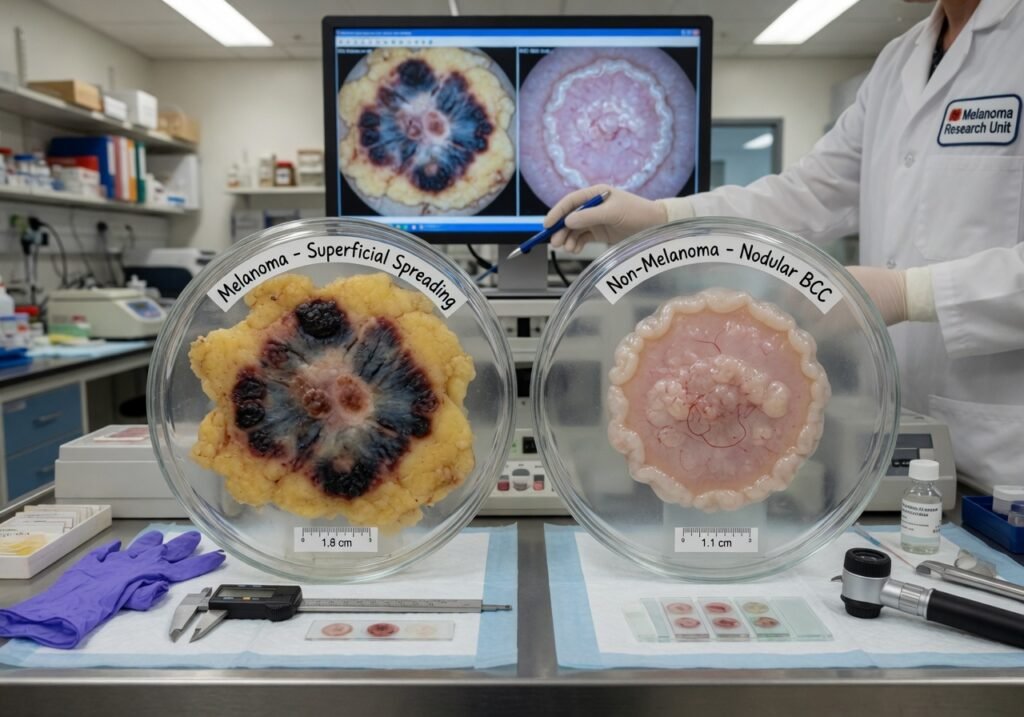
Does a mole that’s been on your skin for twenty years suddenly matter more than a new pink bump you noticed last month?
Most people assume the old mole is more dangerous, but that’s backwards. In reality, the location, depth, and growth pattern matter far more than age. I had a patient last year—Sarah, 58, a retired teacher—who ignored a slightly raised, flesh-colored lesion on her shoulder for three years because it wasn’t dark. When she finally came in, the pathology report showed basal cell carcinoma that had already invaded deeper layers. She’d been lucky; it hadn’t spread beyond the skin. But those three years of delay meant she needed more aggressive surgery than if we’d caught it earlier.
The distinction between melanoma and non-melanoma skin cancers isn’t just academic. It changes everything about prognosis, treatment urgency, and follow-up care. Let’s talk about what actually happens when skin cells start dividing wrong.
Key Facts About Skin Cancer
- Melanoma accounts for roughly 1 percent of all skin cancers but causes approximately 75 percent of skin cancer deaths, according to CDC data—which is why detection timing matters so much
- Non-melanoma skin cancers (basal cell and squamous cell) affect over 3 million Americans annually, making them the most common malignancies overall
- Five-year survival for melanoma diagnosed at Stage 1 (localized) exceeds 99 percent, but drops to 27 percent for Stage 4 disease with metastasis
- Cumulative UV exposure, not just sunburns, drives melanoma risk—even if you don’t burn, repeated sun exposure accumulates cellular damage
- People with fewer than 25 moles have roughly 10 percent lifetime melanoma risk, while those with 100+ moles carry approximately 10-fold higher risk
How Skin Actually Develops Cancer
Think of your skin like a factory with quality control. The outer layer (epidermis) contains melanocytes—cells that produce the pigment melanin to protect against UV rays. Normally, these cells divide and die on schedule. But UV radiation damages the DNA inside them, creating mutations. Most of the time, your immune system catches and destroys these mutated cells. Sometimes it doesn’t.
Here’s the part most articles skip: not all mutations are equal. A mutation in the BRAF gene often leads to melanoma. A mutation in the KIT gene? Different pathway entirely, different treatment implications. Non-melanoma cancers arise from basal cells (the bottom layer of epidermis) or squamous cells (the upper layer). These grow slowly in most cases, but they can still cause real damage if they invade deeper structures like nerves or bone.
The critical difference in behavior: melanoma cells have this nasty tendency to spread vertically downward and then outward into other tissues and organs. Non-melanoma cancers typically grow outward and downward more gradually. This is why melanoma demands urgent attention while a basal cell carcinoma on your arm might warrant a different timeline—though “different timeline” doesn’t mean “ignore it.”
Causes and Risk Factors That Actually Matter
UV radiation—from sun exposure or tanning beds—remains the primary culprit for both types. But intensity and timing create different risks. A teenager who gets blistering sunburns has elevated melanoma risk for life. Someone with chronic sun exposure as a construction worker or farmer develops more non-melanoma cancers. Why the difference? It’s partly about the depth of penetration and the type of cell affected.
Fair skin, blue eyes, and red or blonde hair increase your risk dramatically. If you have these traits, your baseline melanoma risk is roughly 20-25 times higher than someone with very dark skin. But—and this is the part people miss—dark-skinned individuals who do develop melanoma often get diagnosed much later because they’re less vigilant about checking, and clinicians sometimes miss lesions on darker skin.
Family history matters significantly. If your parent or sibling had melanoma, your risk increases by 8-10 fold. Genetic syndromes like familial atypical multiple mole and melanoma syndrome (FAMMM) can push lifetime risk near 90 percent.
Here’s what most sources don’t emphasize enough: immunosuppression is a major under-recognized risk factor. If you’ve had an organ transplant and take immunosuppressive medications, or if you have HIV with low CD4 counts, your skin cancer risk—particularly non-melanoma types—shoots up dramatically. I’ve seen squamous cell carcinomas in transplant patients that were more aggressive and recurrent than typical cases.
Chemical exposures matter too. Arsenic in groundwater, occupational exposure to tar or pitch—these increase squamous cell risk particularly. Age increases risk for both types, though melanoma can strike at any age.
What You’ll Actually Notice
Most people know the ABCDE rule for melanoma: asymmetry, border irregularity, color variation, diameter over 6mm, and evolving (changing). That’s useful, but incomplete. I tell patients to look for “the ugly duckling”—a mole that looks different from your other moles. The one that makes you think, even subconsciously, “that doesn’t belong.”
Early melanoma often presents as a flat or slightly raised lesion with irregular borders and mixed colors (browns, blacks, tans, even pinks). You might notice it itches or bleeds slightly when you brush against it. Some people spot a new dark line under the fingernail—subungual melanoma, which occurs in nail beds and is often diagnosed late because people think it’s a bruise.
Basal cell carcinoma frequently appears as a waxy, translucent bump, sometimes with small blood vessels visible on the surface. It might have a rolled border and a depression in the center—almost like a tiny crater. The surface might look scaly or crusty. These usually appear on sun-exposed areas like the face, ears, or bald scalp.
Squamous cell carcinoma often looks like a rough, scaly patch that might be red or brown. It could feel tender. If it’s on your lip, it might look like a sore that doesn’t heal for weeks.
The honest truth? Early lesions often don’t hurt, don’t itch, and don’t bleed. Many people find them by accident. That’s why annual skin checks matter, not waiting for symptoms.
How Diagnosis Actually Works
Your dermatologist will examine the lesion with a dermoscope—basically a magnifying lens with special lighting that lets them see patterns within the lesion invisible to the naked eye. If they see something suspicious, the only way to know for certain is a skin biopsy. Not a visual diagnosis. Not “probably melanoma.” A biopsy.
During biopsy, we remove the lesion (or a representative sample) under local anesthesia. This takes maybe 10 minutes. You’ll feel pressure and slight burning from the numbing medication, then cutting sensation but no pain. The specimen goes to pathology where a dermatopathologist examines it under a microscope, looking for malignant cells and measuring depth of invasion (called Breslow thickness for melanoma). This is critical information.
If melanoma is confirmed, you’ll need additional staging—possibly blood work looking for elevated LDH (lactate dehydrogenase) which can indicate systemic disease, and imaging studies depending on thickness. Sentinel lymph node biopsy might be recommended for melanomas thicker than 1mm, where microscopic spread to regional lymph nodes becomes more likely.
For non-melanoma types, staging is usually simpler unless the cancer is large, deep, or in a sensitive area like the face or genitals.
Treatment Options Currently Available
Surgical excision remains the foundation. For most non-melanoma cancers, simple excision with 4-5mm margins cures the problem. For melanoma, margins expand to 1cm (for thin melanomas) up to 2cm (for thicker ones). The goal is removing all malignant cells while preserving function and appearance.
For advanced or recurrent melanoma, we now have immunotherapy options that have transformed outcomes. Checkpoint inhibitors like nivolumab and pembrolizumab work by releasing the brakes on your immune system, allowing T cells to attack melanoma cells. For melanomas with BRAF mutations, BRAF inhibitors like vemurafenib can shrink tumors rapidly—though resistance often develops within months.
Targeted therapy based on genetic testing has become standard for advanced disease. NRAS mutations, KIT mutations, NF1 mutations—each has treatment implications. This is why pathology reports now include molecular testing.
Mohs micrographic surgery is excellent for non-melanoma cancers on the face or other cosmetically sensitive areas. The surgeon removes tissue layer by layer, examining each under the microscope during the procedure. This ensures complete removal while preserving as much normal skin as possible.
Radiation therapy occasionally plays a role for advanced cases or when surgery isn’t feasible. Topical treatments like imiquimod cream can work for very early, superficial basal cell carcinomas, though they require weeks of application.
Daily Management and Skin Surveillance
After treatment, you’ll need regular follow-up—every 3-6 months for the first few years if melanoma, less frequent for non-melanoma unless you have multiple lesions. Self-examination matters hugely. Use a mirror or recruit a partner to examine your scalp, behind ears, between toes, and your back—areas you can’t easily see.
Take photos of suspicious lesions on your phone dated and labeled. Showing your dermatologist photos from six months prior is incredibly valuable for determining if something is actually changing. One patient brought me pictures showing a lesion had grown noticeably in four months—that changed our recommendation from observation to biopsy.
Protect your skin going forward. Broad-spectrum sunscreen with SPF 30 or higher, applied generously and reapplied every two hours. Seek shade during peak UV hours (10am-4pm). UPF-rated clothing, hats, and sunglasses aren’t optional—they’re part of your medical management.
Some patients benefit from dermatology visits with total body photography, where images of your entire skin are documented and compared year to year. This helps identify new lesions or changes in existing ones.
What Actually Prevents Skin Cancer
The evidence is clear: sunscreen works. A landmark Australian study published in the Journal of Clinical Oncology showed daily sunscreen use reduced melanoma incidence by 40-50 percent over 10+ years. But—and this is crucial—sunscreen is one tool, not the only tool. Avoiding tanning beds matters. Seeking shade matters. Protective clothing matters.
There’s no such thing as a safe tan. That bronzed look represents DNA damage, period. The idea that you need some sun exposure for vitamin D is overstated—you can get vitamin D from diet, supplements, and incidental sun exposure without intentionally tanning.
For people with many moles or strong family history, some dermatologists recommend regular screening. There’s no evidence that scanning everyone saves lives, but for high-risk individuals, it catches problems earlier. More controversial: some evidence suggests that beta-carotene supplementation might reduce non-melanoma risk in people with low dietary intake, though the data isn’t conclusive enough to recommend universally.
Common Questions People Actually Ask
Sources & Medical References
HealthTopics.com articles are based on peer-reviewed medical research and guidance from the NIH, CDC, and WHO. See our editorial policy for full sourcing standards.