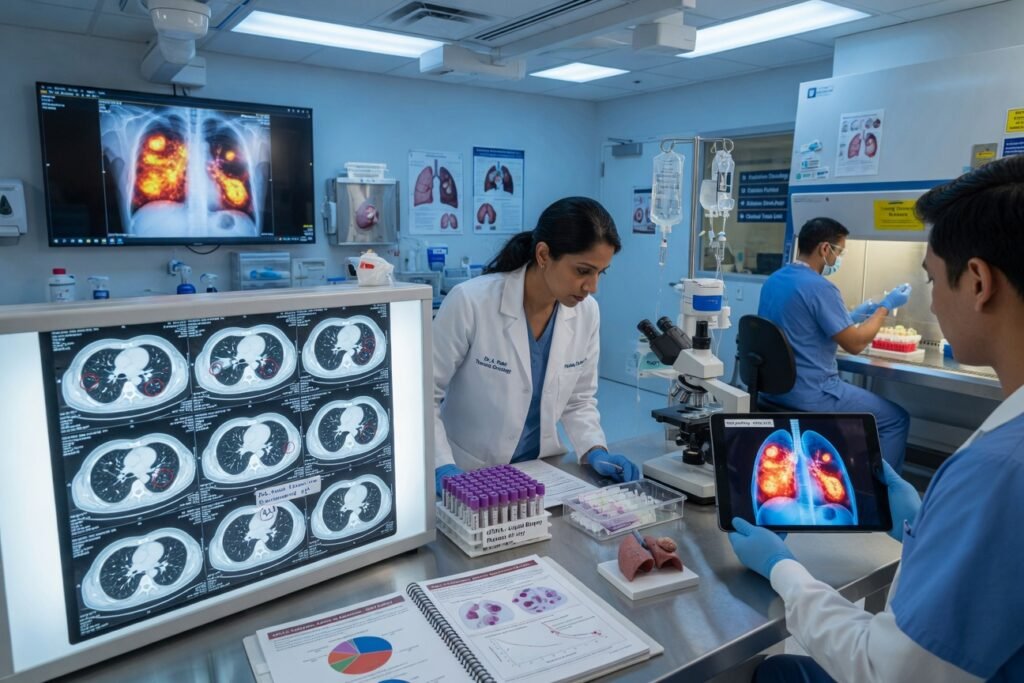
Sarah, a 58-year-old retired librarian who never smoked, came to my office complaining of a persistent dry cough. Her sister had lung cancer, and Sarah assumed that family history meant she was safe without cigarette exposure. Six weeks later, after a CT scan revealed a 2-centimeter nodule in her left upper lobe, she learned that roughly 20% of lung cancers occur in never-smokers—and her adenocarcinoma carried a specific EGFR mutation that made her a perfect candidate for targeted therapy. The biggest misconception I correct daily: lung cancer is not a smoker’s disease exclusively. In fact, the National Cancer Institute reports that non-smokers account for approximately 10-15% of all lung cancer deaths in the United States, and this number is climbing as smoking rates decline while never-smoker cases increase.
Key Facts About Lung Cancer
- Lung cancer remains the leading cause of cancer death globally, with 127,070 expected deaths in the United States in 2024 according to the American Cancer Society
- Small cell lung cancer (SCLC) represents 15% of diagnoses but accounts for approximately 27% of lung cancer deaths due to aggressive biology
- The 5-year survival rate for stage I non-small cell lung cancer is 56%, but drops to 5% for stage IV disease—yet immunotherapy combinations have improved stage IV survival to 15-17% in select populations
- Adenocarcinoma now surpasses squamous cell carcinoma as the most common lung cancer type, comprising roughly 40% of all cases, partly because it develops in the outer airways where never-smokers are more commonly affected
- PET-CT scans detect metastatic disease in 30-40% of patients initially thought to have localized lung cancer based on conventional imaging alone
Understanding Lung Cancer: What’s Actually Happening
Think of your lung cells like a carefully organized city where growth is strictly regulated. Each cell follows rules—divide when needed, die when old, stay in its designated zone. Lung cancer starts when cells in the respiratory tract break these rules. A single cell acquires a mutation (or series of mutations) that overrides the brakes controlling growth. That rogue cell divides repeatedly, creating a clone of identical misbehaving descendants. Over months or years, these cells accumulate additional mutations, becoming more aggressive and acquiring the ability to invade surrounding tissue and eventually spread elsewhere in the body.
What distinguishes lung cancer from, say, colon cancer is the unique environment. Your lungs are directly exposed to whatever you breathe—tobacco smoke, air pollution, asbestos fibers, radon gas. These irritants trigger chronic inflammation, DNA damage, and cellular stress that accelerates mutation accumulation. But genetics matter profoundly too. Some people inherit variations in DNA repair genes (like BRCA1/BRCA2) that make them vulnerable regardless of exposure. Others harbor oncogenic mutations like EGFR or ALK that are already present at birth in certain cells, waiting only for a triggering event.
Causes and Risk Factors: Beyond Smoking
Cigarette smoking causes roughly 80% of lung cancer cases overall, but let’s be precise: it’s not just the act of smoking—it’s the duration and intensity. Someone who smoked 30 cigarettes daily for 40 years has a vastly different risk profile than someone who smoked 5 cigarettes daily for 5 years. The 2014 Surgeon General’s Report found that smoking less than 1 cigarette daily still carries about 50-64% of the lung cancer risk of smoking a full pack.
Secondhand smoke exposure increases risk by 20-30%, measured most accurately in adults who never smoked themselves. Radon, a naturally occurring radioactive gas that seeps into homes from soil, represents the second leading cause of lung cancer after smoking—and this risk factor gets overlooked constantly. The EPA estimates radon causes 21,000 deaths annually in the U.S., yet many primary care doctors never order radon testing for symptomatic patients. Occupational exposures matter too: asbestos, silica dust, beryllium, and chromium all substantially elevate risk, particularly when combined with smoking.
Here’s what most articles miss: prior history of lung disease itself is a major risk factor. Chronic obstructive pulmonary disease (COPD), idiopathic pulmonary fibrosis (IPF), and even poorly controlled asthma increase lung cancer risk independent of smoking history. The scarred, inflamed lung tissue creates an environment primed for malignant transformation. Air pollution, particularly fine particulate matter (PM2.5), is an independent risk factor documented by the JAMA study following over 200,000 participants—each 5-microgram increase in PM2.5 associated with a 15% increase in lung cancer risk.
Signs and Symptoms: What Patients Notice First
A cough lasting more than three weeks is the most common early warning sign, yet patients often dismiss it as bronchitis or post-nasal drip. What makes a cough concerning is persistence—it doesn’t respond to standard cough medicines, doesn’t improve with antibiotics, and may gradually change in character. Some patients describe a tickle deep in the chest that triggers unproductive coughing fits, especially at night. Others notice the cough is productive but the sputum lacks the thick, yellow character of infection.
Hemoptysis—spitting up blood—is less common but more alarming. Even streaks of blood in sputum warrant urgent evaluation. Chest pain that worsens with deep breathing suggests pleural involvement. Hoarseness lasting weeks can indicate vocal cord paralysis from a tumor pressing on the recurrent laryngeal nerve. Shortness of breath develops gradually, sometimes so slowly patients adjust their activity without realizing the decline. They skip stairs, avoid walking distance, take breaks during shopping.
Constitutional symptoms appear later: fatigue that seems disproportionate to activity, unintentional weight loss (often 10-15 pounds over weeks), loss of appetite, and night sweats drenching bedsheets. These symptoms mean the cancer has likely progressed beyond the lung. Some patients present with shoulder pain from a Pancoast tumor (apex of lung) invading the brachial plexus, or hoarseness from superior vena cava syndrome when a mass compresses major veins.
Diagnosis: The Process
Diagnosis begins with imaging. A chest X-ray catches obvious masses but misses 20-30% of nodules smaller than 1 centimeter. Low-dose CT (LDCT) scanning, which delivers radiation exposure equivalent to 15-20 chest X-rays, detects nodules as small as 3 millimeters and is what the U.S. Preventive Services Task Force recommends for high-risk individuals aged 50-80 with a 20+ pack-year smoking history.
When a nodule appears, the next step depends on size and characteristics. Nodules smaller than 8 millimeters typically get follow-up imaging in 3-6 months. Larger nodules warrant further evaluation through bronchoscopy, percutaneous biopsy, or in some cases, surgical biopsy. Bronchoscopy allows the pulmonologist to visualize airways and sample tissue directly. Transthoracic needle biopsy uses imaging guidance to sample peripheral nodules.
Once cancer is confirmed histologically, molecular testing becomes essential—not optional. Testing for EGFR mutations (found in 40-50% of adenocarcinomas), ALK rearrangements (5-7% of cases), ROS1 (1-2%), and PD-L1 expression determines which targeted therapies apply. This isn’t just academic classification; it fundamentally changes treatment strategy and prognosis. Staging involves CT of chest and abdomen, PET-CT imaging, and often brain MRI, since the brain is a common site for metastatic disease.
Treatment Options: What Works Now
Treatment depends on cell type, molecular profile, stage, and performance status. Surgery remains curative for early-stage disease when technically feasible. Lobectomy (removing one lobe) is preferred over wedge resection whenever possible because of superior oncologic outcomes.
For advanced non-small cell lung cancer (NSCLC) with EGFR mutations, tyrosine kinase inhibitors (TKIs) like erlotinib, gefitinib, or afatinib are first-line therapy, producing response rates of 60-75% and median progression-free survival of 10-13 months. ALK-positive tumors respond dramatically to ALK inhibitors like crizotinib or alectinib, with some patients achieving remissions lasting years. These targeted drugs work because they specifically block the mutant proteins driving cancer growth.
For EGFR and ALK wild-type tumors, immunotherapy has revolutionized treatment. Checkpoint inhibitors like pembrolizumab or nivolumab block PD-1/PD-L1 interactions that tumors use to hide from the immune system. Combined with chemotherapy (platinum-pemetrexed for adenocarcinoma, platinum-gemcitabine for squamous), these regimens improve median overall survival from 12 months to 14-15 months in stage IV disease. For patients with high PD-L1 expression (≥50% of tumor cells), pembrolizumab monotherapy alone produces durable responses in some cases.
Small cell lung cancer requires different approaches. Etoposide plus cisplatin chemotherapy with concurrent thoracic radiation is standard for limited-stage disease. Atezolizumab added to chemotherapy improves survival modestly in extensive-stage SCLC. Prophylactic cranial irradiation prevents brain metastases in chemotherapy responders.
Radiation therapy treats localized tumors (stereotactic body radiation therapy, or SBRT, delivers high doses precisely for early-stage peripherally located tumors) and brain metastases. Palliative radiation relieves bone pain and treats spinal cord compression emergencies.
Practical Daily Management for Lung Cancer Patients
Manage treatment side effects systematically. Chemotherapy-induced nausea responds better to preventive antiemetics like aprepitant or ondansetron started before treatment than trying to control established nausea. Fatigue, the most prevalent side effect, rarely improves with rest alone—structured light exercise (30 minutes walking most days) actually reduces fatigue more effectively than bed rest.
Immunotherapy triggers inflammatory responses that can cause pneumonitis (lung inflammation), hepatitis, or colitis. Report new dyspnea, persistent diarrhea, or jaundice immediately rather than waiting for scheduled appointments. Targeted TKI therapy may cause diarrhea (mitigated by loperamide or dietary modification) or skin rash (often manageable with dermatologic consultation).
Nutritional support matters. Chemotherapy alters taste perception—foods suddenly taste metallic or unpleasant. Working with an oncology dietitian to identify tolerable, calorie-dense foods prevents malnutrition. Supplement with high-protein shakes if solid food becomes challenging. Monitor weight weekly; unexplained loss beyond 5% suggests inadequate intake or treatment complications.
Coordinate care with your oncologist before starting supplements or herbal products. St. John’s Wort interferes with many chemotherapy drugs. High-dose antioxidants may reduce chemotherapy efficacy. Mental health support—counseling or support groups—improves treatment adherence and quality of life more than most patients anticipate.
Prevention: What Actually Reduces Risk
Smoking cessation remains paramount. Quitting at any age reduces lung cancer risk, though risk decreases gradually—it takes 15+ years after quitting for former smokers to approach the baseline risk of never-smokers. Varenicline (Chantix) and combination nicotine replacement therapy achieve quit rates of 25-35%, substantially higher than willpower alone.
For current or former heavy smokers, annual low-dose CT screening detects early-stage cancer when surgery is still curative. The National Lung Screening Trial demonstrated that LDCT screening reduces lung cancer mortality by 20% compared to chest X-ray in this population.
Test your home for radon using EPA-approved test