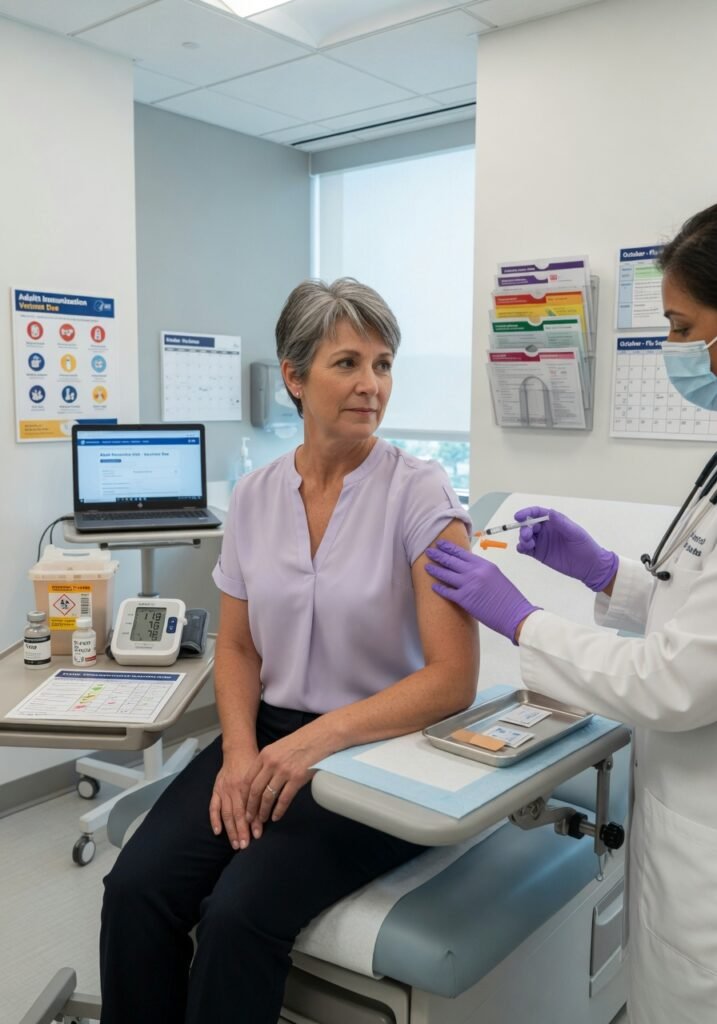

Maria, a 42-year-old marketing director, hadn’t thought about vaccines since high school. She assumed that once you’d gotten your childhood shots, you were set for life. Then her doctor mentioned she was overdue for shingles protection and asked about her pneumococcal status. Maria’s reaction was typical: “Don’t I already have immunity from when I was a kid?” The answer is more complicated than yes or no.
Here’s what most people get wrong about adult vaccination: immunity isn’t a light switch you flip once and it stays on forever. Some vaccines do provide lifelong protection—measles, for instance. Others fade with time, requiring boosters every 5 or 10 years. And some diseases that posed minimal risk at age 15 become serious health threats by age 50 or 65. Your body’s immune system changes as you age, which is precisely why your vaccination needs change too.
Adult Vaccination: The Reality of Changing Immunity
Key Facts About Adult Vaccines
- Only 29.3% of adults aged 50 and older received the shingles vaccine (Shingrix) as of 2022, according to CDC data, despite shingles affecting roughly 1 in 3 Americans in their lifetime.
- The tetanus and diphtheria booster (Td or Tdap) loses protective effectiveness over approximately 10 years, meaning most adults need a new dose every decade of adult life.
- RSV vaccination (Arexvy or Abrysvo), newly approved for adults 60 and older in 2023, prevents respiratory syncytial virus infection—a virus that hospitalizes over 14,000 older adults annually in the United States.
- Pneumococcal vaccine recommendations shifted in 2024; a single dose of pneumococcal conjugate vaccine (Pneumovax 20) now replaces the previous sequential dosing strategy for most immunocompetent adults.
- Annual influenza vaccination reduces your risk of flu illness by roughly 40 to 60% depending on the season and viral strain match, per CDC analysis of surveillance data.
How Immunity Actually Works Over Time
Think of your immune system like a security team for your body. When you receive a vaccine, you’re essentially running a drill—exposing your immune cells to a “wanted poster” of a disease-causing organism, but not the genuine threat itself. Your B cells memorize what the invader looks like and produce antibodies. Your T cells learn how to coordinate a response.
The problem: that security team’s memory gets fuzzy. For some diseases, the muscle memory lasts decades or a lifetime. For others—particularly bacterial infections like pertussis—the antibodies decline noticeably within 5 to 10 years. Your immune cells don’t disappear; they simply become less reactive. This is why you can be “immune” at age 30 but vulnerable again at 50, even without any new exposure to the disease. Additionally, older adults experience immunosenescence, a gradual decline in immune system efficiency that makes vaccination response slower and sometimes weaker. A 70-year-old’s immune system won’t mount the same robust response to a new vaccine as a 25-year-old’s would, which is why some vaccines have higher-dose formulations specifically for older adults.
Risk Factors That Determine Your Adult Vaccine Needs
Age remains the primary factor. A 25-year-old and a 65-year-old have vastly different vaccination priorities. But several other factors reshape what you actually need.
Occupation matters more than most people realize. Healthcare workers need annual flu shots and proof of immunity to measles, mumps, and rubella. Daycare staff face different risks than office workers. Teachers in certain states must meet specific immunization requirements. Travel patterns change everything—if you’re flying to Southeast Asia next month, Japanese encephalitis and typhoid considerations emerge. If you work with animals or travel to endemic regions, rabies pre-exposure prophylaxis might apply to you.
Underlying medical conditions create specific vulnerabilities. Diabetes increases your risk of serious pneumococcal and influenza complications. Chronic heart or lung disease does the same. Immunocompromised patients—those with HIV, on immunosuppressive medications for autoimmune conditions, or recovering from recent chemotherapy—need different vaccines, different doses, or timing adjustments. Someone with a history of Guillain-Barré Syndrome has a genuine contraindication to certain vaccines, not just a vague “we should be cautious.”
Here’s what most articles miss: your vaccination history gaps themselves are a risk factor. If you never completed your childhood series or your medical records were lost in a move, you might have partial or no immunity to diseases you assumed were covered. For adults with uncertain vaccination history, serology testing (blood tests checking for antibodies) can clarify what you actually need, rather than simply re-vaccinating based on assumptions.
What You Actually Experience: Recognition and Early Patterns
You don’t experience your vaccination status directly—that’s the subtle point many patients miss. You don’t “feel” immune or unimmune. The recognition of your vaccination needs comes through a conversation with your doctor, a review of your records, or increasingly, a check of your state’s immunization registry.
What you might notice is the gap: you’ve never had chickenpox and never got varicella vaccine as a kid (a real scenario for people vaccinated after the routine recommendation began in 1995). Or you realize you haven’t had a tetanus booster since 2005 and you stepped on a rusty nail last week. Or you’re turning 50 and your insurance suddenly covers shingles vaccination.
Early warning signs that you should review your vaccination status include: beginning a new job in healthcare or education, planning international travel, developing a chronic illness like diabetes or heart disease, starting an immunosuppressive medication, or turning 50, 60, or 65—ages when recommendations shift substantially.
Assessment: How Your Doctor Determines What You Need
Your doctor’s process for assessing vaccination needs follows a straightforward but sometimes overlooked path. First, they review your records. Not just a vague “are you up to date?” but an actual examination of which vaccines you received, when, and how many doses.
Second, they ask targeted questions: any severe allergies (particularly to gelatin, eggs, or neomycin, which affect certain vaccines)? Pregnancy status? History of Guillain-Barré Syndrome? Current immunosuppressive therapy? Recent live vaccine administration elsewhere? These aren’t generic health questions—each changes the recommendations.
Third, they reference your age and risk category. The CDC publishes separate schedules for immunocompetent adults, those aged 50-64, those 65 and older, and immunocompromised individuals. These are genuinely different, not minor variations.
Some doctors use immunization registries—state or local databases that track your vaccination history across different clinics. This prevents duplication and identifies gaps. From your perspective, this should feel efficient rather than invasive: it’s simply ensuring you get what you need without unnecessary repeats.
Current Vaccination Recommendations: What Actually Works
For all immunocompetent adults: Tetanus, diphtheria, and pertussis protection via Tdap (preferably once as an adult) followed by Td boosters every 10 years. Annual influenza vaccine—the specific formulation changes yearly based on predicted circulating strains. Most adults need at least one dose; those 65 and older might benefit from higher-dose versions like Fluzone High-Dose or adjuvanted formulations like Fluad Quad.
At age 50 or older: Recombivax HB or Engerix-B (hepatitis B series, typically three doses, even if you received it decades ago—immunity wanes). Shingrix for shingles prevention—two doses administered 2 to 6 months apart. This vaccine prevents shingles in roughly 90% of recipients and post-herpetic neuralgia in over 95% of those who would have developed it.
At age 19 and older with specific conditions: Pneumococcal vaccination with the newly simplified Pneumovax 20 for most immunocompetent adults. MPRV (measles, mumps, rubella, varicella) if born in 1957 or later without proof of two doses or serologic immunity. Meningococcal vaccines for certain age groups and risk factors. Hepatitis A series for those without prior immunity.
Age 60 and older: RSV vaccination with either Arexvy or Abrysvo—a genuinely new option that addresses a significant cause of hospitalization in older adults. RSV causes severe respiratory illness in roughly 1% of older adults who acquire infection.
The timing matters. Don’t space multiple vaccines in the same visit unnecessarily—most can be given together without problems, which means efficiency rather than prolonged gaps in protection. Live vaccines (if you need them, which most adults don’t) require 28-day spacing from other live vaccines.
Managing Your Adult Vaccination Schedule Practically
Keep a personal vaccination record. Not just a vague memory of “yeah, I got my shots.” Actually maintain a copy of your immunization record with dates and specific vaccines. When you change doctors or move states, this becomes invaluable. The CDC provides a free record form online; your state might offer digital records through a registry you can access yourself.
Schedule proactively rather than reactively. Don’t wait until you’re injured or exposed to remember tetanus. Don’t plan international travel and suddenly scramble for vaccines you should have months earlier. Build it into your annual primary care visit. Before your birthday that ends in zero (30, 40, 50, etc.), check what changes in recommendations apply to your new age group.
Understand your insurance coverage. Most Medicare plans cover recommended vaccines at no cost. Commercial insurance typically covers adult vaccines at no cost when considered preventive. However, newer vaccines like RSV or Shingrix might require prior authorization or copayments depending on your plan. Call ahead rather than discovering coverage surprises at the pharmacy.
Ask about timing if you’re recently ill or have a scheduled medication change. Severe acute illness warrants delaying non-urgent vaccination. Starting an immunosuppressive medication? Some vaccines should be given before, not after. These aren’t reasons to skip vaccination—they’re reasons to coordinate timing.
Manage side effects realistically. Pain at the injection site and mild fatigue are normal. Fever lasting more than 48 hours, severe arm swelling, or symptoms that genuinely concern you warrant a call to your doctor—not panic, but confirmation that what you’re experiencing is expected.
Prevention: What the Evidence Actually Shows
Vaccination prevents disease. This isn’t controversial in medicine; the data is overwhelming. The CDC reports that measles vaccination prevents roughly 21 million deaths per decade in children globally. Influenza vaccination reduces hospitalization in older adults by approximately 40%. Shingrix reduces shingles incidence by 90% and post-herpetic neuralgia by 97% in vaccinated older adults.
But here’s the nuance: prevention doesn’t mean zero risk. Vaccinated people occasionally still contract the disease they’re vaccinated against—this is called breakthrough infection. It’s rare, and when it happens, the illness is typically milder. If you get influenza despite vaccination, you’re less likely to require hospitalization. If you get shingles after Shingrix, your pain is usually less severe.
The other prevention reality: herd immunity matters. When 85-90% of a population is immune to a disease, that disease struggles to spread—protecting the small percentage who can’t be vaccinated due to genuine medical contraindications (infants too young for certain vaccines, patients with severe allergies, immunocompromised individuals with limited vaccine response). Your vaccination protects not just you but your immunocompromised neighbor, your newborn niece, and your friend undergoing chemotherapy.
Frequently Asked Questions About Adult Vaccines
Sources & Medical References
HealthTopics.com articles are based on peer-reviewed medical research and guidance from the NIH, CDC, and WHO. See our editorial policy for full sourcing standards.