
How Often You Really Need an Eye Exam (And What Your Doctor Actually Checks)
Marcus Chen, a 42-year-old accountant, went five years between eye exams because his vision felt fine—until his ophthalmologist discovered early glaucoma that would’ve caused irreversible blindness within a decade if left untreated. Here’s what most people don’t realize: the CDC reports that approximately 2.9 million Americans have undiagnosed glaucoma right now, and about 3 million have diabetic retinopathy they don’t know about. You can’t feel these diseases happening. Your eyes won’t send you a warning signal until serious damage is done. This is why the screening interval—how often you actually need that appointment—matters more than most of us think.
Key Facts About Eye Exams
- Adults without risk factors need comprehensive eye exams every 5-10 years through age 40, then every 2-4 years from 41-60, and annually after 61, according to the American Academy of Ophthalmology
- Dilated fundus examination can detect diabetic retinopathy an average of 2-3 years before patients develop visual symptoms
- Intraocular pressure screening catches approximately 65-75% of open-angle glaucoma cases when performed during routine exams, yet only about 50% of Americans have had one in the past two years
- Comprehensive eye exams take 45-90 minutes on average and include 8-12 distinct measurements and observations
- An eye exam can reveal systemic diseases like hypertension, diabetes, heart disease, and even certain cancers before symptoms appear elsewhere in the body
What’s Actually Happening During Your Eye Exam
Think of your eye as a specialized camera that needs regular maintenance checks—but unlike a camera, you’re the only person who lives with the consequences when it breaks. An eye exam isn’t just about whether you need stronger glasses. Your ophthalmologist or optometrist is evaluating at least seven different systems simultaneously: your refractive error (how light bends in your eye), your eye muscle function, your peripheral vision, your optic nerve health, your retinal integrity, your eye pressure, and the blood vessels feeding your retina.
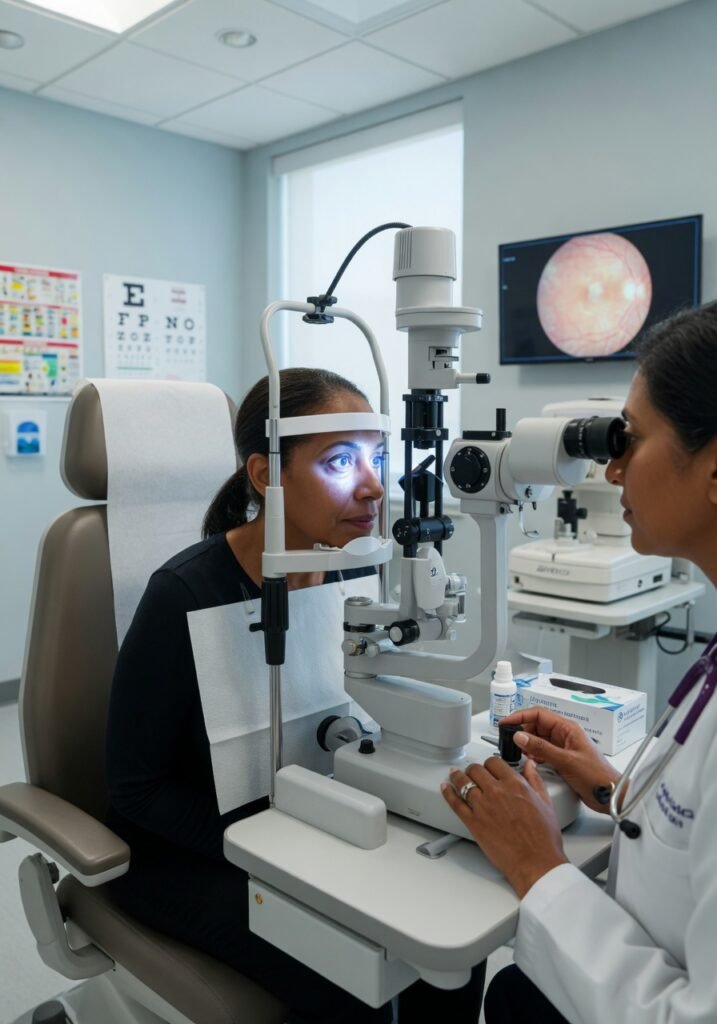
When your doctor puts that phoropter in front of your face—the instrument with all the lenses—they’re measuring refraction. But when they dilate your pupils with tropicamide or phenylephrine drops and peer into the back of your eye with that bright light, they’re actually examining millimeter-scale structures that can reveal systemic disease before your primary care doctor would ever catch it. A yellow deposit on your retina might be early macular degeneration. A hemorrhage you can’t see might signal uncontrolled diabetes. Copper-colored deposits might indicate syphilis. Your eye is essentially a window into your vascular system.
Who Needs Eye Exams and When
Frequency isn’t one-size-fits-all, and this is where most people get it wrong. A healthy 35-year-old with no family history of eye disease has different needs than a 35-year-old with type 2 diabetes and a mother who had glaucoma.
Low-risk adults (no diabetes, no eye disease history, no symptoms) can go 5-10 years between exams before age 40. After 40, switch to every 2-4 years. After 60, annual exams become standard because age-related conditions like presbyopia, cataracts, and age-related macular degeneration accelerate.
Higher-risk patients need more frequent screening. This includes anyone with diabetes (annual dilated exams minimum), anyone over 40 with a family history of glaucoma (every 1-2 years), anyone with hypertension (every 2 years), anyone on medications like tamoxifen or finasteride that affect ocular health, or anyone with previous eye disease.
One often-overlooked risk factor: myopia progression in children. If your child is becoming increasingly nearsighted, they’re not just going to need stronger glasses—rapid myopia progression is now linked to increased risk of myopic macular degeneration, glaucoma, and retinal detachment later in life. Some ophthalmologists now recommend biannual exams for children with progressive myopia and may prescribe atropine drops or orthokeratology lenses to slow progression.
What Patients Actually Experience: Signs You Might Need an Exam Sooner
Most people wait until vision noticeably blurs before scheduling an eye exam. But several red flags warrant immediate evaluation, not a six-month wait:
- Sudden floaters or flashes—these can indicate retinal detachment, which is an ophthalmologic emergency requiring evaluation within 24 hours
- Gradual peripheral vision loss—you might notice you’re bumping into things on one side, or your visual field feels narrower. This is classic for glaucoma and often goes unnoticed until significant damage occurs
- Eye pain with redness and light sensitivity—could be acute angle-closure glaucoma, which requires same-day treatment to prevent permanent blindness
- Double vision or sudden eye misalignment—suggests cranial nerve involvement or thyroid eye disease requiring urgent workup
- Metamorphopsia—straight lines appearing wavy—suggests macular disease and needs evaluation within 1-2 weeks
- Halos around lights, especially combined with eye discomfort—classic presentation of angle-closure glaucoma or corneal edema
The overlooked warning sign most patients miss: difficulty adjusting from bright to dim environments. While everyone experiences this mildly, significant delays in dark adaptation can indicate early retinal degeneration or optic nerve compromise.
The Testing Process: What Gets Measured
A comprehensive dilated eye exam involves several specific tests. Visual acuity measurement starts with the standard Snellen chart—but your doctor also checks how well you see at distance, near, and intermediate ranges. Then comes tonometry, which measures intraocular pressure using either applanation (a small probe briefly touches your numbed cornea) or non-contact methods (a puff of air). Normal pressure is typically 10-21 mmHg, though some people tolerate higher pressures without damage and others develop glaucoma at “normal” pressures.
Automated refraction uses a phoropter to determine your prescription precisely. Gonioscopy (using a special lens to visualize your eye’s drainage angle) determines glaucoma risk. Dilated fundoscopy examines your optic nerve, macula, blood vessels, and peripheral retina. Many offices now include optical coherence tomography (OCT) imaging, which provides high-resolution cross-sectional images of your retina and optic nerve. This 30-second scan can detect macular edema, drusen, and optic nerve cupping that would be difficult to spot clinically.
Visual field testing (perimetry) maps your peripheral vision—you stare at a fixation point while lights appear at different locations and you click a button when you see them. This objectively measures whether glaucoma, stroke, or neurologic disease is affecting your visual field.
Current Treatment Approaches for Diagnosed Conditions
If your eye exam reveals disease, treatment depends entirely on what’s found. For refractive errors, the options range from glasses to contact lenses to surgical correction with LASIK or PRK. For dry eye disease found during examination, treatment escalates based on severity: artificial tears (preservative-free for frequent use), cyclosporine ophthalmic emulsion 0.05% or lifitegrast 5% to reduce inflammation, warm compresses and eyelid hygiene, or in severe cases, punctal plugs to preserve your own tears.
Early glaucoma detected on exam might warrant topical prostaglandin analogs (latanoprost, travoprost, bimatoprost) as first-line therapy—these increase uveoscleral outflow of fluid. If pressure remains inadequately controlled, your doctor adds beta-blockers (timolol), carbonic anhydrase inhibitors (dorzolamide, brinzolamide), or alpha-agonists (brimonidine). Only about 30-40% of glaucoma patients achieve target pressures with monotherapy, so combination treatments are common.
Diabetic retinopathy found during screening might be managed with strict glycemic control initially, but proliferative disease requires pan-retinal photocoagulation laser treatment or anti-VEGF injections (bevacizumab, ranibizumab, aflibercept) to prevent vision loss. Early treatment reduces the risk of severe vision loss by 95% compared to untreated disease.
Day-to-Day Management After an Eye Exam
After your exam, your pupils will remain dilated for 4-6 hours—plan accordingly. You’ll be light-sensitive and your near vision will be blurry, so avoid driving until the drops wear off. Ask for those disposable sunglasses they often offer; they’re not just convenient, they’re functional.
If you’ve been prescribed new glasses or contacts, allow 1-2 weeks for adaptation. Your brain needs time to adjust to different optics, especially if you received bifocals or progressive lenses for the first time. Some initial dizziness or visual distortion is normal and usually resolves.
If you’ve been diagnosed with a condition requiring treatment, set a phone reminder for medication compliance. Glaucoma medications are only effective if you use them. Studies show that approximately 50% of patients with prescribed glaucoma drops have poor adherence, leading to progressive vision loss they could have prevented.
Schedule your next appointment before leaving the office. Having that date locked in prevents the “I’ll schedule it later” phenomenon that leads to years of missed exams.
Prevention: What Actually Works
Can you prevent the need for eye exams? Not really—everyone needs them. But you can reduce the likelihood of finding serious disease during those exams.
Tight glycemic control in diabetics reduces diabetic retinopathy risk by 76% according to the Diabetes Control and Complications Trial. That means actually meeting your HbA1c targets, not just taking metformin and hoping for the best.
Blood pressure control matters. Elevated hypertension accelerates retinal vascular disease and increases glaucoma risk. Target <130/80 mmHg based on current American Heart Association guidelines.
Smoking cessation reduces age-related macular degeneration risk by approximately 25-30%. It’s one of the few modifiable risk factors for this otherwise genetic condition.
UV protection actually works—wearing UV-blocking sunglasses reduces pterygium, cataracts, and possibly macular degeneration risk. Look for sunglasses blocking 99-100% of UVA and UVB.
Omega-3 supplementation shows modest benefit for dry eye disease, particularly in people who spend significant screen time. The evidence is mixed for macular degeneration prevention, but the AREDS2 study found that lutein, zeaxanthin, and omega-3 supplementation reduced advanced macular degeneration progression by 10-25%.
Frequently Asked Questions
Do I need an eye exam if my vision feels fine?
Yes. Glaucoma, diabetic retinopathy, macular degeneration, and retinal tears produce no symptoms until significant damage occurs. That’s why screening intervals matter—you’re catching disease before you feel it. Even if your vision is perfect, diseases that threaten it may already be developing silently.
Can I just get a vision screening at
Sources & Medical References
HealthTopics.com articles are based on peer-reviewed medical research and guidance from the NIH, CDC, and WHO. See our editorial policy for full sourcing standards.