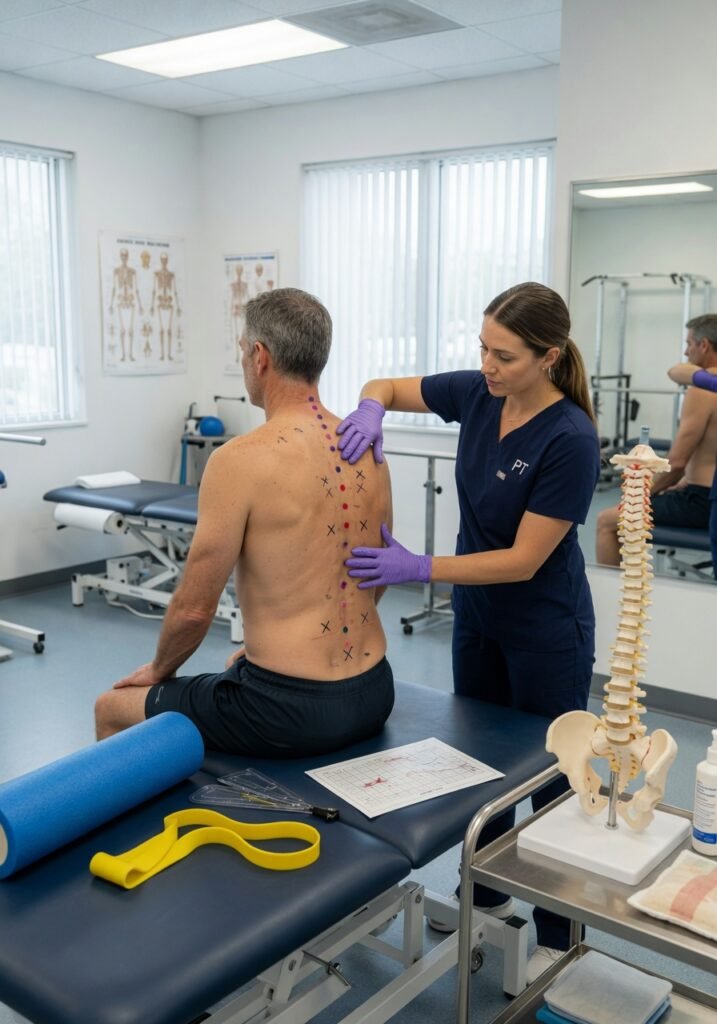
Sarah woke up at 5 AM with her lower back so stiff she couldn’t bend forward to touch her knees—something she’d done effortlessly her whole life. At 34, she assumed she’d slept wrong, but the stiffness got worse each morning, lingering for hours. After three months of progressive pain and a few swollen knee joints, her rheumatologist ordered an HLA-B27 blood test and an MRI. The diagnosis hit hard: ankylosing spondylitis, a chronic inflammatory arthritis that primarily attacks the spine and sacroiliac joints. She’d never heard of it before, and her biggest fear was ending up in the hunched posture she’d seen in older patients with severe disease.
Key Facts About Ankylosing Spondylitis
- Approximately 1.4 million Americans have ankylosing spondylitis, with about twice as many men affected as women
- The HLA-B27 gene is present in 90% of patients with ankylosing spondylitis, but only about 6-8% of people carrying HLA-B27 develop the disease
- According to the NIH, spinal fusion can occur in 30% of ankylosing spondylitis patients if left untreated or inadequately managed
- TNF-inhibitor medications like adalimumab (Humira) and etanercept (Enbrel) can slow radiographic progression by up to 70% when started early
- Men typically develop symptoms between ages 20-40, while women often present 5-10 years later, leading to diagnostic delays in female patients
Understanding Ankylosing Spondylitis: What’s Actually Happening
Your immune system normally fights invading bacteria and viruses, then shuts down when the threat passes. In ankylosing spondylitis, something goes wrong with that shutdown sequence. Your body mistakes the tough ligaments and joint capsules of your spine—particularly where they attach to bone at the sacroiliac joints—as foreign invaders. This triggers chronic inflammation that doesn’t quiet down. Over months and years, your body responds to this persistent inflammation by laying down scar tissue and new bone in the damaged areas. This is bone formation where bone shouldn’t be. Eventually, vertebrae can fuse together, turning your flexible spine into something more like a bamboo pole.
Think of it like this: normal inflammation is a fire alarm going off when there’s actual smoke. In ankylosing spondylitis, the alarm stays triggered even when no smoke exists, and eventually the repeated inflammatory signals cause your body to start reinforcing the “damaged” areas with new bone. That reinforcement is meant to stabilize, but it locks your spine in place.
Causes and Risk Factors: What We Know and What We’re Still Learning
The genetic component is huge here. Having the HLA-B27 gene dramatically increases your risk, but genetics aren’t destiny—that 8% conversion rate shows environmental triggers matter tremendously. What are those triggers? That’s where things get interesting and less discussed than they should be.
Male sex is a clear risk factor, though why remains incompletely understood. There’s emerging research suggesting that estrogen may have a protective effect, which could explain the later onset and sometimes milder presentation in women. Family history matters—if a parent or sibling has ankylosing spondylitis and you carry HLA-B27, your risk jumps substantially.
Here’s the overlooked piece: recent studies suggest gut dysbiosis—an imbalance in your intestinal microbiome—may play a triggering role. People with ankylosing spondylitis show different bacterial populations compared to controls, particularly elevated Klebsiella species in some patients. This connects to intestinal permeability issues and increased bacterial lipopolysaccharide in the bloodstream, which can activate immune responses in genetically predisposed individuals. It’s not proven causation, but it’s compelling enough that some researchers are exploring targeted probiotics and dietary modifications, though evidence remains preliminary.
Age of onset typically falls between 20-40, with peak diagnosis in the late twenties to mid-thirties. Smoking doesn’t directly cause ankylosing spondylitis, but smokers with the disease show faster progression and worse imaging outcomes.
Signs and Symptoms: What Patients Actually Feel
The earliest symptom is almost always inflammatory back pain, and here’s what distinguishes it from regular mechanical back pain: it gets worse with rest and better with activity. You feel stiffest in the morning, sometimes for an hour or more. Stretching and light movement improve it. This is backwards from mechanical pain caused by a disc herniation or strain, which typically feels better when you rest.
The pain starts deep in the low back and buttocks, often one-sided initially. You might notice increased stiffness on one side when you bend sideways. Many patients describe it as a dull ache that gradually worsens over weeks and months. Some experience it as burning pain radiating into the hip or groin.
Beyond the spine, ankylosing spondylitis can attack peripheral joints—your knees, ankles, hips, shoulders. About 30% of patients develop peripheral arthritis at some point. Eye inflammation (anterior uveitis) occurs in roughly 25-30% of cases and can cause sudden eye pain, redness, blurred vision, and light sensitivity. Fatigue is underrecognized but significant; many patients report exhaustion that doesn’t match their activity level.
The progressive stiffness and loss of spinal mobility develops gradually. You might first notice difficulty looking up, then difficulty bending sideways, then the characteristic forward-stooped posture when the disease advances untreated. Chest wall involvement can restrict rib cage expansion, causing shortness of breath with exertion. Some patients develop enthesitis—inflammation at tendon and ligament insertion points—causing heel pain or Achilles tendon pain.
Diagnosis: The Clinical Process
Your doctor will start with a detailed history focused on the character of your back pain—did it start insidiously in your twenties or thirties? Does morning stiffness last more than 30 minutes? Does movement improve it? They’ll examine your spinal mobility using the Schober test (marking your skin and measuring how far your spine flexes forward) and assess for any peripheral joint swelling.
Blood tests are essential. The HLA-B27 genetic marker is positive in about 90% of ankylosing spondylitis cases, but it’s not diagnostic by itself—it’s a risk factor test. Your doctor will also check inflammatory markers: erythrocyte sedimentation rate (ESR) and C-reactive protein (CRP). Interestingly, about 30% of ankylosing spondylitis patients have normal inflammatory markers despite active disease, so a negative CRP doesn’t rule it out.
Imaging confirms diagnosis. Standard X-rays of the pelvis and sacroiliac joints show characteristic changes—erosions and sclerosis at the sacroiliac joint borders (the “shiny corner sign”), and eventually bridging syndesmophytes that connect vertebral bodies. Magnetic resonance imaging (MRI) is more sensitive early on, detecting bone marrow edema and early inflammatory changes before X-rays show anything.
The Assessment of Spondyloarthritis International Society (ASAS) criteria are what rheumatologists actually use for diagnosis. They require either imaging evidence (sacroiliitis on MRI or X-ray) plus one additional feature (like HLA-B27, inflammatory back pain, arthritis, enthesitis, or uveitis), or HLA-B27 positivity plus two additional features.
Treatment Options: Current Evidence
NSAIDs like indomethacin (Indocin) and naproxen are first-line for pain and inflammatory control. Studies show they might slow radiographic progression if used continuously, not just intermittently. Doses matter—100 mg daily of indomethacin or 1000 mg daily of naproxen, sustained, works better than occasional use.
TNF-inhibitor biologics are the game-changers. These include adalimumab (Humira), etanercept (Enbrel), infliximab (Remicade), and golimumab (Simponi). A JAMA publication showed that TNF inhibitors slow spinal radiographic progression substantially when started early, with some patients achieving minimal or no progression over 2-4 years. They work by blocking tumor necrosis factor-alpha, a key inflammatory mediator. Most insurance requires documented failure of NSAIDs first, but once approved, they’re dramatically effective for many patients.
Sulfasalazine helps with peripheral arthritis and enthesitis but has minimal effect on spinal disease. Methotrexate similarly has limited benefit for axial (spinal) ankylosing spondylitis, though it helps peripheral manifestations in some patients.
Newer IL-17 inhibitors like secukinumab (Cosentyx) and ixekizumab (Taltz) are approved and effective, particularly for patients who don’t tolerate or respond well to TNF inhibitors. They work through a different immune pathway.
Physical therapy deserves emphasis as treatment, not just adjunct care. Regular stretching, extension exercises, and posture-focused training slow functional decline significantly. Swimming is particularly valuable because it mobilizes your spine without impact stress.
Practical Daily Management Strategies
Morning routine matters enormously. Spend 5-10 minutes gently stretching before getting out of bed—simple knee-to-chest stretches, spinal twists, and hip flexor stretches. A warm shower or bath before stretching helps significantly. Keep your bedroom temperature reasonable; cold stiffens you more.
Throughout the day, avoid prolonged sitting. Every 30-45 minutes, stand and do 2-3 minutes of movement. Specific exercises help: prone press-ups (lying on your stomach and pushing your upper body up with your arms) fight the forward-stoop tendency. Wall stretches for chest opening counteract postural changes.
Sleep posture matters. Use a thin pillow or none at all; thick pillows force your neck into flexion. Sleep as flat and extended as possible. Some patients find a firm mattress helpful for spinal stability.
Work ergonomics need attention. Your computer screen should be at eye level. Your chair should support your lower back curve. Sit on sit-stand desks when possible, alternating between positions.
Consider swimming or water aerobics 3-4 times weekly. The buoyancy reduces joint load while allowing full spinal mobility—it’s nearly ideal for ankylosing spondylitis. Avoid high-impact activities like running; low-impact options like walking or cycling work better.
Prevention: What the Evidence Shows
You cannot prevent ankylosing spondylitis if you carry HLA-B27, but you can slow or potentially prevent progression from asymptomatic to symptomatic disease. Early NSAID use in genetically predisposed individuals with back pain shows promise but isn’t standard practice yet.
Once diagnosed, the evidence is clear: early aggressive treatment with TNF inhibitors, combined with regular exercise, slows structural progression. Waiting until your spine is already fusing is much harder to reverse than treating early.
Maintaining spinal mobility through daily stretching and exercise throughout your life appears to prevent the severe postural deformities that develop with inactivity. The stiff spine needs regular mobilization to maintain whatever range remains.
Frequently Asked Questions
Will ankylosing spondylitis definitely lead to a hunched back?
No, not necessarily. Modern TNF-inhibitor treatment combined with consistent exercise can prevent or minimize spinal fusion and postural changes. Historical data showing severe kyphosis (hunched posture) came from patients with undiagnosed or untreated disease. Early treatment and daily extension exercises make a significant difference in long-term
Sources & Medical References
HealthTopics.com articles are based on peer-reviewed medical research and guidance from the NIH, CDC, and WHO. See our editorial policy for full sourcing standards.