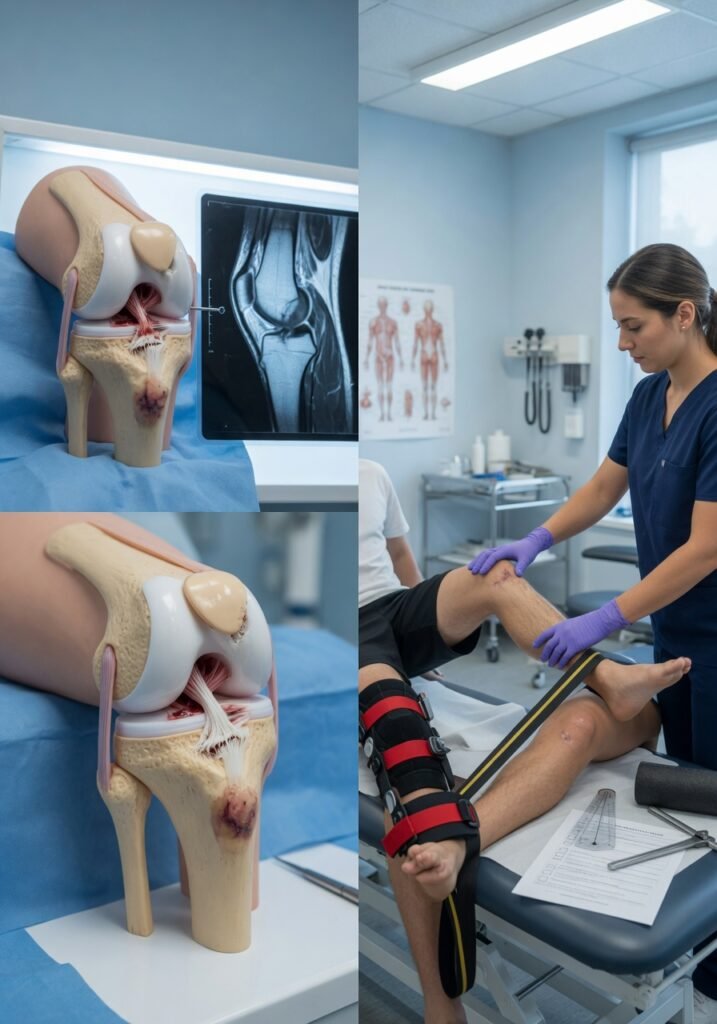
Sarah, a 28-year-old recreational soccer player, planted her left foot to cut left during a weekend match when her knee buckled inward with a sickening pop. She felt immediate sharp pain, and within minutes her knee swelled to nearly twice its normal size. Now, sitting in my clinic three weeks later, she’s facing a decision that will reshape her next 12-18 months: does she have ACL reconstruction surgery, or does she try to function without that ligament through careful rehabilitation and activity modification?
An anterior cruciate ligament tear is one of the most common knee injuries I see, particularly in patients aged 15-40 who participate in pivoting or cutting sports. The real challenge isn’t diagnosing the tear—it’s figuring out the right treatment path for each individual. Some people return to competitive sports after reconstruction. Others maintain an active lifestyle without surgery. Still others choose surgery but never recapture their pre-injury performance level. The decision is more nuanced than you’ll find in most online sources.
Key Facts About ACL Tears
- Approximately 250,000 ACL injuries occur annually in the United States, with roughly 100,000 resulting in ACL reconstruction surgeries per year, according to data from the American Orthopaedic Society for Sports Medicine.
- About 70% of ACL injuries occur through non-contact mechanisms—sudden deceleration, plant-and-cut movements, or landing from a jump—rather than direct collision.
- Women experience ACL injuries at 2-10 times the rate of men in similar sports, though the exact biological mechanism remains incompletely understood.
- Without surgery, roughly 50-70% of patients with ACL tears develop recurrent instability episodes within the first year if they return to cutting or pivoting sports.
- ACL reconstruction has a re-tear rate of approximately 15-20% within two years, depending on graft type, return-to-sport timing, and patient compliance with rehabilitation.
Understanding Your ACL Tear
Your ACL is a thick band of connective tissue that runs diagonally through your knee joint, tethering your tibia (shinbone) to your femur (thighbone). Think of it as the primary restraint keeping your shinbone from sliding forward under your thighbone—a critical stabilizer during dynamic movements. When you tear this ligament, you lose that restraint immediately. Your knee doesn’t have a backup system that compensates automatically.
The tear typically happens in one of two ways: either the ligament snaps cleanly in two, or it pulls away from where it attaches to the bone. Complete tears are more common than partial tears, and once the fibers rupture, they don’t reattach on their own. Unlike a muscle that can heal with scar tissue, ligaments lack robust blood supply in certain regions, making spontaneous healing extremely limited.
Here’s the clinical reality most websites gloss over: a torn ACL doesn’t necessarily mean immediate disability. Some patients—particularly older, less active individuals—do fine with a reconstructed knee that relies on surrounding muscles for stability. Others cannot, because their activity demands exceed what muscular compensation can provide.
Causes and Risk Factors
The typical scenario is a sudden deceleration combined with a cutting movement. You’re running forward at moderate-to-high speed, then you plant one foot hard and redirect your body perpendicular to that planted foot. Your quadriceps contracts powerfully to slow you down, your hamstring tries to stabilize the knee, but the rotational forces overwhelm your ACL. That’s the mechanism in roughly 70% of cases, and it’s why soccer, basketball, American football, and skiing have the highest ACL injury rates.
Non-contact injuries dominate—and this matters for prevention. Direct blows to the knee from an opponent cause only about 30% of ACL tears. So teaching proper landing mechanics prevents more injuries than just “avoid contact.”
Age matters significantly. ACL injury risk peaks between 15-25 years old in athletes, then drops substantially after age 30 in non-athletes. Skeletal maturity plays a role—kids with open growth plates (unfused bone ends) have different injury patterns than skeletally mature adults.
Female sex is a genuine risk factor. Hormonal fluctuations during the menstrual cycle may increase ACL laxity and injury risk, though the evidence is mixed. Neuromuscular differences—women often show less quadriceps-to-hamstring coordination during dynamic movements—appear more consistently important. It’s not one factor; it’s a constellation.
Here’s what most articles miss: previous ACL injury carries enormous significance. If you’ve torn your ACL in one knee, you have a 3-6 times higher risk of tearing it in the opposite knee within the first two years. This phenomenon drives many of my recommendations for prevention in patients with prior injuries.
Signs and Symptoms
The immediate sensation—that sudden “pop” or “snap” in the knee—occurs in roughly 70% of ACL tears. It’s a distinctive sensation that patients often describe as hearing a sound or feeling something give way. Pain follows within seconds, though the pain can be surprisingly modest compared to the swelling.
Acute swelling is remarkable. Most patients develop substantial effusion (fluid in the joint) within 2-4 hours. The knee feels warm, tight, and grossly enlarged. This isn’t bruising (though that appears later); it’s joint fluid accumulation from hemorrhage and inflammatory response.
Give the acute phase a week, and the immediate pain often diminishes substantially. Here’s what catches people off guard: you might feel almost normal in certain movements. Walking on flat ground can feel relatively fine. But the moment you try to cut, pivot, or land from a jump, your knee feels genuinely unstable—like it might “slip out.” That sensation of instability persists in ways sharp pain doesn’t.
Early warning signs that are often overlooked: some patients report subtle episodes of the knee “giving way” weeks before a complete tear. These brief moments of instability might happen during routine activities, seemingly resolve, then happen again. If you experience even one episode of true instability—where your knee actually buckles and your leg feels unreliable—get imaging. Don’t wait for a traumatic injury.
Patients with chronic ACL tears (injuries from months or years ago that were never formally diagnosed) sometimes don’t have significant symptoms in everyday life. They’ve unconsciously modified their movement patterns and activity level to accommodate the instability. They might feel fine until they try a sport or activity they haven’t done recently.
How Diagnosis Actually Works
Clinical examination comes first. I perform the Lachman test, anterior drawer test, and pivot shift test. The pivot shift test is most specific for ACL tears—when positive, it has roughly 98% specificity. However, it can be difficult to elicit in acute injuries because patient guarding (muscle tensioning) interferes with the examination.
MRI is the gold standard, and I’ll order it when the clinical suspicion is high. MRI accurately identifies ACL tears in over 95% of cases and also reveals associated injuries—torn meniscal cartilage, bone bruising patterns, collateral ligament damage—that influence treatment decisions. But here’s what most patients don’t understand: you don’t always need MRI immediately. If your clinical exam is clearly positive and you’ve decided you want surgery regardless of findings, some surgeons will schedule reconstruction based on clinical criteria alone.
Some patients pursue ultrasound or less formal imaging first, hoping to avoid MRI cost or time. That occasionally works, but the risk is missing associated injuries that would change your treatment plan. I typically recommend MRI within the first two weeks after injury, when swelling has somewhat resolved but before you’ve developed compensatory muscle changes that make diagnosis harder.
Treatment Options: Surgery Versus Conservative Care
This is where evidence becomes genuinely complicated—and where your individual circumstances matter enormously.
Conservative Treatment Without Surgery
Rehabilitation focuses on quadriceps and hamstring strengthening, proprioceptive training (retraining your body’s sense of knee position), and functional movement retraining. Physical therapy typically involves 12-16 weeks of structured training, with progression toward sport-specific drills if you choose to return to athletics. Nonsteroidal anti-inflammatory medications like ibuprofen manage initial swelling and pain, typically for 7-10 days acutely.
Some patients maintain active lifestyles without surgery, particularly those willing to avoid cutting or pivoting sports. Studies show that roughly 50% of patients managed conservatively without returning to pivoting sports do well long-term. But if you return to soccer, basketball, or similar activities, your re-injury risk climbs substantially.
ACL Reconstruction Surgery
Reconstruction is the definitive treatment if you want to return to cutting or pivoting sports. The surgery doesn’t repair your native ACL—it reconstructs it using a graft. Surgeons use one of several graft sources: bone-patellar tendon-bone autograft (taking tissue from your own patellar tendon), hamstring tendon autograft, or allograft (donor tissue). Each has advantages and tradeoffs regarding strength, healing rate, and long-term outcomes.
Recovery is lengthy. Physical therapy rehabilitation typically extends 6-9 months before returning to cutting sports, and full recovery often takes 12-18 months. Return-to-sport too early significantly increases re-tear risk—this is one area where the evidence is absolutely clear. Objective criteria, including strength testing and movement quality assessments, should guide your return timeline, not just calendar time or how you feel.
Operative complication rates are low (less than 5% for serious complications), but they exist. Infection, graft failure, arthrofibrosis (excessive scar tissue limiting motion), and deep vein thrombosis are rare but possible.
Which Path Is Right?
Consider reconstruction if: you’re younger than 40, you want to return to jumping or cutting sports, or you’ve experienced episodes of instability affecting daily function. Consider conservative care if: you’re willing to modify activities permanently, you participate primarily in straight-line sports, you’re older, or you have significant medical comorbidities making surgery risky. The honest truth is that some reconstructed knees perform beautifully while others don’t, and some non-surgical knees remain perfectly functional while others chronically give way. Patient selection matters more than the treatment itself.
Practical Daily Management
During acute recovery, ice for 15-20 minutes every 2-3 hours during the first 72 hours reduces swelling. Elevation above heart level helps fluid drainage. Compression with an elastic wrap provides external stability when you’re mobile. Crutches for the first 2-3 days reduce pain and swelling accumulation.
For either treatment path, avoid early aggressive weight-bearing in the first week. Yes, some swelling is normal and expected, but systematic increase in swelling with activity suggests you’re doing too much too soon.
Patellar-femoral pain often develops as a secondary problem during ACL rehabilitation because people preferentially unload their involved leg. Strengthening the hip abductors and external rotators specifically addresses this pattern. It’s not glamorous, but these small muscles prevent downstream knee pain.
If you pursue surgery, plan for real life disruption during months 1-3. Driving is limited. Managing stairs requires technique. Returning to work depends on your job—desk work within 2-3 weeks is reasonable, but jobs requiring standing or walking take 4-6 weeks.
Prevention Strategies
Neuromuscular training programs—structured interventions focusing on proper landing mechanics, deceleration control, and rapid directional changes—reduce ACL injury risk by roughly 50% in prospective studies, according to research published in the Journal of Athletic Training. The programs typically involve 15-20 minute sessions 2-3 times per week and need to be ongoing, not a one-time intervention.
Specific elements matter: landing with bent knees rather than straight legs, controlling knee valgus (inward collapse), and developing rapid muscle response to unexpected perturbations. Generic “agility training” doesn’t prevent ACL injuries. Deliberate, coached correction of movement patterns does.
Sources & Medical References
HealthTopics.com articles are based on peer-reviewed medical research and guidance from the NIH, CDC, and WHO. See our editorial policy for full sourcing standards.