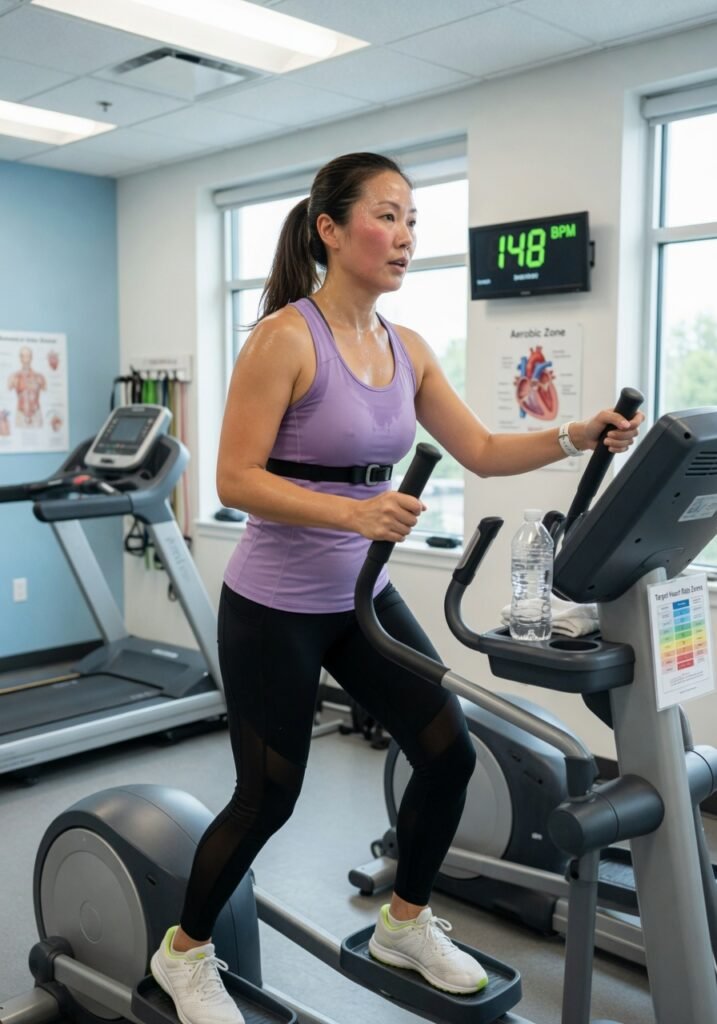
Why Does Your Heart Rate Stay Elevated for Hours After a 20-Minute Run, But Drop Quickly After Walking?
Sarah, a 42-year-old accountant, asked me this during a routine visit. She’d started jogging three months ago and noticed her resting heart rate had dropped from 78 to 62 beats per minute. But here’s what surprised her: after moderate jogging, her heart stayed elevated; after casual walking, it returned to baseline within minutes. The answer reveals something crucial about how cardio actually reshapes your cardiovascular system—and it’s not just about burning calories during the workout itself. It’s about what happens in the recovery phase, when your body is literally remodeling itself at the cellular level.
Key Facts About Cardio Exercise
- Regular cardio reduces risk of cardiovascular disease by 35% according to research published in JAMA Cardiology, with benefits appearing within 4-6 weeks of consistent activity
- Your stroke volume—the amount of blood your heart pumps per beat—can increase by 15-25% with sustained aerobic training over 3-6 months
- The CDC reports that only 28% of American adults meet aerobic activity guidelines (150 minutes moderate-intensity per week), yet those who do reduce all-cause mortality risk by 19%
- High-intensity interval training (HIIT) can improve VO2 max in as little as 2 weeks, whereas steady-state cardio typically requires 6-8 weeks to show measurable improvements
- Post-exercise oxygen consumption (EPOC)—the “afterburn effect”—accounts for only 6-15% of total calories burned during a cardio session, not the 30-50% many fitness influencers claim
Understanding How Cardio Exercise Actually Works in Your Body
Think of your cardiovascular system like a water distribution network in a city. Initially, the pipes are narrow, the pumps aren’t very efficient, and water pressure fluctuates. When you do cardio repeatedly, you’re essentially upgrading that entire system. Your capillaries—the tiniest blood vessels—multiply in number. Your heart muscle becomes stronger and more efficient, pumping more blood with fewer beats. Your muscles develop more mitochondria, the cellular powerhouses that extract oxygen from blood.
What’s happening at the molecular level is even more interesting. When you exercise aerobically, your muscles demand oxygen. This triggers the release of vascular endothelial growth factor (VEGF), which literally stimulates growth of new blood vessels. Simultaneously, your endothelial cells—the innermost layer of your arteries—become more responsive to nitric oxide, a molecule that relaxes blood vessel walls. This is why your blood pressure drops and your arteries become more flexible with consistent cardio training. You’re not just moving your body; you’re rewriting the instructions your cells follow.
The nervous system changes too. Your parasympathetic nervous system—the “rest and digest” branch—strengthens. This is why trained athletes have lower resting heart rates. Their bodies become more efficient at the baseline, conserving energy. Meanwhile, their sympathetic nervous system (the “fight or flight” response) becomes more responsive when needed, which is why they can access higher heart rates during intense exercise.
Risk Factors and Considerations Before Starting Cardio
Most articles discuss the obvious barriers: sedentary lifestyle, obesity, poor genetics. But here’s what I see missed constantly: your exercise tolerance baseline matters profoundly. Someone who’s been sedentary for five years will respond to cardio differently than someone who was previously active. The detraining effect is real—your cardiovascular adaptations can diminish by 30-50% in as few as two weeks without activity, which is why restart weeks feel harder than continuation weeks.
Age isn’t the limitation people think it is, but exercise-induced arrhythmia becomes more relevant after age 50. If you have a history of palpitations, syncope, or family history of sudden cardiac death, you need baseline testing before starting high-intensity cardio. I’m talking about an EKG and possibly a stress test—not optional for this population.
Here’s the less-discussed risk factor: medication interactions with exercise. Beta-blockers blunt your heart rate response, so you can’t use typical heart rate zones as safely. ACE inhibitors can cause dizziness during intense cardio. Certain diabetes medications increase hypoglycemia risk during prolonged exercise. Your pharmacist should be part of the conversation when you’re starting a new training program, not just your trainer.
Also consider your joint structure. High-impact cardio like running stresses your knees, hips, and ankles differently depending on your biomechanics. Flat feet, high arches, muscle imbalances—these don’t contraindicate running, but they demand specific modification. I’ve seen more running injuries from inadequate footwear and training progression than from cardiovascular limitation.
What You’ll Actually Experience: The Day-to-Day Changes
In the first two weeks, most people notice shortness of breath more than fatigue. Your brain is receiving better oxygen supply, so mental fog lifts—this happens before your heart actually becomes stronger. You might feel more anxious initially; your sympathetic nervous system is being stimulated in new ways.
Around week three to four, recovery improves. You stop feeling winded after climbing stairs. Your heart rate returns to baseline faster after activity. This is your body’s capillary density beginning to increase.
The early warning signs that you’re overtraining? Not typical muscle soreness—that’s normal. Watch for elevated resting heart rate (5-10 beats higher than your baseline), persistent fatigue that sleep doesn’t fix, irritability, or difficulty concentrating. These suggest your nervous system is overtaxed. Your body is asking for recovery, not more intensity.
What most people don’t expect: mood changes. Regular cardio increases BDNF (brain-derived neurotrophic factor), a protein that supports neuron growth. You’ll likely feel calmer and more resilient to stress within 4-6 weeks. This isn’t placebo—it’s neuroplasticity happening in real time.
How Your Fitness Is Actually Assessed
A proper cardio assessment starts with history. I ask: when did you last exercise regularly? Any chest pain, shortness of breath, or syncope? Family history of cardiac disease? This shapes whether you need baseline testing or can proceed safely.
The initial measurement is your resting heart rate, taken in the morning before standing. This is your honest baseline. Then comes VO2 max testing if you’re starting high-intensity training—either through a submaximal treadmill test (safer for deconditioned people) or a graded exercise test with gas exchange measurement (more accurate). The second option gives precise oxygen consumption; the first estimates it from heart rate response.
For most people, a simple field test suffices: the 6-minute walk test or a modified Cooper’s test. How far can you walk or jog in 6 minutes? This predicts your aerobic capacity reasonably well and requires no equipment. At eight weeks into training, repeat it. The improvement in distance correlates with cardiovascular adaptation.
Blood pressure should be rechecked regularly. Systolic pressure dropping 5-10 mmHg after 8-12 weeks indicates your vessels are becoming more elastic—a hard sign that cardio training is working.
Training Approaches: What the Evidence Actually Supports
The gold standard for cardiovascular improvement remains moderate-intensity steady-state cardio: 150 minutes weekly at 50-70% of your maximum heart rate. Running, cycling, swimming, rowing—the modality matters less than consistency. This approach builds aerobic base, improves lipid profiles, and carries low injury risk for most people.
High-intensity interval training (HIIT)—alternating 30-90 second bursts of near-maximal effort with recovery periods—produces faster VO2 max improvements. A 2023 NEJM study showed HIIT improved VO2 max 25% faster than moderate-intensity training. But HIIT demands careful progression and isn’t appropriate for deconditioned individuals or those with uncontrolled hypertension.
Hybrid approaches work best long-term. Three weekly sessions at moderate intensity, one weekly HIIT session, plus one longer steady effort (90-120 minutes at conversational pace) gives you aerobic base, metabolic flexibility, and injury resilience. This is what I recommend to most patients.
Resistance training alongside cardio matters more than most people realize. Adding two weekly strength sessions improves power output, prevents running injuries, and maintains muscle mass. You’re not just building a better aerobic engine; you’re building better hardware to run that engine.
Practical Implementation: Making Cardio Sustainable
Start with honest assessment of available time. Don’t commit to five-days-weekly if you realistically manage three. Undercommitting and succeeding beats overcommitting and failing within six weeks. Begin at conversational pace—you should be able to speak in full sentences but not sing. If you’re breathless mid-sentence, dial it back.
Progression is critical and often rushed. Increase intensity or duration by 10% weekly maximum. Week one: three 20-minute sessions at conversational pace. Week two: three 22-minute sessions. Week three: two 22-minute sessions plus one 25-minute session. This prevents overuse injury and allows your aerobic system to adapt systematically.
Environmental factors matter. Humidity reduces heat dissipation; if you’re exercising in hot weather, start earlier or later in the day and reduce intensity by 10-15%. Cold air can trigger bronchospasm if you’re asthmatic; breathing through a scarf helps. Elevation above 5,000 feet temporarily reduces oxygen availability; give yourself 2-3 weeks to acclimatize before expecting normal performance.
Footwear is investment, not expense. A gait analysis at a specialty running store ($50-75) prevents months of pain. Shoes need replacement every 300-500 miles; tracking mileage prevents injury from worn cushioning.
Recovery is training. Sleep consolidates cardiovascular adaptations; aim for 7-9 hours nightly. Nutrition matters—carbohydrate within two hours post-exercise replenishes glycogen; protein within that window supports adaptation. Simple as that.
Prevention: What Actually Reduces Disease Risk
The cardiovascular disease prevention is profound but requires honesty about timeline. Studies show atherosclerotic plaque progression halts within 12-16 weeks of regular cardio and reverses gradually over 1-2 years if combined with dietary improvement. You’re not going to reverse 10 years of sedentary living in 10 weeks, but measurable improvements in arterial function occur within 4-6 weeks.
Hypertension control is particularly dramatic. Systolic pressure drops 5-8 mmHg from regular moderate-intensity cardio—equivalent to some antihypertensive medications. Diastolic pressure improves slightly less. Combined with dietary sodium restriction, this often allows medication reduction in consultation with your physician.
Metabolic benefits include improved insulin sensitivity (appearing within 2-3 weeks before weight loss occurs), triglyceride reduction, and modest HDL elevation. LDL cholesterol changes minimally with exercise alone but improves significantly when cardio is paired with dietary saturated fat reduction.
One caveat: excessive high-intensity training without adequate recovery may temporarily increase inflammation markers. This doesn’t mean cardio is harmful; it means respecting the rest-adaptation cycle matters. Elite athletes pushing 15+ hours weekly face different physiology than recreational exercisers doing 3-4 hours weekly.
Questions People Actually Ask
Sources & Medical References
HealthTopics.com articles are based on peer-reviewed medical research and guidance from the NIH, CDC, and WHO. See our editorial policy for full sourcing standards.