Last month, a 52-year-old accountant named Marcus came into my office looking absolutely exhausted. He’d been taking 10 mg of zolpidem every night for three years, but lately he’d wake at 3 AM regardless, then spend two hours scrolling through his phone in anxiety. His wife had mentioned he seemed foggy even during the day. What struck me was that Marcus had never actually tried cognitive behavioral therapy for insomnia—he just assumed that sleeping pills were his only real option.
Here’s what the research actually shows: cognitive behavioral therapy for insomnia, or CBT-I, works better than sedative medications for most people, and the improvements stick around even after treatment ends. That’s not something you hear from every doctor, partly because pills are faster to prescribe and insurance billing is simpler. But the evidence is solid, and I want to walk you through why CBT-I deserves to be the first thing we try.
Key Facts About CBT-I
- According to the NIH, CBT-I produces remission of insomnia in 50-60% of patients compared to 30-40% for sedative-hypnotic medications like zolpidem or zopiclone
- Sleep gains from CBT-I remain stable at 12-month follow-up, while medication-dependent patients typically relapse within weeks of discontinuation
- The average CBT-I protocol involves 6-8 weekly or biweekly sessions of 50-60 minutes with a trained therapist
- CBT-I specifically targets the hyperarousal state—the brain’s stuck fight-or-flight response—rather than chemically sedating you
- About 75% of patients who complete CBT-I reduce or eliminate sleep medication entirely within six months
Understanding How CBT-I Actually Works
Your brain in insomnia isn’t simply “tired.” It’s more like a smoke detector that’s become hypersensitive. A small noise triggers a full alarm. Your nervous system stays revved up even when circumstances don’t demand it. CBT-I doesn’t just hand you a sedative to override that alarm—it recalibrates the detector itself.
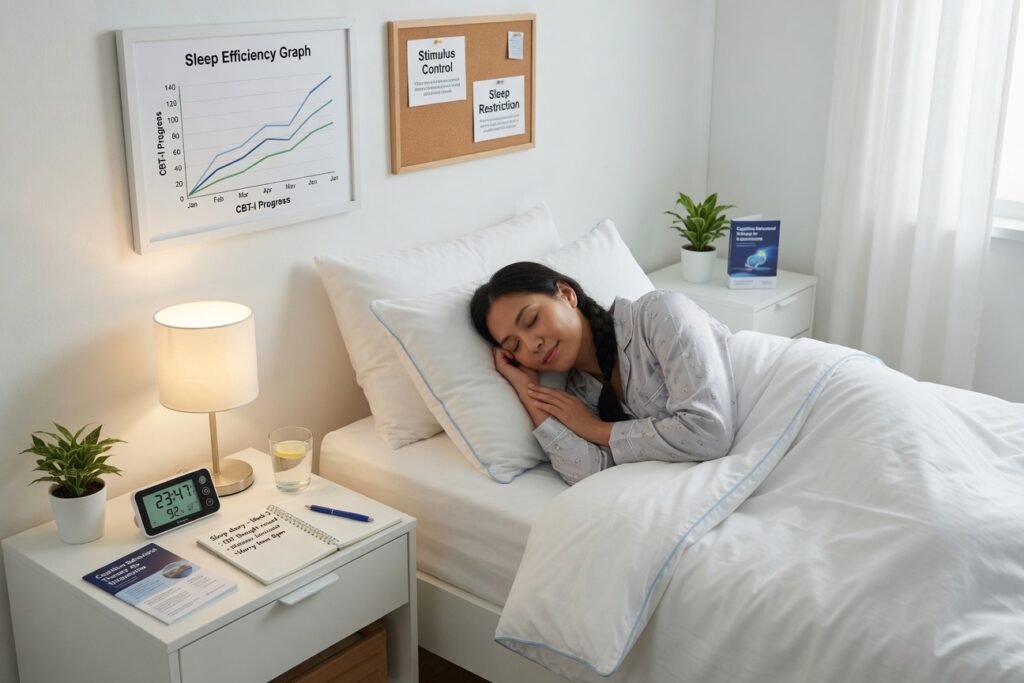
The mechanism involves several interlocking components. First, there’s stimulus control—retraining your brain so the bedroom becomes genuinely associated with sleep rather than worry. If you’ve spent 300 nights lying awake in bed staring at the ceiling, your brain has learned a powerful association: bed equals wakefulness. CBT-I breaks that link by having you leave the bedroom if you’re not asleep within 15-20 minutes, then only return when genuinely drowsy.
Second is sleep restriction therapy. This sounds counterintuitive—a therapist intentionally limits your time in bed initially, creating mild sleep deprivation that consolidates your sleep architecture. When you can only spend six hours in bed instead of nine, you sleep more efficiently. As your sleep improves, bed time gradually increases.
Third, there’s cognitive restructuring—examining the catastrophic thoughts that accompany your insomnia. You think, “If I don’t sleep tonight, I’ll ruin tomorrow’s presentation,” and that anxiety itself becomes the barrier to sleep. A CBT-I therapist helps you see these thoughts more realistically: one bad night doesn’t destroy performance, and the anxiety about not sleeping often matters more than the sleep loss itself.
Causes and Risk Factors for Insomnia
Insomnia rarely has a single cause. It’s usually a constellation of factors that have converged. Age matters—the CDC reports that about 35% of adults over 45 experience insomnia symptoms, compared to roughly 15% of those under 30. Hormonal changes in women around perimenopause and menopause can trigger it. Chronic pain conditions like fibromyalgia or osteoarthritis become insomnia risk factors partly because pain itself worsens sleep, but also because pain-related anxiety and the hypervigilance that comes with it creates the same overactive nervous system we discussed.
Work stress and irregular schedules definitely contribute. But here’s what most articles don’t emphasize: the anxiety about insomnia itself becomes a powerful perpetuating factor. You lose one night of sleep, worry about losing more, and that worry keeps you awake. This is called “performance anxiety” around sleep, and it’s what keeps people stuck in insomnia cycles even after the original trigger has resolved. Someone had a stressful month at work six months ago, insomnia developed, but now their insomnia persists because they’ve become terrified of not sleeping. That fear is the real problem now.
Other significant risk factors include mood disorders (depression and anxiety increase insomnia risk 5-10 fold), sleep apnea—which many insomniacs actually have without realizing it—certain medications like SSRIs or beta-blockers taken late in the day, and excessive caffeine intake past 2 PM. Alcohol use is subtle here too. People often use alcohol to fall asleep faster, but it fragments sleep quality severely and creates dependency.
What Insomnia Actually Feels Like
Patients describe insomnia in different patterns. Some can’t fall asleep at all, lying awake for an hour or more despite fatigue. Others fall asleep fine but wake at 2 or 3 AM and can’t return to sleep—this is called maintenance insomnia. Some experience early morning awakening, waking at 4 AM when they’d prefer to sleep until 6:30 AM. Then there’s non-restorative sleep, where you sleep seven hours but wake feeling like you haven’t slept at all.
The daytime consequences are real. People report difficulty concentrating at work—not just feeling tired, but actually struggling to hold information. Memory feels compromised. Mood becomes brittle; minor frustrations trigger disproportionate irritability. Some patients develop what I call “sleep anxiety spirals”—as bedtime approaches, dread builds because they anticipate another night of failure.
Early warning signs often missed: you start avoiding bedtime activities (reading in bed, cuddling with a partner) because you’ve associated the bedroom with frustration. You begin checking the clock compulsively at night. You find yourself researching sleep products obsessively or trying a new supplement every week. These behaviors, while completely understandable, actually reinforce the cycle because they maintain hyperarousal and the sense that sleep is a fragile, complicated problem requiring constant management.
How Insomnia Gets Diagnosed
There’s no blood test for insomnia. Diagnosis relies on clinical criteria and your own description. I use the DSM-5 criteria: difficulty initiating or maintaining sleep, or early morning awakening, occurring at least three nights per week for at least three months, with the sleep disturbance causing significant daytime impairment. The distinction matters—mild sleep difficulty everyone experiences occasionally isn’t insomnia. Insomnia is when it’s persistent and genuinely affecting your functioning.
I always ask: When did this start? Was there a specific trigger—a loss, a life change, a stressful period? How many nights per week is this happening now? What have you already tried? Have you ever had sleep apnea screening? Because if someone is waking gasping or has a partner who reports witnessed apnea episodes, treating insomnia as purely behavioral misses the underlying sleep-disordered breathing.
Some patients benefit from a sleep diary—recording bedtimes, wake times, nighttime awakenings, and daytime energy for 1-2 weeks. This gives us baseline data and often reveals patterns. Occasionally, a sleep study (polysomnography) becomes necessary if we suspect sleep apnea, periodic limb movements, or REM sleep behavior disorder masquerading as insomnia. But for straightforward insomnia without those red flags, a thorough clinical conversation is usually sufficient for diagnosis.
Treatment Options: What Actually Works
The JAMA published research showing that CBT-I and medication each improve sleep in the short term, but CBT-I sustains improvement longer and produces greater overall remission rates. The key difference: CBT-I teaches you how to sleep normally again. Medication makes you drowsy. Those aren’t the same thing.
That said, treatment options include several paths. CBT-I is typically delivered over 6-8 sessions by a psychologist or trained therapist. It’s the gold standard. Pharmacotherapy with sedative-hypnotics like zolpidem (Ambien), eszopiclone (Lunesta), or zaleplon (Sonata) provides rapid symptom relief but doesn’t address underlying causes. Melatonin receptor agonists like ramelteon work differently than benzodiazepines, binding melatonin receptors rather than GABA receptors, and carry less dependence risk, though they’re not stronger than CBT-I. Selective serotonin reuptake inhibitors like sertraline sometimes help if depression or anxiety underlies insomnia, but they’re not specifically for insomnia treatment.
Here’s my clinical practice: I recommend CBT-I as first-line treatment. If someone needs faster relief while starting therapy, we might use short-term medication—maybe two to four weeks of ramelteon or a low dose of trazodone—while therapy begins. We then taper the medication as CBT-I takes effect. This combination works better than either alone for severe cases.
Practical Daily Management Strategies
Once you’re in CBT-I treatment, you’ll implement specific behavioral changes. Keep a consistent sleep schedule—the same bedtime and wake time seven days weekly, even weekends. Your body’s circadian rhythm strengthens with consistency. Avoid the bedroom except for sleep and intimacy; this is stimulus control in action. Ensure your bedroom is cool (around 65-68 degrees Fahrenheit), dark, and quiet.
Implement the 15-20 minute rule: if you’re not asleep within that window, get out of bed. Go to another room, do something unstimulating and not in bright light—perhaps read something boring or fold laundry—then return to bed only when drowsy. This prevents your brain from learning that bed is where you lie awake and worry.
Limit caffeine to before noon. Caffeine has a half-life of 5-6 hours; that 3 PM coffee is still 50% active at 9 PM. Avoid alcohol as a sleep aid; it worsens sleep fragmentation. Exercise is genuinely helpful—regular aerobic activity improves sleep quality—but not within three hours of bedtime, as it can be stimulating.
Set a “worry window” earlier in the day—maybe 4-5 PM—where you explicitly process concerns and write them down. This prevents rumination at bedtime. Many patients find this one technique transformative because it gives their anxious brain permission to address concerns at a designated time, freeing bedtime from intrusive thoughts.
Prevention and Long-Term Outcomes
The best prevention is maintaining sleep hygiene and addressing stress before it becomes insomnia. But once you’ve had insomnia, you’re at higher risk for recurrence, which is why the lasting benefit of CBT-I matters so much. Unlike medication, the skills persist. You’ve genuinely changed how your brain relates to sleep.
Some nuance here: CBT-I works exceptionally well for people with primary insomnia (no underlying medical condition), but requires modification for those with comorbid conditions. If you have major depressive disorder causing insomnia, you need treatment for depression too. If undiagnosed sleep apnea contributes, CPAP therapy becomes essential. The prevention strategies involve addressing the full picture, not just sleep in isolation.
Frequently Asked Questions
How long does it take for CBT-I to work?
Most patients notice meaningful changes within 2-4 weeks of starting CBT-I, though the full benefit typically emerges by week 6-8. The sleep restriction component temporarily worsens
Sources & Medical References
HealthTopics.com articles are based on peer-reviewed medical research and guidance from the NIH, CDC, and WHO. See our editorial policy for full sourcing standards.