Sarah, 52, noticed blood on the toilet paper three times over two weeks. She assumed hemorrhoids—everyone gets those eventually—and nearly threw out the reminder notice for her first colonoscopy. Two days before her appointment, she almost cancelled because she dreaded the prep. That colonoscopy found a 2-centimeter polyp with dysplasia. Caught at stage 0. Her gastroenterologist removed it completely during the procedure, and follow-up imaging showed no spread. Sarah’s story plays out thousands of times monthly in America, but the outcome depends entirely on one decision: showing up for screening.
Colorectal cancer kills approximately 52,000 Americans yearly, yet it remains one of the most preventable cancers when detected early. The problem isn’t biology—it’s behavior. Nearly 40 million eligible adults skip screening despite clear guidelines. This article walks through what actually happens with colorectal cancer, why prevention works, and what to expect if you need diagnostic testing or treatment.
Key Facts About Colorectal Cancer
- Approximately 1 in 23 men and 1 in 25 women will develop colorectal cancer in their lifetime, according to the CDC’s most recent surveillance data
- Five-year survival rates exceed 90% for stage I disease but drop to 14% for stage IV, making early detection genuinely life-altering
- Adenomatous polyps take 10-15 years on average to transform into cancer, providing a substantial window for prevention through screening
- The NEJM published findings showing colonoscopy reduces colorectal cancer incidence by 76-90% in screened versus unscreened populations
- Incidence rates in adults under 50 have increased roughly 2% annually over the past two decades, prompting the American Cancer Society to lower screening recommendations to age 45
Understanding Colorectal Cancer: What’s Actually Happening
Your colon and rectum form a continuous tube roughly five feet long. The inner lining contains millions of epithelial cells that constantly regenerate. Most colorectal cancers begin as adenomatous polyps—benign growths that protrude from the mucosa. Think of these polyps as tiny mushrooms sprouting from the intestinal wall. They’re harmless initially, but certain ones accumulate genetic mutations over years. Cells lose their growth brakes. They stop differentiating properly. Eventually, a polyp transforms into cancer when cells invade through the muscular wall into deeper layers.
This transformation rarely happens overnight. The adenoma-to-carcinoma sequence typically unfolds across a decade or more, giving screening an exceptional opportunity to interrupt the process entirely. Remove the polyp before dysplasia becomes invasive cancer, and you’ve essentially prevented the disease.
Risk Factors and Causes: Beyond Age and Family History
Age matters—incidence accelerates after 50, which is why screening starts there (or now at 45 for average-risk individuals). Hereditary conditions like Lynch syndrome or familial adenomatous polyposis dramatically increase risk and require earlier, more aggressive screening. A family history of colorectal cancer before age 60 or in multiple relatives bumps your personal risk substantially.
But here’s what gets overlooked: red and processed meat consumption shows a dose-response relationship with colorectal cancer risk. The mechanisms aren’t fully understood, but processed meat contains nitrates and heterocyclic amines formed during cooking that may damage colonic epithelium. Someone eating processed meat five times weekly faces roughly 20% higher risk than someone eating it once monthly.
Inflammatory bowel disease—both ulcerative colitis and Crohn’s disease—creates chronically inflamed mucosa that accumulates mutations faster. Obesity, particularly in men, correlates with increased risk. Smoking and excessive alcohol consumption contribute. Physical inactivity raises risk independent of obesity. Diabetes, especially poorly controlled type 2 diabetes, shows associations in several cohort studies. And here’s the one most patients don’t consider: aspirin use actually reduces colorectal cancer risk by approximately 20-30% in some studies, which is why your doctor might recommend it preventively at age 60 or beyond if you tolerate it.
Recognizing Symptoms: What Patients Actually Notice
Early-stage colorectal cancer often produces no symptoms whatsoever. This is precisely why screening matters—you find disease in asymptomatic individuals. But when symptoms do appear, they vary by tumor location.
Left-sided tumors obstruct the narrower distal colon, so patients notice changes in bowel habits—pencil-thin stools, urgency, incomplete evacuation. They see blood mixed into stool rather than just on paper. Right-sided tumors grow in the wider proximal colon and may not obstruct, so anemia develops insidiously before the patient realizes anything’s wrong. Fatigue, shortness of breath on exertion, and pale skin sometimes bring patients to their doctor before any GI symptom appears.
Abdominal pain, bloating, or a sense of fullness suggests more advanced disease. Weight loss despite normal appetite is concerning. Rectal tenesmus—the persistent feeling that you need to have a bowel movement even immediately after one—warrants evaluation. Don’t ignore any bleeding from the rectum or black, tarry stools, which indicate upper GI bleeding but can occasionally originate in the right colon.
Diagnosis: The Testing Process
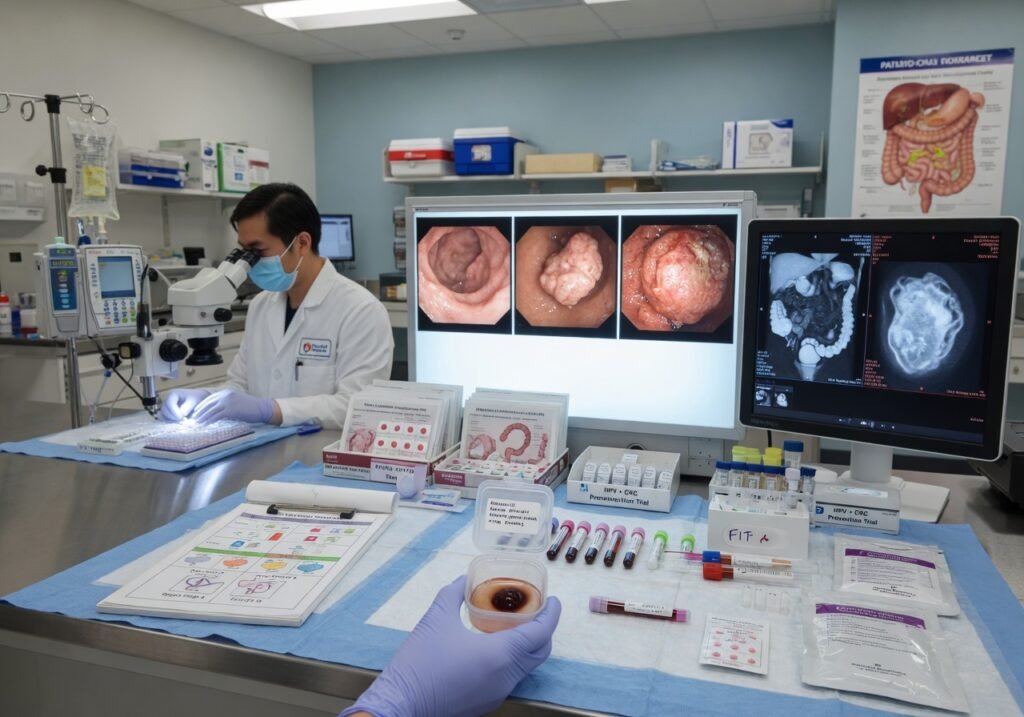
Screening colonoscopy remains the gold standard. You arrive fasting after a bowel prep (typically polyethylene glycol solution or sodium phosphate), receive conscious sedation (usually midazolam and fentanyl), and a gastroenterologist advances a flexible scope through your entire colon, examining the mucosa. The whole procedure takes 20-30 minutes. Biopsies of any suspicious lesions are painless because the mucosa lacks pain receptors. If polyps are found, many can be removed immediately via snare polypectomy—a wire loop that cauterizes the base while removing the lesion.
Flexible sigmoidoscopy examines only the lower third—less uncomfortable, requires less prep, but misses proximal lesions. It’s reasonable for screening if done every 5 years alongside fecal occult blood testing, but colonoscopy is superior. Fecal immunochemical testing (FIT) detects hemoglobin in stool and works well for screening average-risk individuals—sensitivity around 75-85% for advanced adenomas—but requires annual testing and can’t remove polyps found.
CT colonography (virtual colonoscopy) offers an option for those refusing optical colonoscopy, with sensitivity comparable to colonoscopy for lesions larger than 1 centimeter. However, if polyps are found, you need colonoscopy anyway for removal.
Once cancer is diagnosed via biopsy, staging involves CT of the chest, abdomen, and pelvis (sometimes including MRI pelvis for rectal tumors), carcinoembryonic antigen (CEA) blood level, and occasionally PET imaging. Staging determines treatment and prognosis.
Treatment Options: Current Evidence
Stage 0 (carcinoma in situ) and stage I cancers discovered during colonoscopy often can be removed entirely during the procedure if the polyp is small and well-differentiated. These patients typically need only surveillance colonoscopy every 3-5 years. No chemotherapy required.
Stage II and III cancers require surgery—either partial colectomy or anterior/abdominal-perineal resection depending on location. Surgeons remove the tumor with adequate margins and regional lymph nodes. Stage III patients (positive lymph nodes) benefit from adjuvant chemotherapy, typically 5-fluorouracil (5-FU) with leucovorin and oxaliplatin—the FOLFOX regimen—given intravenously in 2-week cycles for six months. This combination reduces recurrence risk by roughly 30-35%.
Stage IV (metastatic) disease presents a more complex landscape. If metastases are isolated to the liver or lung, surgical resection combined with chemotherapy offers potential cure in select cases. For unresectable metastatic disease, first-line chemotherapy includes FOLFOX or FOLFIRI (irinotecan instead of oxaliplatin). Bevacizumab (Avastin), a monoclonal antibody targeting vascular endothelial growth factor, adds survival benefit. Cetuximab or panitumumab, antibodies targeting epidermal growth factor receptor, help in KRAS wild-type tumors. Testing for microsatellite instability (MSI) and mismatch repair deficiency guides use of checkpoint inhibitors like pembrolizumab in certain metastatic cases.
Rectal cancer often requires neoadjuvant (pre-operative) chemoradiation with fluorouracil-based therapy followed by surgery, especially for stage II-III tumors. This approach reduces local recurrence and improves survival.
Daily Management and Living With a Colorectal Cancer Diagnosis
If you’ve been diagnosed, your oncology team becomes essential. Attend every appointment. Keep a symptom diary—note changes in bowel habits, appetite, pain location or character, energy level. This information guides adjustments to treatment.
During chemotherapy, manage side effects proactively. Oxaliplatin causes cumulative peripheral neuropathy (tingling and numbness in hands and feet)—let your oncologist know early if this develops, as dose modifications may help. Irinotecan causes diarrhea in roughly 40% of patients; prophylactic loperamide started the day of infusion helps. Nausea responds to 5-HT3 antagonists like ondansetron. Anemia from chemotherapy or disease may require intravenous iron or erythropoiesis-stimulating agents.
Dietary changes matter. A high-fiber diet supports colon health but can cause bloating during active treatment—adjust gradually. Stay hydrated. Gentle walking or swimming maintains function better than no exercise, even during therapy.
Psychologically, a cancer diagnosis upends your sense of future. Consider joining a support group—either in-person or online through organizations like the Colorectal Cancer Alliance. Cognitive behavioral therapy or counseling helps many patients process the diagnosis and treatment burden.
Prevention: What the Evidence Actually Shows
Screening prevents colorectal cancer by identifying and removing precancerous polyps. That’s not debatable—the evidence is overwhelming. Guidelines from the U.S. Preventive Services Task Force recommend screening for average-risk adults starting at age 45 through 75 via colonoscopy every 10 years, FIT annually, or other approved methods.
Beyond screening, lifestyle modifications reduce risk. Limit processed meat to once weekly or less. Eat vegetables, fruits, and whole grains—aim for 30+ grams of fiber daily. The JAMA published prospective data showing people consuming the highest fiber intake had roughly 15% lower colorectal cancer risk than those consuming the least. Exercise regularly (150 minutes of moderate activity weekly). Maintain a healthy weight. Limit alcohol to one drink daily for women, two for men. Don’t smoke.
Aspirin for primary prevention remains controversial—the U.S. Preventive Services Task Force suggests consideration only in people aged 60 and older with multiple risk factors, as cardiovascular and bleeding risks must be weighed. Hormone replacement therapy in postmenopausal women correlates with reduced colorectal cancer risk but carries its own risks, so it’s not recommended solely for cancer prevention.
Frequently Asked Questions
Sources & Medical References
HealthTopics.com articles are based on peer-reviewed medical research and guidance from the NIH, CDC, and WHO. See our editorial policy for full sourcing standards.