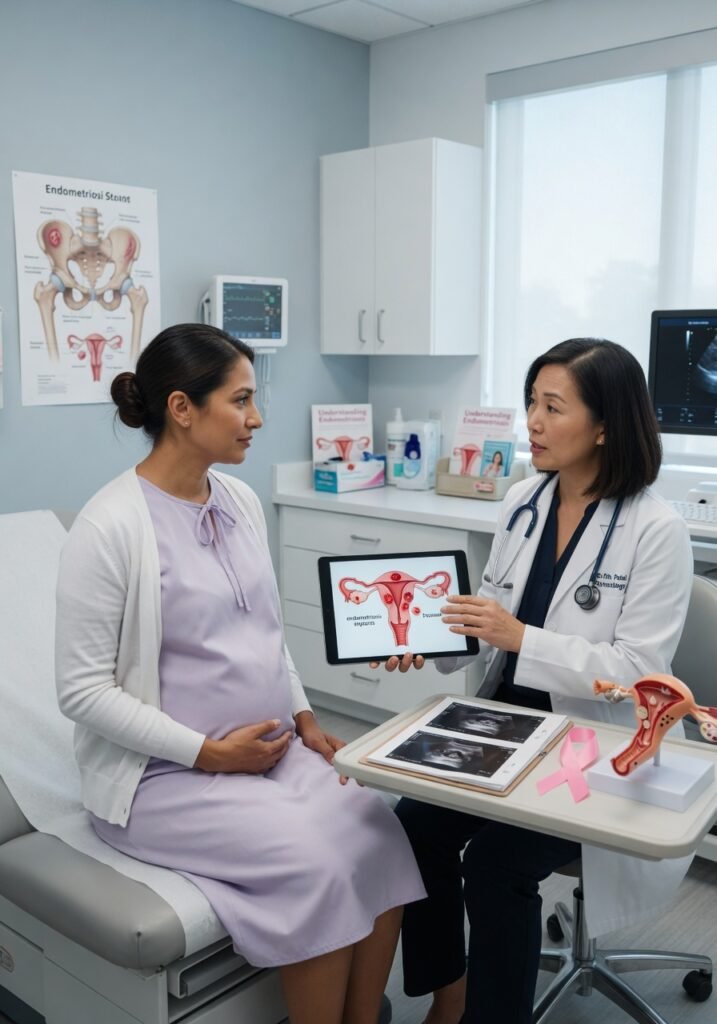

Endometriosis Isn’t Just “Bad Period Cramps”—And That Misconception Is Costing Women Years of Diagnosis
Sarah, a 28-year-old marketing manager, spent four years being told her severe pelvic pain was normal menstrual cramping. Her gynecologist suggested ibuprofen and heat pads. Her primary care doctor wondered if anxiety was amplifying her symptoms. Her mother assured her that all women experience this. Then, during laparoscopic surgery for an unrelated issue, the surgeon found endometrial tissue growing on her bowel, bladder, and ovaries. Suddenly, everything made sense—but she’d lost years to dismissal.
Here’s what’s actually true: endometriosis is a chronic inflammatory disease where tissue similar to the uterine lining grows outside the uterus where it doesn’t belong. It’s not your period hurting more than it should. It’s not psychosomatic. It’s not something you’ll outgrow or manage with better stress relief. According to the NIH, endometriosis affects approximately 10% of reproductive-age women in the United States, yet the average time from symptom onset to diagnosis is 7-12 years. That delay matters because untreated endometriosis can damage your fertility, spread deeper into your organs, and significantly reduce your quality of life.
Key Facts About Endometriosis
- Approximately 176 million women worldwide have endometriosis, with prevalence in reproductive-age women ranging from 6-10% in the general population and up to 50% in infertile women (NIH data)
- The condition involves five stages: minimal, mild, moderate, severe, and extensive, determined by the location, depth, and extent of lesions found during laparoscopy
- About 30-40% of women with endometriosis experience infertility, making it one of the three leading causes of female subfertility along with ovulatory disorders and tubal disease
- Pain severity doesn’t correlate with disease extent—some women with stage 4 endometriosis have minimal symptoms while others with stage 1 disease experience debilitating pain
- The disease typically begins in the teenage years or early twenties but is rarely diagnosed until the late twenties or thirties due to normalization of severe menstrual symptoms
Understanding Endometriosis: What’s Actually Happening Inside Your Body
Think of your uterus as a organ with a specialized lining designed to thicken, break down, and shed once monthly. In endometriosis, cells that look and behave like that uterine lining—called endometrial cells—grow in places they shouldn’t: on your ovaries, fallopian tubes, the peritoneum (the membrane lining your pelvic cavity), and occasionally even in your lungs, diaphragm, or brain.
These misplaced cells respond to your hormonal cycle just like normal endometrial tissue does. Each month, they swell, break down, and bleed. But unlike menstrual blood that leaves your body, this bleeding gets trapped inside your pelvis. Your body tries to clean it up, triggering an inflammatory response. Over time, this repeated inflammation creates scar tissue and lesions that can fuse organs together—a process called adhesion formation.
Here’s the clinical insight most articles gloss over: endometriosis isn’t just about the physical lesions. The disease creates a state of chronic, localized inflammation. The lesion tissue itself produces excessive amounts of prostaglandins (hormone-like substances that cause contractions and pain), cytokines (inflammatory messengers), and nerve growth factors. Your nervous system essentially gets rewired to interpret normal sensations as severe pain—a phenomenon called central sensitization. This is why pain management sometimes requires approaches beyond simply removing lesions.
Causes and Risk Factors: Why Some Women Develop Endometriosis
The exact cause of endometriosis remains incompletely understood, but several mechanisms likely contribute simultaneously.
Retrograde menstruation is the leading theory: some menstrual blood flows backward through your fallopian tubes into your pelvic cavity instead of leaving your body. Most women experience this occasionally without developing endometriosis, suggesting that how your immune system and hormones respond to this refluxed tissue matters more than the reflux itself.
Genetic predisposition plays a measurable role. If your mother or sister has endometriosis, your risk increases five to seven-fold compared to women without a family history. Specific genetic variations in genes controlling estrogen metabolism and immune function influence susceptibility.
Estrogen dependency is fundamental to understanding endometriosis. The lesions themselves produce estrogen locally through increased aromatase enzyme activity. This creates a vicious cycle: more estrogen drives more lesion growth, which produces more estrogen. This is why hormonal treatments that suppress estrogen are effective.
Immunological dysfunction occurs in women with endometriosis. They have elevated levels of certain immune cells in the peritoneal fluid, reduced natural killer cell activity, and altered inflammatory markers. Essentially, the immune system fails to recognize and eliminate these misplaced endometrial cells.
One underappreciated risk factor: early menarche combined with prolonged menstrual exposure. Starting your period before age 12, having cycles shorter than 27 days, or menstruating for longer than 7 days increases your risk. Women who have children and breastfeed (which suppresses menstruation) have lower endometriosis risk. This suggests that cumulative menstrual burden matters biologically.
Signs and Symptoms: What You Actually Experience
Endometriosis pain is qualitatively different from standard menstrual cramping. Patients describe it as sharp, stabbing, or burning rather than the dull achiness of typical cramps. It often doesn’t respond adequately to ibuprofen or naproxen—a red flag that should trigger investigation.
Primary symptoms include:
- Severe dysmenorrhea (painful periods) that worsens progressively over several days, sometimes incapacitating you to the point of missing work or school
- Chronic pelvic pain that exists outside your menstrual cycle—this can be constant, worsening with activity or bowel/bladder function
- Deep pain during or after intercourse (dyspareunia), particularly with deeper penetration, caused by lesions on ligaments supporting your uterus
- Bowel and bladder symptoms including painful defecation, constipation alternating with diarrhea, painful urination, or bladder urgency, especially during your period
- Heavy or prolonged bleeding, sometimes with clots larger than a quarter
- Fatigue and brain fog driven by chronic pain, inflammation, and sometimes anemia from heavy bleeding
Early warning signs often dismissed include: cramping that begins a week before your period (rather than at the onset), pain that gradually worsens year to year, or needing prescription-strength NSAIDs rather than over-the-counter doses to manage menstrual pain.
Diagnosis: Getting Answers Instead of Dismissal
Here’s an uncomfortable truth: the gold standard for endometriosis diagnosis is laparoscopy, a minimally invasive surgical procedure where a surgeon inserts a thin camera through a small incision near your navel to visualize your pelvic organs directly. But you shouldn’t need surgery just to get taken seriously.
The diagnostic process typically begins with your history and physical exam. Your doctor should ask specifically about pain timing, severity, what activities worsen it, and how it affects your daily functioning. They should perform a pelvic examination looking for tenderness, nodules, or restricted organ mobility.
Transvaginal ultrasound is the first imaging step. A small probe is inserted into your vagina to get detailed images of your ovaries and uterus. This can detect ovarian endometriomas (chocolate cysts filled with old blood) and adenomyosis, though it misses peritoneal lesions entirely. Sensitivity for endometriomas is about 85-90%, but sensitivity for all endometriosis is much lower.
MRI with contrast has better sensitivity for deep infiltrating endometriosis (lesions invading muscle layers), detecting 71-90% of cases depending on the type. However, it cannot reliably detect superficial peritoneal lesions and requires time and expense.
Many doctors now offer diagnostic laparoscopy earlier rather than requiring exhausted patients to undergo years of failed medical management first. During this procedure, your surgeon can visualize lesions, obtain biopsies for confirmation, and often treat lesions simultaneously.
A clinical reality most websites omit: your doctor’s bias matters. Studies show gynecologists with endometriosis experience higher diagnostic accuracy and lower thresholds for pursuing diagnosis than those without it. If you’re being dismissed, seeking a second opinion from someone with expertise in reproductive pain is reasonable.
Treatment Options: What Actually Works and for Whom
Endometriosis treatment isn’t one-size-fits-all. The best approach depends on your pain severity, fertility desires, and response to previous treatments.
Hormonal contraceptives remain first-line therapy for many women. Oral contraceptives, the contraceptive patch, or the vaginal ring suppresses ovulation and reduces menstrual flow, thereby decreasing stimulation of endometrial lesions. Continuous or extended-cycle dosing (skipping placebo weeks) can further reduce breakthrough bleeding and pain. Some women experience significant improvement; others find minimal benefit.
Progestin-only options offer alternatives for those who can’t tolerate estrogen. The levonorgestrel intrauterine device (Mirena) releases progestin directly into your uterus, suppressing endometrial growth both systemically and locally. Studies show 50-60% of women achieve significant pain reduction within 6-12 months. The medroxyprogesterone acetate injection (Depo-Provera) given every 12 weeks is another option.
GnRH agonists like leuprolide (Lupron) and goserelin (Zoladex) shut down your pituitary gland, creating a temporary menopause-like state. This aggressively suppresses estrogen and halts endometrial growth. These are powerful drugs used for moderate to severe disease, particularly before planned surgery. The downside: significant menopausal side effects (hot flashes, vaginal dryness, bone density loss) and expense. Treatment typically lasts 3-6 months.
Elagolix (Orilissa) is an oral GnRH antagonist approved specifically for endometriosis pain. Unlike agonists, it blocks GnRH receptors directly. Some women tolerate it better than injectable agonists, though it’s expensive and requires daily dosing.
Surgical excision is reserved for women with deep infiltrating endometriosis or those failing medical management. A skilled endometriosis surgeon removes lesions, typically achieving pain improvement in 60-75% of patients. However, lesions recur in 20-40% of women within 5 years without continued hormonal suppression.
The fertility consideration: If you want to conceive, hormonal suppression delays pregnancy achievement. Many fertility specialists recommend proceeding directly to surgery if you have confirmed endometriosis and infertility, then pursuing assisted reproductive technology if needed.
Practical Daily Management: Strategies That Actually Help
Timing your NSAIDs strategically: Start ibuprofen or naproxen 2-3 days before your expected period begins, not when pain starts. Higher doses (napr
