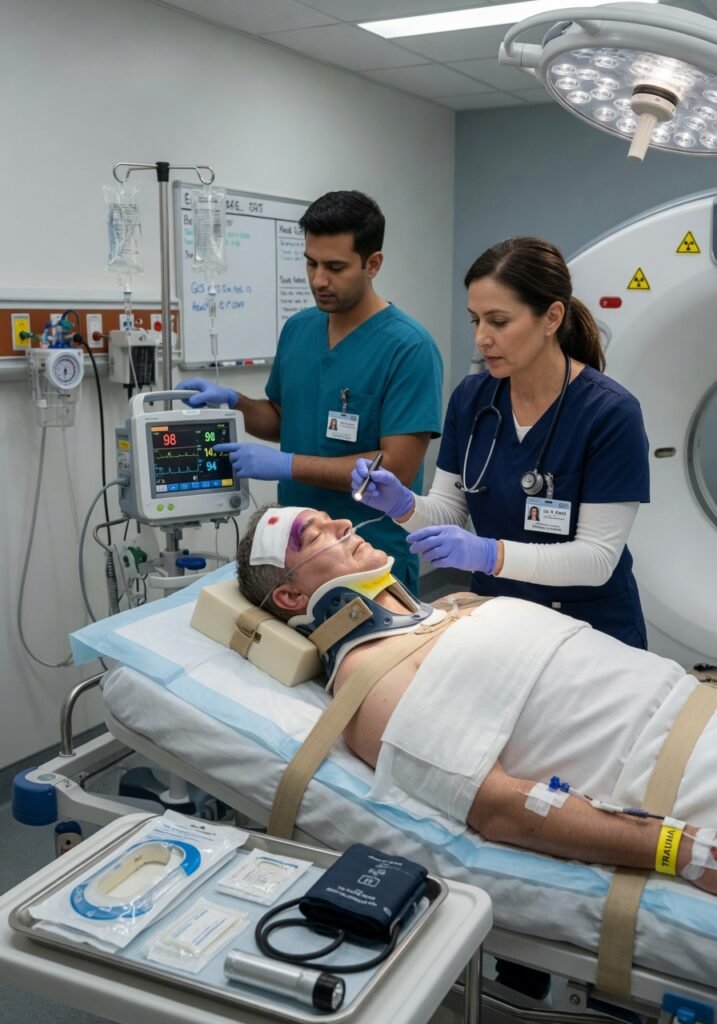

Most people think a head injury only matters if you lose consciousness. That’s dangerously wrong. I’ve seen patients come to the emergency department feeling perfectly alert after hitting their head, then deteriorate within hours because of a subdural hematoma—bleeding between the brain and its protective membrane. The scary part? They felt fine at first. This is exactly why the first 24 hours after any significant head injury require serious attention, and why knowing the actual red flags beats guessing whether you “need to go in.”
Key Facts About Head Injury Emergencies
- According to the CDC, traumatic brain injuries result in approximately 69,000 deaths annually in the United States, with an estimated 2.87 million TBI-related emergency department visits yearly
- Epidural hematomas (blood clots between the skull and brain lining) can expand rapidly, and a 4mm collection can become life-threatening within 12-24 hours even if initial CT scans appear normal
- The NIH reports that roughly 75% of traumatic brain injuries are concussions or mild TBIs, yet mild cases still require emergency evaluation if specific warning signs are present
- Second impact syndrome—sustaining another head injury before symptoms from the first one resolve—can cause catastrophic brain swelling, particularly in athletes under 25 years old
- Patients on anticoagulants like warfarin or apixaban have a 5-10 times higher risk of intracranial bleeding after head trauma, even from falls that would be considered minor in others
Understanding What Actually Happens Inside Your Head After Injury
Think of your brain as a soft organ floating inside a rigid skull, suspended in cerebrospinal fluid like an egg in a protective shell. When you hit your head, that brain doesn’t stop moving just because your skull does. It sloshes forward against the front of your skull, then rebounds backward. Neurons stretch and tear, blood vessels rupture, and chemical cascades begin that can cause swelling for days—even when the initial injury seemed minor.
The real danger isn’t always the impact itself. It’s what happens afterward. Bleeding between brain layers creates pressure. Swelling compresses vital structures. Some bleeds are obvious on imaging within minutes. Others are slow-accumulating—a tiny arterial bleed that looks insignificant at first but gradually expands, compressing brain tissue hour by hour. This is why emergency physicians are far more cautious about head injuries than patients expect them to be.
Causes and Risk Factors That Actually Matter
Motor vehicle collisions cause the most severe head injuries overall, followed by falls (particularly in older adults) and assaults. But let me tell you about a risk factor most articles don’t emphasize enough: your age and medications matter more than most people realize.
If you’re over 60 and fall, even from standing height, your risk of needing urgent intervention climbs dramatically. Your brain tissue atrophies slightly with age, creating more space inside the skull, and blood vessels become more fragile. A fall that a 25-year-old shakes off can cause delayed subdural hematoma in a 70-year-old that doesn’t show symptoms for weeks.
Here’s the overlooked factor: anticoagulant use. If you’re taking warfarin for atrial fibrillation, apixaban for stroke prevention, or even dual antiplatelet therapy with aspirin and clopidogrel, your head injury risk profile changes entirely. You need imaging even after minor head trauma that wouldn’t normally warrant a CT scan. I’ve admitted patients to the ICU after falls from standing who, without anticoagulation, would have gone home fine.
Chronic alcohol use is another one. Not just because it impairs judgment and increases fall risk, but because it causes coagulopathy—your blood doesn’t clot normally—and cerebral atrophy that stretches bridging veins and makes them vulnerable to tearing.
Red Flag Symptoms: What You Actually Feel
Immediate loss of consciousness is obvious. But here’s what people miss: you don’t need to black out for a serious injury. The real warning signs are subtler and often develop gradually.
Watch for severe or worsening headache. Not “my head hurts”—I mean the kind of headache that’s different from anything you’ve experienced, that keeps getting worse instead of improving, that comes with neck stiffness or photophobia (light hurting your eyes). That combination suggests possible bleeding or increased intracranial pressure.
Repeated vomiting is a red flag. One episode of nausea happens. Vomiting once might be from the adrenaline. But if you vomit multiple times hours after the injury, that signals increased intracranial pressure.
Early warning signs people often dismiss: confusion or difficulty concentrating immediately after impact, even without obvious loss of consciousness. Slurred speech. Dizziness that’s disproportionate to the injury. Unusual irritability or personality changes. One pupil appearing larger than the other (anisocoria) is especially concerning—that’s herniation territory.
Here’s the one most articles miss: temporal scalp tenderness with ipsilateral eye pain or vision changes. That specific combination can indicate epidural hematoma expanding along the middle meningeal artery. Don’t wait on that one.
How Emergency Diagnosis Actually Works
When you arrive at the ED with a head injury, the physician is running through the Canadian Head CT Rule or New Orleans Criteria—validated decision tools that determine whether you need imaging. These ask about loss of consciousness, amnesia, age over 60, headache severity, vomiting, and neurological symptoms. If you meet certain criteria, you get a CT scan (non-contrast, typically). If you don’t, you usually go home with instructions.
The CT might appear normal and still miss something. A normal CT within hours of injury doesn’t exclude delayed epidural or subdural hematoma. Some bleeds are too small to see initially but expand over 12-24 hours. This is why observation matters more than the CT itself sometimes.
If your CT shows anything abnormal, you’ll likely get more advanced imaging—MRI brain for better detail of small bleeds or diffuse axonal injury, or repeat CT within 24 hours. Neurosurgery gets consulted for anything requiring potential intervention.
From your perspective: expect a focused neurological exam (your doctor checking pupil size, eye movements, strength, coordination, mental clarity), possibly blood work to check clotting function if you’re on anticoagulants, and imaging if warranted. The whole process usually takes 2-4 hours.
Treatment Options: What Actually Helps
Here’s what surprises patients: there’s no medication that reverses brain injury. The old myth about high-dose steroids helping traumatic brain injury? Killed by the CRASH trial published in NEJM years ago. Steroids don’t help and can harm.
What actually works depends on severity. For mild concussions with normal imaging, you go home with observation instructions and activity modification. For moderate to severe injuries or those with imaging abnormalities, you’re admitted for monitoring. Nursing staff watch your neurological status every 1-2 hours. Any deterioration triggers repeat imaging and possible neurosurgical consultation.
If you have significant intracranial bleeding or brain swelling, you might need mannitol or hypertonic saline to reduce swelling—these osmotic agents draw fluid away from brain tissue. In severe cases, sedation with medications like propofol might be used to reduce brain metabolic demand. Elevation of the head of your bed to 30 degrees helps with cerebral venous drainage.
For epidural hematomas larger than 30mm or with significant mass effect, neurosurgical evacuation is standard. Subdural hematomas may be evacuated depending on size and symptoms. Diffuse axonal injury—the shearing of nerve fibers—has no surgical fix; it’s managed with supportive care and rehabilitation.
Post-discharge, concussion therapy has actually become more sophisticated. Targeted vestibular rehabilitation helps with dizziness. Cognitive rehabilitation addresses “brain fog.” Physical therapy addresses balance issues. These aren’t generic; they’re specific to your deficits.
Practical Daily Management After Head Injury
If you’re discharged home after a head injury evaluation, you need concrete strategies, not vague “rest” instructions.
For the first 72 hours: keep activity to baseline—meaning no physical exertion beyond walking slowly. No heavy lifting, no intense exercise, no contact sports. This isn’t overcautious. Physical exertion raises intracranial pressure and can worsen swelling.
Sleep positioning matters. Keep your head elevated on 2-3 pillows. This reduces intracranial pressure by improving venous drainage. If you have nausea, small frequent meals work better than large ones.
For headache, acetaminophen is preferred over NSAIDs initially—ibuprofen theoretically increases bleeding risk in the acute phase, though this is debated. Avoid tramadol or opioids if possible; they can mask neurological deterioration.
If you’re on anticoagulation, talk to your anticoagulation clinic within 24-48 hours. Many physicians adjust dosing temporarily after head trauma, or switch from warfarin to bridge therapy with enoxaparin.
For return to activities, use the gradual return-to-play protocol: symptom-limited exertion first, then gradual increases only if you remain symptom-free. Rushing back causes prolonged post-concussion syndrome in roughly 10-15% of patients.
Prevention: What Actually Reduces Risk
Car accidents: seat belts reduce head injury mortality by roughly 45% and serious injury by over 50%, according to NHTSA data. Airbags add additional protection. Avoiding distraction and impaired driving prevents most collisions in the first place.
Falls in older adults: home modification works. Remove throw rugs, install grab bars in bathrooms, ensure adequate lighting on stairs. Vision correction—making sure your glasses prescription is current—reduces fall risk substantially. Vitamin D supplementation, strength training, and balance exercises lower fall risk by 15-20% in elderly populations.
Sports injuries: proper tackling technique in football, heading technique in soccer, and graduated return-to-play protocols after concussion reduce recurrent injury. Helmets prevent skull fractures but don’t prevent concussions—that’s a common misconception. A properly fitted helmet (CPSC-certified for bicycles, DOT-approved for motorcycles) is still mandatory though.
For patients on anticoagulants: fall prevention becomes even more critical. Physical therapy to improve balance, vision screening, medication review for drugs causing dizziness or orthostasis—these are your best bets.
Frequently Asked Questions About Head Injury Emergencies
Sources & Medical References
HealthTopics.com articles are based on peer-reviewed medical research and guidance from the NIH, CDC, and WHO. See our editorial policy for full sourcing standards.