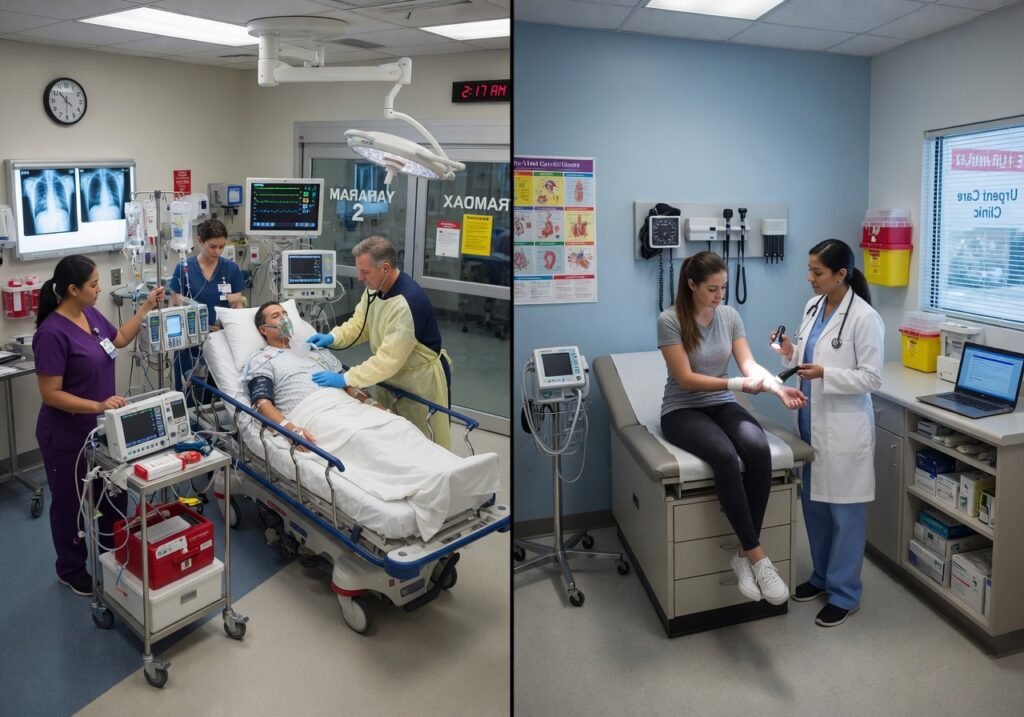
Sarah, a 34-year-old accountant, woke up with a bad headache and went straight to the emergency department at 2 AM, convinced she was having a stroke. After a CT scan and bloodwork, the neurologist told her it was a tension headache—a $3,400 bill for a problem that urgent care would have handled in 20 minutes for $150. Most people believe the emergency room is the default place to go when something feels wrong. In reality, emergency departments are designed to treat life-threatening conditions with minutes to hours of survival importance. The actual truth doctors know? About 40% of emergency room visits could have been handled at urgent care facilities or primary care offices, meaning most people are choosing the wrong setting and paying for it.
What You Actually Need to Know About Emergency Departments vs Urgent Care
Key Facts
- The CDC reports 139.9 million emergency department visits occurred in 2019 in the United States, with approximately 40% of those visits for non-emergent conditions that could be triaged elsewhere
- Average emergency room wait time before seeing a physician is 40 minutes; average treatment time is 2 hours and 38 minutes for admitted patients
- An emergency department visit costs between $1,200 and $13,000 depending on location and acuity, while urgent care averages $150-$300 for the same condition
- Patients with truly life-threatening conditions (chest pain, difficulty breathing, altered consciousness, severe trauma) need imaging and specialist consultation available within 5-10 minutes—something only emergency departments provide
- According to JAMA, hospital-based emergency departments handle approximately 50 million injury-related visits annually, yet 30% involve minor wounds or strains that don’t require emergency-level resources
The System Architecture: Why These Settings Exist at All
Here’s what most patients don’t understand about the medical system: emergency departments and urgent care facilities serve completely different purposes with different infrastructure. Think of it like roads—the emergency department is the hospital’s intensive care expressway with immediate access to operating rooms, CT scanners, blood banks, and specialists on-site. Urgent care is the local clinic corridor, well-maintained and fine for routine issues, but lacking the heavy machinery.
Your body doesn’t actually “know” whether you’re at an emergency department or urgent care. The difference is about what resources surround you. When your heart suddenly arrests in the emergency department, there’s a defibrillator 15 feet away and a cardiologist who can be in the room within 3 minutes. When you have a straightforward bladder infection, those resources are completely unnecessary—and they cost money.
Emergency departments operate under the EMTALA law (Emergency Medical Treatment and Labor Act), which legally requires them to stabilize any patient who arrives, regardless of ability to pay. This creates a perfect storm: they must treat non-emergent cases the same as emergent ones, they can’t turn anyone away, and they bear the financial burden of uncompensated care. That’s partly why you’re paying so much. You’re partially funding the system’s legal obligations.
Understanding When You Actually Need an Emergency Department
Let’s get specific about what “emergency” actually means medically. An emergency is any condition where minutes matter for your survival or permanent disability. The classic categories are:
Conditions requiring immediate emergency care: Chest pain suggesting heart attack, severe difficulty breathing, sudden severe headache with stiff neck (meningitis), loss of consciousness, severe allergic reactions with throat swelling, active severe bleeding you can’t stop, sudden loss of vision or speech (stroke symptoms), or severe trauma from accidents. These conditions kill people in hours without intervention.
The overlooked factor most articles skip: your own physical baseline matters enormously. A blood pressure of 180/110 is emergent for a 30-year-old with no history of hypertension. That same reading in a 72-year-old with chronic hypertension who’s feeling fine? Probably not emergent. Your own medical history and how you’re actually functioning determine urgency—not symptoms alone.
Causes and Risk Factors: Why People Choose Wrong
Why do 40% of emergency room patients end up there unnecessarily? It’s not stupidity—there are legitimate reasons people make this choice:
- Timing anxiety: Urgent care closes at 9 PM. When you get sick at 10:47 PM on a Tuesday, the emergency department is the only option. This alone accounts for significant overcrowding during evening hours.
- Severity uncertainty: You genuinely can’t tell if your abdominal pain is appendicitis or gas. The safe choice feels like the emergency department, but it’s often wrong.
- Insurance confusion: Many people think their insurance won’t cover urgent care without a referral (usually untrue for commercial plans). They go to the emergency department to be “safe.”
- Prior experience bias: If you went to an emergency department once and received excellent care, you return there for similar problems without reconsidering.
- The less-discussed factor: Many patients have learned (correctly) that emergency departments rarely discharge you without tests. If you want reassurance through imaging or bloodwork, the emergency department guarantees it. Urgent care might send you home with “wait and see,” and people find that emotionally unsatisfying even if it’s medically appropriate.
What Actually Happens: The Clinical Process
When you arrive at an emergency department, here’s the actual sequence: triage nurse assesses you in 5-10 minutes using an acuity scale (most use the ESI scale—Emergency Severity Index). You’re assigned a level 1-5, where level 1 is immediately life-threatening and level 5 is minor. Sarah from our opening was probably triaged as level 4.
Then you wait. Not because the system is broken, but because level 2 and 3 patients (serious but not immediately dying) are in rooms being treated. A level 5 patient with a cough might wait 90 minutes while a level 2 patient with chest pain gets immediate ECG and troponin blood tests.
The diagnosis phase varies wildly depending on your condition. Chest pain triggers immediate ECG, IV placement, and troponin testing (a heart enzyme measured via blood). Abdominal pain might involve CT imaging with contrast, bloodwork, and urinalysis. Headache could mean CT head, spinal fluid analysis, or simply clinical examination.
Here’s what most patients miss: emergency physicians order tests to rule out dangerous conditions, not to precisely diagnose your problem. The goal is “is this immediately life-threatening?” If no, you might be referred to follow-up with your regular doctor for diagnosis. This defensive approach explains the testing volume.
Treatment Approaches: What Actually Works
Treatment in an emergency setting is stabilization-focused, not cure-focused. You’re given:
Immediate medications: Aspirin for chest pain (unless contraindicated), oxygen if your breathing is compromised, IV fluids if dehydrated, nitroglycerin for chest pain or shortness of breath, epinephrine for severe allergic reactions, lorazepam or phenobarbital for active seizures, and antibiotics for infections showing signs of sepsis.
The medication choices depend on what’s happening. For acute coronary syndrome (heart attack), you’ll receive dual antiplatelet therapy—aspirin plus either clopidogrel (Plavix) or prasugrel (Effient)—plus an anticoagulant like enoxaparin (Lovenox) or unfractionated heparin. You’ll likely need an angiogram for definitive treatment.
For stroke, timing is critical. If you arrive within 4.5 hours of symptom onset, IV alteplase (tPA—tissue plasminogen activator) can dissolve the clot. After that window, mechanical thrombectomy might be an option if large vessel occlusion is confirmed on imaging. Neither option works if you arrive too late.
The misconception to correct: antibiotics fix infections immediately. Actually, antibiotics kill bacteria, but your immune system does the removing. You might feel worse for 24-48 hours as toxins are released. Antibiotics are given in the emergency department for signs of sepsis (overwhelming infection), not for every bacterial infection.
Most admitted emergency patients need hospital-level monitoring—continuous heart rate monitoring, frequent vital signs checks, repeat bloodwork, or specialist consultation. That’s what justifies admission beyond initial treatment.
Daily Management: When You Actually Get Home
After emergency stabilization, your actual recovery happens at home with specific actions:
Medication adherence becomes critical. If you received nitroglycerin for chest pain, you likely left with a prescription for a long-acting form (extended-release isosorbide mononitrate) plus short-acting sublingual nitroglycerin for breakthrough symptoms. Taking the long-acting form every day matters. Missing doses raises heart attack risk again.
Follow-up timing is non-negotiable. The emergency department discharge paperwork will say “see your cardiologist in 1 week” or “follow up with your primary care doctor in 3 days.” These aren’t suggestions. Your condition is stabilized temporarily. Definitive treatment and monitoring happen in follow-up.
Red flag recognition prevents re-admission. If you were treated for chest pain, you need to know: returning chest pain, shortness of breath during normal activity, or severe fatigue means return immediately. The emergency department can’t predict which patients will deteriorate at home, so knowing your own warning signs is your safety net.
Activity modification prevents complications. Post-emergency cardiac events often require activity restriction (no heavy lifting, no running) for specific periods. This isn’t being overcautious—it’s preventing re-rupture or re-thrombosis while healing occurs.
Prevention: What Actually Reduces Emergency Visits
The evidence on prevention is surprisingly simple but requires consistency:
Primary prevention—preventing disease altogether—works best. Regular blood pressure monitoring and antihypertensive medication (ACE inhibitors like lisinopril, beta-blockers like metoprolol, or calcium channel blockers like amlodipine) reduce stroke risk by 35-40%. That’s not a guess; that’s what the data shows.
Secondary prevention—catching disease early—matters tremendously. Annual ECG and stress testing for people over 50 with risk factors identifies coronary disease before heart attacks happen. This is different from preventing disease; it’s preventing emergencies from disease you already have.
Access to primary care reduces emergency visits by 25-30% for chronic disease management. Patients with a regular doctor who manages blood pressure and diabetes are far less likely to show up in emergency with uncontrolled conditions.
The caveat: access matters. If you lack insurance or reliable primary care, prevention becomes impossible. This is why uninsured populations have higher emergency department usage—not because they’re less responsible, but because they lack the preventive infrastructure.
Choosing Emergency vs Urgent Care: Your Decision Framework
Use this framework when you’re deciding:
Choose emergency if: You have chest pain, severe difficulty breathing, suspected stroke symptoms, severe head injury or suspected skull fracture, uncontrolled bleeding, signs of severe infection with fever and confusion, severe allergic reaction with breathing changes, severe abdominal pain with inability to move, or poisoning/overdose.
Choose urgent care if: You have moderate chest pain but no shortness of breath or diaphoresis (sweating), mild to moderate abdominal pain without fever, minor lacerations needing stitches, ankle sprains, cough/cold symptoms lasting several days, ear infections, urinary tract infections, or minor burns.
Choose your primary care doctor if: You have chronic condition flare-up but stable vital signs, medication refills, non-emergency bloodwork, skin problems, or follow-