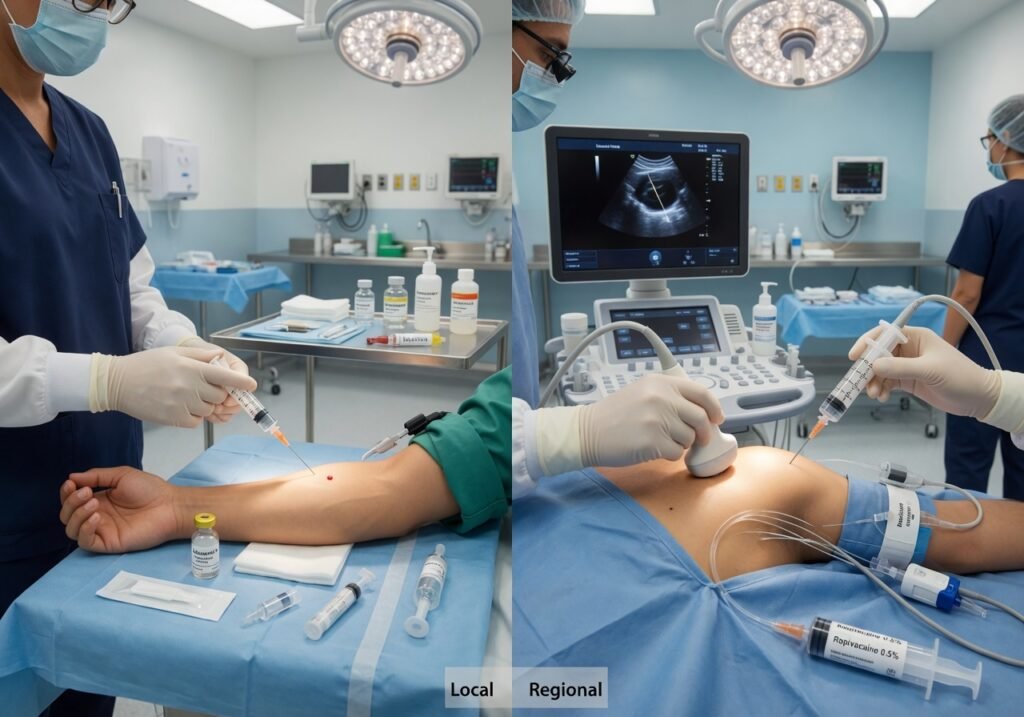
Local vs Regional Anesthesia: What Actually Happens When Your Dentist Numbs Your Tooth
Sarah, a 42-year-old accountant, walked into her oral surgeon’s office dreading a wisdom tooth extraction. She’d heard horror stories about being “awake the whole time,” convinced that local anesthesia meant she’d feel everything. What surprised her most wasn’t the procedure itself—it was realizing that her surgeon had numbed only a precise area around her tooth, leaving her completely aware but genuinely pain-free. Most people think local anesthesia is just a weaker version of “being put under,” but here’s what medical professionals actually know: local anesthesia works differently than general anesthesia entirely. It doesn’t make you unconscious. It doesn’t affect your whole body. Instead, it blocks pain signals in a specific, geographic region by interrupting how nerves communicate with your brain. This distinction matters enormously for safety, recovery time, and what you should realistically expect.
Key Facts About Local Anesthesia
- Local anesthetics reach full effectiveness within 5-10 minutes of injection and typically last 30-90 minutes depending on the drug—lidocaine provides roughly 30-60 minutes of coverage, while bupivacaine extends to 4-6 hours
- According to JAMA Surgery, approximately 85% of minor surgical procedures in outpatient settings use local or regional anesthesia as the primary anesthetic method
- The most commonly used agents are lidocaine (fast-acting), bupivacaine (longer-lasting), and prilocaine, each with different metabolic profiles affecting duration and safety margins
- Systemic toxicity from local anesthetics occurs in fewer than 1 in 1,000 injections when dosed appropriately, but the risk increases substantially with overdose or accidental intravascular injection
- Regional anesthesia—which affects an entire nerve or nerve bundle serving a larger area—requires more skill than local injection and is often performed by anesthesiologists or trained specialists, whereas local injections are routinely given by dentists, dermatologists, and primary care physicians
Understanding How Local Anesthesia Actually Works in Your Body
Think of your nerves as electrical cables transmitting messages. Normally, when a scalpel touches your skin, sensory nerves fire action potentials—rapid electrical impulses—that race to your spinal cord and brain, which interprets those signals as pain. Local anesthetics like lidocaine work by blocking sodium channels in nerve cell membranes. Sodium ions can’t flow, the electrical impulse stutters and stops, and the message never completes the journey to your brain. You feel pressure and vibration (those travel through different, larger nerve fibers), but not pain.
Here’s the subtle part most patients miss: local anesthesia doesn’t eliminate sensation entirely. During a dental procedure, you might hear the drill, feel the vibration, sense water spray, even feel gentle tugging. What you won’t experience is the sharp, burning pain that would otherwise accompany tissue damage. Your brain receives accurate information about what’s happening—you’re just not suffering through it neurologically.
Who Needs Local vs Regional Anesthesia, and Why It Matters
Local anesthesia suits minor procedures affecting small, discrete areas: removing skin lesions, stitching lacerations, extracting single teeth, performing biopsies, or treating varicose veins. You stay awake, cooperative, and recover within minutes. Regional anesthesia becomes necessary when the surgical area is larger or deeper. A nerve block for shoulder surgery, spinal anesthesia for a cesarean section, or epidural anesthesia for labor pain control—these involve anesthetizing entire nerve bundles or spinal segments, affecting a broad anatomic region.
The critical overlooked factor? Patient anxiety influences which anesthetic is actually appropriate. Someone with severe dental phobia might request sedation (a separate intervention) to manage anxiety, even though the local anesthetic itself would prevent pain. Anxiety and pain are neurologically distinct. A patient can be anxious and comfortable simultaneously, or calm and in pain. Your dentist or surgeon needs to know which one you’re primarily worried about.
Specific Medications Used in Local Anesthesia Practice
Lidocaine remains the gold standard. It’s fast-acting (onset within 3-5 minutes), metabolized rapidly by the liver, and suitable for most minor procedures. A typical dental injection contains 2% lidocaine with epinephrine (adrenaline) added to constrict blood vessels, keeping the drug localized and extending duration.
Bupivacaine is the choice when longer duration matters. It takes 10-15 minutes to work fully but lasts substantially longer, making it preferred for surgical procedures expected to exceed 30 minutes. Some surgeons prefer articaine for dental work because it penetrates bone better than lidocaine.
Prilocaine is useful when epinephrine is contraindicated—patients with certain cardiac conditions or taking specific blood pressure medications sometimes can’t tolerate the adrenaline component. Topical anesthetics like benzocaine cream numb superficial tissue before injection, reducing the sting of the needle itself.
The combination of anesthetic plus epinephrine versus anesthetic alone represents a deliberate clinical choice. Epinephrine increases safety by reducing systemic absorption, but it can cause tachycardia or anxiety in sensitive patients. Your provider should discuss this specifically, not just assume one approach fits everyone.
What You’ll Actually Experience: The Step-by-Step Reality
First comes the sting. That needle breaking skin genuinely hurts for a fraction of a second. Then, as the anesthetic infuses into tissue, you’ll notice the area becoming numb—usually described as a spreading heaviness or tingling sensation. Most people can identify the exact moment anesthesia takes effect. Within seconds to a minute, pain sensation vanishes from the injected region.
During the procedure itself, you might experience odd sensations. Pulling, pressure, vibration, warmth from electrocautery, or coolness from irrigation fluid. These aren’t painful, but they’re real sensations your brain is processing. This is why some patients describe the experience as “I felt everything but it didn’t hurt”—accurate. Some people find this psychologically reassuring (they know the surgeon is working); others find it unsettling.
After the procedure, numbness persists for hours. Biting your cheek or lip accidentally is a genuine risk because you can’t feel the injury happening. Eating solid food before full sensation returns is inadvisable. The tingling sensation as the anesthetic wears off is normal and usually resolves within an hour.
What Influences How Well Local Anesthesia Works for You Personally
Inflammation is the primary factor most articles overlook. Infected or acutely inflamed tissue is acidic, and local anesthetics are less effective in acidic environments—their molecular structure depends on proper pH to penetrate nerve membranes. An infected tooth with an abscess sometimes requires treating the infection first because the anesthetic simply won’t work adequately. Your dentist might need to prescribe antibiotics before attempting the procedure.
Your genetic variation in drug-metabolizing enzymes affects how quickly you metabolize anesthetics. Some people genetically have slower metabolism (pseudocholinesterase variants), meaning anesthesia lasts longer. Liver function matters—anyone with hepatic disease might have anesthetics linger in their system longer than expected.
Age plays a subtle role. Elderly patients sometimes require slightly lower doses because of altered pharmacokinetics, while children and young adults metabolize drugs more rapidly. Pregnancy alters drug distribution and metabolism, requiring dose adjustments.
Prior sensitivity or allergy is worth clarifying beforehand. True allergy to amide local anesthetics (lidocaine, bupivacaine, prilocaine) is extraordinarily rare—less than 1% of reported reactions. Most “allergies” actually represent reactions to the preservative methylparaben in multi-dose vials, not the anesthetic itself. Ester-class anesthetics (procaine, tetracaine) genuinely cause more allergic reactions than amides and are now less commonly used for this reason.
Practical Management When You’re Getting Local Anesthesia
Tell your provider about your anxiety level beforehand. Don’t minimize it or feel embarrassed. “I get nervous with needles” or “I panic when I feel pressure” helps them choose the right approach. Some physicians will apply topical benzocaine cream first, making the needle stick less noticeable. Others will inject slowly, using smaller gauge needles, or distract you during injection.
Eat a light meal beforehand. Hypoglycemia amplifies anxiety and can cause lightheadedness during procedures. Avoid caffeine an hour before if you’re already nervous—it magnifies the jittery response to epinephrine in the anesthetic.
Ask specifically which anesthetic they’re using and how long you should expect numbness. Don’t assume all local anesthesia lasts the same duration. If you need to return to work or drive, knowing whether the numbness will last 45 minutes or 4 hours matters for planning.
If you’re having multiple injections (as often happens with extensive dental work), space requests between them. Going from one injection point to another without pause compounds the psychological stress.
What Current Evidence Shows Actually Prevents Complications
According to NIH clinical data, complications from properly administered local anesthesia are genuinely uncommon. The best prevention involves straightforward practices: confirming you’re not allergic to the specific anesthetic, ensuring your provider knows your complete medication list (some blood pressure and cardiac medications interact with epinephrine), and being upfront about maximum dosing limits based on your body weight.
The evidence strongly supports asking questions rather than staying silent. Patients who communicate concerns have better outcomes and fewer adverse events—not because their providers are doing something different, but because clear communication prevents misunderstandings about expectations and medical history.
Practical Daily Considerations Post-Procedure
For several hours after local anesthesia, treat the numbed area delicately. Don’t chew the inside of your cheek—it happens more easily than you’d think. Avoid hot beverages or soup until full sensation returns; you might burn your mouth without realizing it. If you were numb around your mouth or throat, be cautious with swallowing until normal sensation returns.
Mild swelling, bruising, or tenderness at the injection site is normal and typically resolves within 24-48 hours. If swelling worsens after several hours, becomes red, warm, or develops drainage, contact your healthcare provider—these could indicate infection.
Resume normal activity immediately. You don’t need bed rest or special recovery time after local anesthesia the way you would after general anesthesia. Drive, work, exercise normally. The only limitation is avoiding activities where you might injure the numbed area without noticing.
Frequently Asked Questions About Local Anesthesia
Sources & Medical References
HealthTopics.com articles are based on peer-reviewed medical research and guidance from the NIH, CDC, and WHO. See our editorial policy for full sourcing standards.