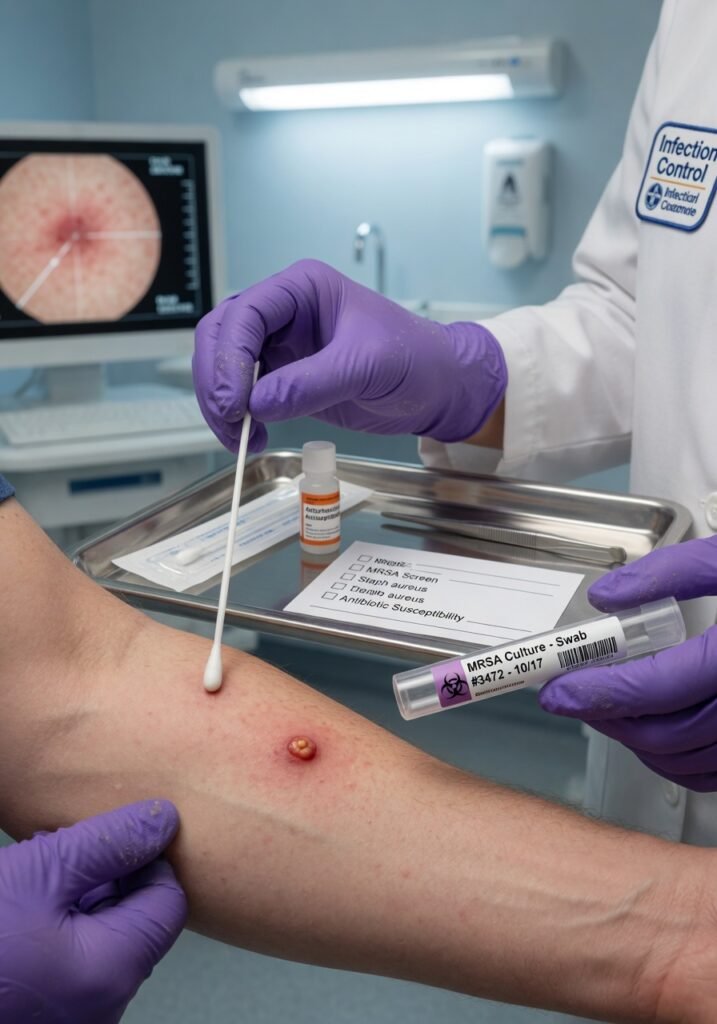

MRSA Infection: What You Need to Know About Antibiotic-Resistant Staph
Sarah, a 34-year-old accountant, noticed a small red bump on her knee after a fall at the gym. Within three days, it had swollen to the size of a golf ball, turned purple, and started draining. Her urgent care doctor took one look and said, “This could be MRSA.” Research shows that approximately 2% of the U.S. population carries MRSA in their nose or on their skin without ever knowing it, yet healthcare-associated MRSA infections have actually declined by nearly 40% since 2005 according to CDC surveillance data—a victory that few people realize has happened. But community-acquired MRSA? That’s a different story. It’s spreading in gyms, locker rooms, and among otherwise healthy people, and it doesn’t respond to standard antibiotics that worked for generations.
Key Facts About MRSA
- MRSA causes approximately 119,000 invasive infections annually in the United States, with roughly 19,000 deaths per year according to NIH data
- The bacterium produces a penicillin-binding protein (PBP2a) that allows it to survive beta-lactam antibiotics like penicillin and methicillin—this is the actual mechanism of resistance
- Community-acquired MRSA (CA-MRSA) is often more virulent than hospital-acquired strains because it produces Panton-Valentine leukocidin (PVL), a toxin that destroys white blood cells
- About 30-40% of healthcare workers carry MRSA without symptoms, making them potential vectors for transmission
- MRSA skin infections respond well to drainage plus antibiotics like doxycycline or trimethoprim-sulfamethoxazole (TMP-SMX), with cure rates exceeding 90% when treated appropriately
Understanding MRSA: How Resistance Actually Develops
Let me explain what’s happening at the cellular level when you get a MRSA infection. Normal staph bacteria have cell walls that are built and maintained by penicillin-binding proteins. When penicillin enters the bacterial cell, it locks onto these proteins and prevents the cell wall from forming properly—the bacteria essentially explodes from internal pressure. MRSA acquired a gene (the mecA gene) that codes for an altered penicillin-binding protein that penicillin cannot recognize or bind to. It’s like the bacteria changed its locks, and now penicillin has the wrong key.
Here’s the critical part: this resistance didn’t develop because you took antibiotics incorrectly. It developed through evolutionary pressure in hospitals during the 1960s, when methicillin was introduced as a “solution” to penicillin-resistant staph. Within a few years, MRSA emerged. Today, these resistant strains have spread into the community, and they’re passed person-to-person through skin contact, contaminated surfaces, or occasionally through respiratory droplets.
Causes and Risk Factors: Who Actually Gets MRSA?
The obvious risk factors are familiar to most people: recent hospitalization, antibiotic use, chronic medical conditions, or healthcare employment. But here’s what most articles gloss over: relative immunosuppression is enormous. I mean actual immune dysfunction, not just “being run down.” Patients with HIV/AIDS, those on immunosuppressive medications for rheumatologic disease, or people with poorly controlled diabetes have dramatically higher infection rates and worse outcomes.
The less-discussed risk factor? Recurrent skin barrier damage. Eczema, psoriasis, or any chronic dermatitis that compromises the skin’s protective function creates a superhighway for MRSA colonization. I’ve seen more MRSA infections in patients with moderate-to-severe eczema than in healthcare workers. The bacteria need entry, and broken skin is the door.
Community settings matter too: contact sports (especially wrestling and football), shared gym equipment, crowded living quarters like college dormitories, and tattoo/piercing parlors with poor sterilization all carry elevated risk. Ironically, family contact with someone who carries MRSA is less risky than you’d think—about 10-15% of household contacts get colonized within a month.
Signs and Symptoms: What MRSA Actually Feels Like
Most skin MRSA infections start innocuously. You might notice a small pimple or insect-bite-like lesion that doesn’t itch much but looks slightly angrier than normal. This is the critical window—days 1-3. Some people ignore it. Others apply over-the-counter acne treatments, which don’t help. By day 3-4, you’ll usually feel it before you fully see it: there’s warmth, tenderness, or a dull ache around the area. The redness deepens. Swelling increases.
Unlike viral pimples, MRSA skin infections often develop a purulent center—actual pus that’s usually yellow or greenish. There might be surrounding cellulitis (spreading redness beyond the immediate lesion). Some patients develop systemic symptoms: fever, malaise, or swollen lymph nodes in the groin or armpit. But here’s the thing: not all MRSA skin infections cause fever. Some remain localized, which means people delay seeking care because they feel fine otherwise.
An overlooked early warning sign is rapid progression despite home care. If you’ve been treating a “pimple” with warm compresses and over-the-counter antibiotics for 5+ days and it’s getting worse rather than better, that’s your signal to see a doctor. MRSA doesn’t respond to neosporin or triple antibiotic ointment.
Diagnosis: What Your Doctor Will Actually Do
When you come in with a suspicious lesion, your doctor should culture it. This isn’t a guess. We get a sterile swab of the pus (or aspirate fluid with a needle if there’s cellulitis without obvious drainage), and it goes to the microbiology lab. The lab will identify the organism as Staphylococcus aureus and then run susceptibility testing to determine if it’s methicillin-resistant. Results typically come back in 24-48 hours, though some labs now have rapid PCR tests that return results in 4-6 hours.
Here’s what most patients don’t realize: your doctor might not wait for results before starting treatment. If the clinical picture looks like MRSA—a rapidly progressive skin infection, especially in someone with risk factors or from a high-prevalence area—treatment often starts empirically with antibiotics that cover MRSA while the culture is pending. This is appropriate and evidence-based, not “premature.”
Blood cultures are obtained if you have signs of systemic infection: fever, tachycardia, hypotension, or if the infection is spreading rapidly. For deep tissue infections or suspected bacteremia, imaging might include ultrasound to look for abscess formation or CT scan if there’s concern for deeper spread.
Treatment Options: What Actually Works
Let’s talk specifics. For uncomplicated skin and soft tissue MRSA infections—what we call SSTIs—the gold standard treatment is incision and drainage plus antibiotics. The drainage part is crucial. Many patients expect antibiotics alone to resolve an abscess, but that’s not how pus works. The abscess needs to be opened, drained, and cleaned. Your doctor might do this in the office with local anesthesia, or in more serious cases, under general anesthesia in an operating room.
After drainage, antibiotic choices depend on severity and location. For mild-to-moderate skin infections, doxycycline (100 mg twice daily) or trimethoprim-sulfamethoxazole (TMP-SMX) (1-2 double-strength tablets twice daily) are excellent first-line options. Both have good tissue penetration and reasonable side effect profiles. Doxycycline is contraindicated in pregnancy; TMP-SMX requires renal function monitoring and can interact with warfarin.
For more serious infections—bacteremia, pneumonia, endocarditis, or severe cellulitis—you need IV antibiotics. Vancomycin remains the standard, typically dosed at 15-20 mg/kg every 8-12 hours depending on kidney function. Linezolid (600 mg IV or PO twice daily) is an alternative with the advantage of excellent bone and lung penetration. Ceftaroline is a fifth-generation cephalosporin that’s active against MRSA and increasingly used for serious infections, though it’s significantly more expensive than vancomycin.
Duration matters: uncomplicated skin infections typically need 7-10 days of antibiotics post-drainage. Bacteremia or deep infections might require 4-6 weeks of therapy, with repeat blood cultures to document clearance.
Practical Daily Management: Making Recovery Smoother
After drainage and starting antibiotics, here’s what actually helps. First: wound care. If you had an incision, keep it clean and dry. Change dressings daily or as directed. If there’s continuing drainage, you might need a packing strip inside the wound—don’t be alarmed by this. It prevents premature closure and abscess reformation.
Pain control matters more than people prioritize. Ibuprofen or acetaminophen helps with inflammation and discomfort. Your doctor might prescribe something stronger if needed, but many MRSA skin infections are manageable with over-the-counter analgesics once drained.
Second: strict hand hygiene and contamination prevention. Wash hands frequently with soap and water before touching your wound or face. Alcohol-based sanitizers work but aren’t ideal if your hands are visibly soiled. Don’t share towels, razors, or personal items. If you have roommates, wash your clothes separately on hot water with regular detergent (bleach isn’t necessary). Shower daily, but don’t submerge the wound site until it’s fully healed and closed.
Third: follow-up care. See your doctor 2-3 days after drainage to confirm improvement. The infection should show signs of resolution: less warmth, less swelling, less drainage. If it’s worsening or unchanged, your treatment plan needs adjustment—maybe you need IV antibiotics, or there’s a deeper abscess that wasn’t initially drained.
Fourth: decolonization if you have recurrent infections. Some patients with multiple MRSA episodes benefit from intranasal mupirocin ointment twice daily for 5 days, combined with chlorhexidine body washes. This reduces nasal and skin carriage, though it doesn’t prevent reinfection entirely.
Prevention: What Actually Protects You
The evidence on MRSA prevention is sobering: you can’t prevent exposure entirely if you’re in high-risk environments. But you can reduce your risk substantially. Proper hand hygiene—soap and water or alcohol-based sanitizer—reduces transmission by roughly 50% according to multiple controlled trials.
For gym-goers: wipe down equipment before and after use with the provided disinfectant. Shower immediately after your workout. Don’t share towels or water bottles. Wear shoes in communal locker areas. These aren’t magical, but they matter.
For healthcare workers: follow contact precautions. Glove before touching patients with suspected or confirmed MRSA. Hand hygiene is paramount. Some facilities require active surveillance cultures for high-risk patients, which identifies carriers and allows preventive measures.
For the general population: don’t take antibiotics unnecessarily. Unnecessary antibiotic use drives resistance. If you’re prescribed antibiotics, take the full course even if you feel better—stopping early selects for resistant organisms. Keep your skin intact. Don’t use other people’s razors, towels, or personal care items.
Here’s the nuance most articles miss: <strong