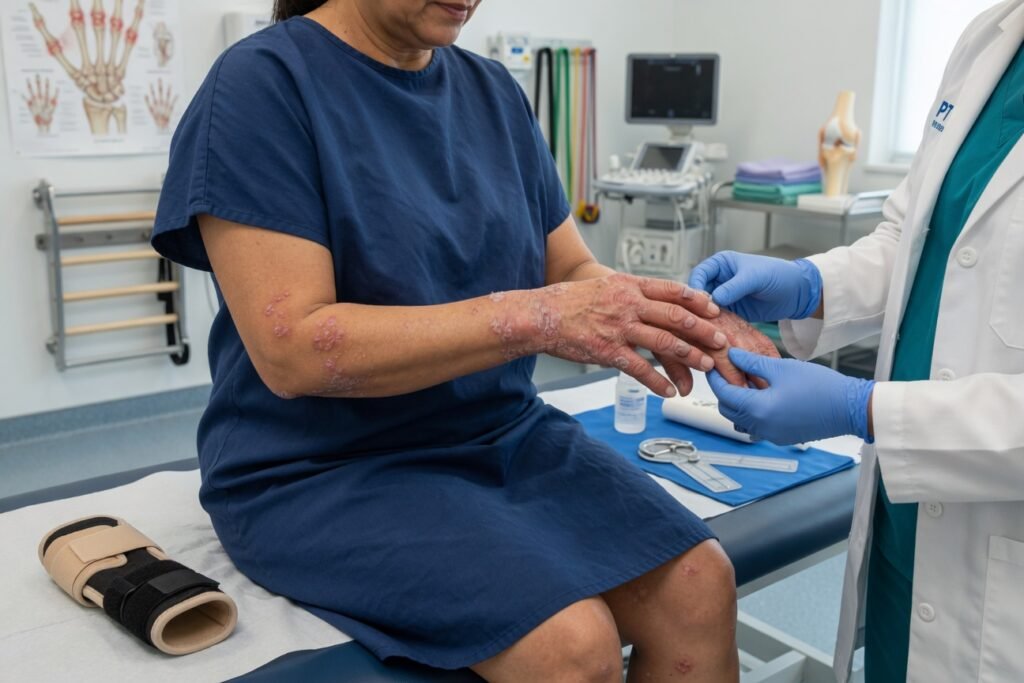
Sarah, a 42-year-old marketing manager, noticed small patches of red, scaly skin on her elbows about eight months ago. Her dermatologist treated it as typical psoriasis—manageable with topical steroids. But three months later, her right knee swelled painfully, and her fingers became stiff enough that opening jars became impossible. What she didn’t realize was that her skin condition and joint pain weren’t separate problems—they were two manifestations of the same systemic disease attacking her body in ways that topical creams could never fully address.
What You Need to Know About Psoriatic Arthritis
Key Facts
- Approximately 30% of people with psoriasis develop psoriatic arthritis, according to the American Academy of Dermatology, though onset can occur years before or after skin symptoms appear
- Men and women develop the condition at equal rates, typically between ages 30 and 50, but it can emerge in children
- Five distinct patterns exist: asymmetric oligoarticular (most common, affecting 70% of cases), symmetric polyarticular, distal interphalangeal predominant, spondylitis, and arthritis mutilans
- Without appropriate treatment, psoriatic arthritis causes permanent joint damage in up to 47% of untreated patients within two years, as documented in JAMA Dermatology
- The disease is driven by TNF-alpha and IL-17 immune pathway dysregulation, making biologic medications highly effective compared to traditional DMARDs alone
The Mechanics: How Psoriasis and Arthritis Connect
Think of psoriatic arthritis as your immune system’s security team going haywire at a building with multiple entrances. Your body is supposed to patrol for invaders, but instead it starts attacking the building itself—specifically the joints and skin. In this case, T-cells and dendritic cells in your immune system mistakenly identify your joint lining (synovium) and skin cells as threats.
Here’s what makes psoriatic arthritis unique compared to rheumatoid arthritis: while rheumatoid arthritis primarily involves antibodies against your own tissue, psoriatic arthritis centers on overproduction of inflammatory cytokines—particularly TNF-alpha, IL-17, and IL-23. These chemical messengers flood your joints, causing the synovial lining to thicken, swell, and eventually damage the cartilage and bone underneath. Simultaneously, the same inflammatory cascade appears in your skin, creating the characteristic plaques.
The timeline matters. You might have psoriasis for years without joint involvement, or joint pain might precede obvious skin plaques. Roughly 10% of people develop arthritis before any skin manifestations appear, which often leads to delayed diagnosis because rheumatologists are initially looking at joint involvement without the “obvious” psoriasis clue.
What Actually Causes Psoriatic Arthritis?
Genetics loaded the gun; environment pulled the trigger. If you have a first-degree relative with psoriasis or psoriatic arthritis, your risk jumps to approximately 10%—far higher than the general population baseline of 1-2%. The HLA-B27 and HLA-Cw6 alleles appear in about 60-70% of psoriatic arthritis patients, though carrying these genes doesn’t guarantee disease development.
Environmental triggers matter more than many articles acknowledge. Infection with streptococcal bacteria can precede disease onset by weeks to months. HIV infection carries a particularly strong association—people with HIV and psoriasis have significantly higher rates of arthritis development. Trauma to joints (including surgery) can unmask latent psoriatic arthritis in genetically susceptible individuals. Smoking increases both the risk of developing the disease and its severity.
One overlooked factor: obesity. Studies show that weight gain correlates with disease flares and reduced treatment response, independent of other factors. The mechanism involves adipose tissue producing inflammatory cytokines that amplify the Th17 immune response driving psoriatic arthritis. Weight management isn’t just about general health—it directly affects disease activity.
Stress and lifestyle disruption can trigger flares in people with underlying genetic susceptibility, though stress doesn’t cause the disease outright. Vitamin D deficiency appears increasingly relevant; some evidence suggests supplementation may reduce flare frequency, though this remains an area requiring more research.
What Psoriatic Arthritis Actually Feels Like Day-to-Day
Most articles describe joint swelling and pain generically. Here’s what your patients actually experience: waking up with hands so stiff they can’t make a fist for the first 30-45 minutes. Stairs becoming a careful negotiation because your knees feel like they’re grinding. The frustration of skin flaking constantly—in meetings, on dark clothes, everywhere. Alternating between days of relative normalcy and sudden flares where movement becomes genuinely difficult.
Early warning signs that get missed: subtle swelling in finger joints that doesn’t look dramatic. Heel pain that mimics plantar fasciitis but doesn’t respond to typical treatments—this is enthesitis, inflammation where tendons attach to bone, and it’s characteristic of psoriatic arthritis. Eye inflammation (uveitis) occurring in about 7-10% of patients, sometimes before joint symptoms emerge. Nail changes—pitting, onycholysis (separation from the nail bed), ridging—these aren’t just cosmetic and often precede skin plaques.
The fatigue deserves mention separately. This isn’t tiredness from not sleeping well. It’s a constitutional symptom driven by inflammatory cytokine production, often debilitating enough to affect work performance. Patients describe it as trying to function while carrying invisible weight.
Getting Diagnosed: The Process and What to Expect
Diagnosis requires pattern recognition rather than a single definitive test. No blood test screams “psoriatic arthritis!” Unlike rheumatoid arthritis, which frequently shows rheumatoid factor and anti-CCP antibodies, psoriatic arthritis is usually rheumatoid factor negative. In fact, about 75% of psoriatic arthritis patients test negative for rheumatoid factor, which can initially point clinicians toward misdiagnosis.
The evaluation combines several elements. Clinical assessment of joint pattern—asymmetric involvement of small joints, DIP joint tenderness, heel pain, and dactylitis (swollen “sausage” fingers) are clues. Imaging helps: X-rays might show periosteal new bone formation or pencil-in-cup deformities in advanced cases. MRI can detect early synovitis before radiographic changes appear. Lab work includes checking inflammatory markers (ESR and CRP), though normal values don’t rule out the disease—roughly 15% of patients have normal inflammatory markers despite active disease.
The CASPAR criteria (Classification Criteria for Psoriatic Arthritis) guide diagnosis, requiring inflammatory joint disease plus at least three of these: current psoriasis, history of psoriasis, psoriatic nail dystrophy, negative rheumatoid factor, dactylitis, or juxtaarticular bone formation on imaging.
Early diagnosis matters profoundly. Patients diagnosed and treated within three months of symptom onset have significantly better long-term outcomes compared to those with diagnostic delays exceeding one year.
Treatment: Moving Beyond Topical Creams
This is where treatment philosophy shifts fundamentally. Once joint involvement occurs, topical therapies and UVB phototherapy aren’t sufficient. The goal becomes halting immune-mediated joint destruction before it becomes irreversible.
Traditional DMARDs like methotrexate (15-25 mg weekly) still form first-line therapy for many patients, particularly those with mild-to-moderate disease without rapid progression. Sulfasalazine and leflunomide offer alternatives. However, psoriatic arthritis responds differently to these drugs than rheumatoid arthritis does—monotherapy failure rates run higher.
TNF-inhibitors changed the game for moderate-to-severe disease. Adalimumab, etanercept, infliximab, and golimumab suppress TNF-alpha production, reducing inflammation throughout the body and skin simultaneously. Studies show that TNF-inhibitors achieve low disease activity or remission in 40-60% of patients when combined with methotrexate.
IL-17 and IL-23 inhibitors represent the newer frontier. Secukinumab (IL-17 inhibitor) and ustekinumab (IL-23 inhibitor) offer particularly good efficacy for patients with significant skin involvement alongside arthritis. Ixekizumab provides another IL-17 option. These biologics achieve remarkably high remission rates—up to 70% in some trials—particularly in early disease.
NSAIDs like naproxen or indomethacin provide symptom relief but don’t halt disease progression. Corticosteroids should be minimized; while they provide short-term control, they don’t modify disease course and carry risks with long-term use.
Treatment selection depends on disease pattern, severity, and skin involvement. Asymmetric oligoarticular disease with minimal skin involvement might start with methotrexate plus NSAIDs. Polyarticular disease with significant psoriasis typically warrants biologic therapy earlier.
Managing Daily Life With Psoriatic Arthritis
Medication adherence tops the list. Missing biologic doses isn’t like occasionally missing a vitamin supplement—it allows inflammation to rebound quickly, undoing disease control. Set phone reminders. Use injection aids if subcutaneous administration becomes difficult with joint stiffness.
Temperature modulation works better than most realize. Cold packs reduce acute swelling during flares. Heat—warm showers, heated blankets, paraffin wax—loosens stiffness in the morning and improves mobility for hours. This isn’t fancy; it’s thermodynamics applied to synovial fluid viscosity.
Activity matters but requires strategy. Complete rest worsens long-term outcomes by promoting joint stiffness and muscle atrophy. Low-impact activities—swimming, walking on level ground, stationary cycling—maintain fitness without joint stress. Physical therapy specifically addressing your affected joints makes a measurable difference, particularly during flares when motivation dips.
Footwear deserves attention. Your typical running shoe won’t address heel pain from enthesitis. Supportive shoes with heel cushioning, sometimes combined with custom orthotics, meaningfully reduce pain. Some patients benefit from night splints for hands to minimize morning stiffness.
Skin care requires consistency. Emollients applied immediately after bathing lock in moisture. Topical vitamin D derivatives work for plaques even with systemic treatment ongoing. Anti-itch strategies prevent the scratch-flare cycle where scratching triggers inflammation.
Sleep optimization matters because poor sleep amplifies inflammatory responses. If joint pain disrupts sleep, discuss timing of pain medication with your rheumatologist—sometimes adjusting dosing schedules improves nocturnal control.
What The Evidence Actually Shows About Prevention
You can’t prevent psoriatic arthritis if you carry the genetic predisposition—no amount of perfect behavior stops disease that’s programmed into your immune system. However, you can delay onset and reduce flare frequency.
Smoking cessation prevents disease progression and improves treatment response. Smokers with psoriatic arthritis show worse outcomes, higher inflammatory markers, and reduced medication efficacy. The mechanism involves smoking suppressing regulatory T-cells that normally dampen immune responses.
Weight management through balanced diet and regular activity correlates with fewer flares. The mechanism isn’t mysterious—adipose tissue produces inflammatory mediators, so reducing body fat reduces inflammatory triggers. Even modest weight loss (5-10% of body weight) shows measurable improvements in disease activity.
Infection prevention matters. Treating streptococcal infections promptly, maintaining current vaccinations, and managing chronic infections like gingivitis prevents triggers in susceptible individuals. No evidence supports avoiding infection entirely, but managing common bacterial infections seems sensible.
Vitamin D normalization (levels above 30 ng/mL) shows promise in observational studies, though randomized trials specifically in psoriatic arthritis are limited. Given vitamin D’s role in immune regulation, maintaining adequate levels