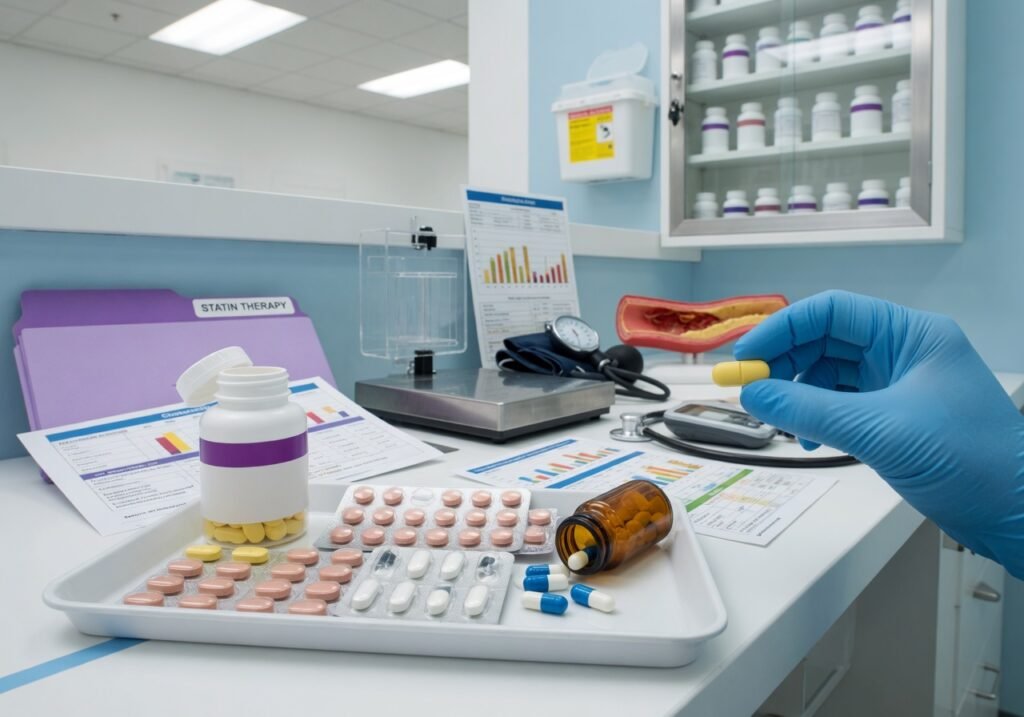
Statins: What Your Doctor Might Not Tell You About These Cholesterol Medications
Sarah, a 52-year-old marketing executive, came to my office convinced that starting atorvastatin meant she’d have to live with constant muscle pain and brain fog for the rest of her life. She’d read forums, scrolled through Reddit, and heard from her cousin that statins “ruin your quality of life.” Here’s what I had to correct: statins don’t cause side effects in most people taking them. The misconception—that these drugs are inherently toxic to muscles and cognition—persists because the vocal minority who do experience problems tend to write about it loudly, while the millions taking statins without incident stay silent. The actual truth is more nuanced and, frankly, far more interesting than the “dangerous drug” narrative.
Key Facts About Statins
- Statins reduce the risk of major cardiovascular events by approximately 22% over five years in people with existing heart disease, according to data published in JAMA Cardiology.
- Only 2-3% of patients discontinue statins due to muscle-related symptoms, yet surveys show 10-15% of patients believe they’re experiencing statin-induced myopathy when taking them.
- The NNT (number needed to treat) to prevent one heart attack or stroke is approximately 67 for primary prevention over five years in moderate-risk patients.
- Atorvastatin, rosuvastatin, and pravastatin have different drug interaction profiles—pravastatin interacts with fewer medications than atorvastatin, which matters if you’re on multiple prescriptions.
- Statin effectiveness at lowering LDL cholesterol ranges from 20-30% reduction with pravastatin 40mg to 50-55% reduction with rosuvastatin 40mg, meaning potency varies significantly between agents.
Understanding How Statins Actually Work
Think of your liver as a factory that produces cholesterol using a specific assembly line. The critical tool on that line is an enzyme called HMG-CoA reductase—this is where the actual building process happens. Statins are competitive inhibitors that park themselves right at this workstation and say “not today.” By blocking this enzyme, statins reduce how much cholesterol your liver manufactures, which forces your body to pull existing cholesterol out of your bloodstream to compensate. That’s why your LDL (bad cholesterol) drops.
But here’s where most articles oversimplify: statins don’t just lower cholesterol. They also stabilize plaques already stuck to your artery walls, reduce inflammation in vessel linings, and improve how your endothelium (the inner lining of arteries) functions. This is why people who’ve already had a heart attack benefit from statins even when cholesterol numbers are already reasonable. The cardiovascular protection goes beyond simple cholesterol arithmetic.
Who Needs Statins: Risk Factors and Less-Discussed Nuances
The obvious factors everyone mentions: high LDL cholesterol, family history of early heart disease, smoking, diabetes, hypertension. But here’s what gets overlooked—your coronary artery calcium score, which you can actually get measured without waiting for a crisis. A CAC score of 0 means you have essentially no calcified plaque and your 10-year heart attack risk is quite low, even with elevated cholesterol. Conversely, a CAC score above 100 suggests you benefit from statins regardless of traditional risk scores alone.
Another underutilized factor: chronic kidney disease. Your kidneys filter out medication metabolites, and as kidney function declines, certain statins accumulate. This is why pravastatin or rosuvastatin make more sense than simvastatin or atorvastatin in patients with significant renal disease. Also consider inflammatory markers like high-sensitivity C-reactive protein (hsCRP). Someone with normal cholesterol but markedly elevated hsCRP might benefit from statins for their anti-inflammatory effects, though this remains somewhat controversial in preventive guidelines.
What You Actually Feel When Taking Statins
Most people feel nothing. That’s the honest answer. They take the pill, their cholesterol improves on the next lab work, and life continues. But for the small percentage who do experience side effects, they’re real and they’re frustrating.
True statin-induced muscle symptoms typically begin within weeks to a few months of starting the medication or increasing the dose. The classic presentation isn’t vague fatigue—it’s specific muscle aching, typically in large muscle groups like thighs or calves, sometimes accompanied by weakness that makes climbing stairs notably harder. Some patients describe a heavy, almost toxic feeling in their muscles rather than sharp pain.
An often-missed early warning sign: cognitive effects that aren’t full-blown memory loss but rather a subtle fuzziness, like a persistent slight fog over your thinking. Patients describe it as “not feeling sharp” or difficulty retrieving words they know they know. This happens to perhaps 5-10% of statin users but rarely gets documented because it’s subjective and often attributed to aging or stress instead.
Liver enzyme elevation is extremely rare with modern statins at standard doses—it occurs in less than 1% of users. You’d only know about it from your lab work, not from how you feel.
How Doctors Actually Diagnose the Need for Statins
It starts with your lipid panel—total cholesterol, LDL, HDL, and triglycerides. But here’s the clinical reality: that one set of numbers isn’t sufficient to make the statin decision in many patients. I typically want to see at least two measurements weeks apart in someone without existing cardiovascular disease, because cholesterol fluctuates and one elevated reading might not represent your baseline.
Then comes risk stratification. Using the Framingham Risk Score or the newer ACC/AHA atherosclerotic cardiovascular disease (ASCVD) risk calculator, I determine your 10-year risk of a heart attack or stroke. Someone with a 7.5% 10-year risk sits in that gray zone where the decision depends on shared decision-making—your preferences matter as much as the numbers.
If you’ve already had a cardiovascular event (heart attack, stroke, or had stent placement), the decision is straightforward—you get statins. Period. This is secondary prevention, and the evidence is ironclad. The uncertainty exists primarily in primary prevention for people without prior events.
Some cardiologists now order a CAC scan—that CT scan measuring calcium in your coronaries. This adds specificity to risk prediction, especially for people at intermediate risk. A negative CAC can lower your risk assessment substantially.
Current Treatment Options: Which Statin and Why
Your choices include pravastatin, simvastatin, lovastatin, fluvastatin, atorvastatin, rosuvastatin, and pitavastatin. The first three are intermediate potency. Atorvastatin and rosuvastatin are high-intensity options. Each behaves differently in your body.
Atorvastatin (Lipitor) is the most prescribed because it’s potent, well-studied, and available as an inexpensive generic. But it gets metabolized by your liver’s cytochrome P450 system, which means it interacts with many other drugs. If you take calcium channel blockers like diltiazem or multiple other medications, this becomes relevant.
Rosuvastatin (Crestor) is slightly more potent than atorvastatin at equivalent doses and has fewer drug interactions. It concentrates more in liver tissue and less in muscle, which might explain why some people who develop muscle symptoms on atorvastatin tolerate rosuvastatin better.
Pravastatin is less potent but has the fewest drug interactions and causes the fewest cognitive side effects in my experience, though the evidence for this is limited. I often start older patients or those on complex medication regimens with pravastatin.
For people with statin-induced muscle symptoms, switching between statins sometimes helps—the symptoms might be agent-specific rather than class-specific. I might also reduce the dose, shift to every-other-day dosing, or add ezetimibe (a non-statin cholesterol drug) to maintain efficacy while using less statin.
Managing Your Life While Taking Statins
If you’re on a statin, your actual management strategy should include specific elements. Track your lipid panel results—know your numbers and know the trends. Some patients respond dramatically; others need dosage optimization. Your doctor should recheck lipids 4-12 weeks after starting or changing doses.
Document your baseline muscle strength and cognition if you’re starting statins. Seriously. Have a clear sense of what you can do at baseline—how far you can walk, whether you can do 30 pushups, how sharp you feel mentally. This creates a reference point. If something changes, you’ll notice because you’re comparing to your actual baseline, not vague recollection.
Maintain consistent exercise. Counterintuitively, patients on statins who exercise regularly have fewer muscle complaints. Don’t interpret muscle symptoms as a reason to stop exercising; rather, it’s often a reason to discuss dose adjustment with your doctor.
Request your CAC score if you’re in the primary prevention gray zone. This single test can shift the risk calculus significantly and might prevent you from taking a medication you don’t actually need, or conversely, might convince you that preventive therapy makes sense.
Note any new symptoms clearly and report them during follow-up visits. Vague complaints of “feeling off” are harder to act on than “my calves ache after climbing stairs, starting two weeks after I began the medication.”
Prevention: What Actually Reduces Heart Attack and Stroke Risk
Statins are part of prevention, but they’re not the whole story. The evidence is overwhelming that smoking cessation reduces cardiovascular risk far more dramatically than any medication—I mean the risk reduction is in the range of 50-70% within the first year of quitting. That dwarfs what statins do.
Blood pressure control matters enormously. A systolic blood pressure of 120-130 versus 140+ makes a measurable difference in cardiovascular events over years. Getting this controlled—whether through lisinopril, amlodipine, or other agents—is non-negotiable.
Aspirin for primary prevention in older adults has become more controversial recently. The 2022 USPSTF recommendations suggest selective use rather than routine use, so this isn’t something to assume you need.
Exercise isn’t optional—30 minutes of moderate activity most days genuinely reduces heart attack risk independently of weight loss. You don’t need to lose 50 pounds for the benefit; the cardiovascular advantage starts accumulating immediately.
The Mediterranean diet pattern shows cardiovascular benefit, though honestly, the specifics matter less than consistency. Any eating pattern you’ll actually maintain that’s rich in vegetables, whole grains, fish, and lower in processed foods will help.
Frequently Asked Questions About Statins
Can statins cause permanent muscle damage?
True statin-induced muscle injury (rhabdomyolysis) is extraordinarily rare—fewer than 3 cases per 100,000 patients annually. It typically presents with severe muscle pain and elevated creatine kinase levels far above normal. Most patients experience muscle aching that resolves once the statin is discontinued or the dose is reduced, with no permanent damage. If you develop muscle symptoms, report them immediately rather than stopping the medication unilaterally.
Does grapefruit juice really interact with statins?
Yes, but only with certain statins. Atorvastatin, simvastatin, and lovastatin are significantly affected by grapefruit juice, which inhibits the enzyme that breaks these statins down, leading to higher drug levels and increased side effects. Pravastatin and rosuvastatin are minimally affected. If you take atorvastatin and drink grapefruit juice regularly, consider switching statins or eliminating the juice.