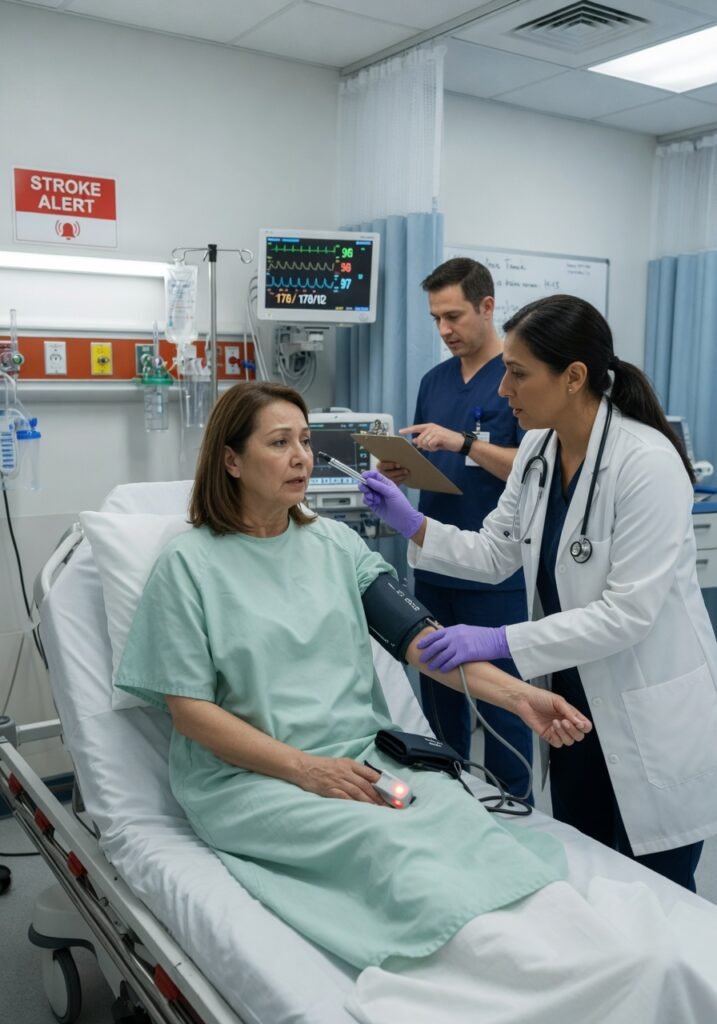
Stroke Emergency: Why Every Minute Costs You Brain Cells
Marcus, a 58-year-old accountant, woke up one Tuesday unable to smile evenly in the mirror. His wife noticed the drooping on his left side but Marcus downplayed it—he’d been stressed lately, probably just tired. By the time they arrived at the emergency room three hours later, neurologists told them the window for the most effective clot-busting treatment had closed. This is the most dangerous misconception about stroke: that you have time to wait, watch, or even schedule a doctor’s appointment.
Here’s what’s actually true. A stroke happens when blood stops flowing to your brain, and every minute without blood flow kills approximately 1.9 million brain cells. This isn’t metaphorical or exaggerated—it’s measured in actual cellular death. The first three hours after symptom onset represent the critical window for thrombolytic therapy, the medication that can dissolve clots and restore blood flow. After that window closes, the damage becomes largely irreversible. Understanding this time component isn’t just medical trivia. It’s the difference between walking out of a hospital and needing years of rehabilitation.
Key Facts About Stroke Emergency
- The CDC reports that 795,000 strokes occur annually in the United States, with approximately 610,000 being first attacks and 185,000 being recurrent strokes
- Ischemic strokes account for 87% of all stroke cases, while hemorrhagic strokes represent 13%—this distinction matters because treatments differ completely
- Alteplase (tPA), the gold-standard clot-busting drug, must be administered within 4.5 hours of symptom onset to maximize benefit, with the best outcomes occurring within the first 3 hours
- Thrombectomy—mechanical removal of clots—can be performed up to 24 hours after symptom onset in select patients, potentially rescuing brain tissue that would otherwise die
- Approximately 87% of stroke survivors experience some degree of disability, highlighting why prevention and rapid treatment aren’t optional considerations
What Actually Happens During a Stroke
Think of your brain’s blood vessels like highways delivering oxygen-rich fuel to different neighborhoods. When one highway gets blocked—whether by a blood clot traveling from your heart or by plaque buildup in the vessel itself—that entire neighborhood loses its supply. Unlike your heart or lungs, your brain has virtually no stored oxygen reserves. Within seconds of losing blood flow, neurons begin misfiring. Within minutes, they start dying. The surrounding tissue becomes increasingly damaged as metabolic waste products accumulate and acid builds up in the cells.
Here’s the clinical insight most health websites skip: the area immediately around the core damage, called the penumbra, isn’t dead yet—it’s just gasping for oxygen. This doomed-but-not-quite-dead zone is where treatment actually works. Get blood flowing back to the penumbra within hours, and you can rescue neurons that would have died. Wait too long, and that tissue is gone permanently, no matter what treatment you throw at it. The brain doesn’t regenerate the way your skin does.
What Causes Strokes and Who’s Actually at Risk
Most ischemic strokes happen because a blood clot forms in the heart—usually due to atrial fibrillation, an irregular heartbeat—then travels to the brain. Others occur when plaque inside a carotid or cerebral artery ruptures, triggering clot formation right there in the vessel. Hemorrhagic strokes happen when a weakened blood vessel ruptures, usually secondary to chronic hypertension or an arteriovenous malformation.
The traditional risk factors matter: hypertension, diabetes, smoking, high cholesterol, obesity. But here’s what gets overlooked constantly—sudden changes in those factors. A patient who’s had stable blood pressure for years but suddenly spikes to 180/110 is at acute risk. The damage isn’t always from chronic elevation; it’s from the instability. Sleep apnea is another underappreciated culprit. Patients with untreated obstructive sleep apnea have oxygen drops throughout the night, which stresses the cardiovascular system and increases clot formation risk. Many people with sleep apnea don’t know they have it because they don’t remember waking up.
Age matters—risk doubles every decade after 55. But age alone isn’t destiny. A 45-year-old with undiagnosed atrial fibrillation and smoking habit is at higher acute risk than a 75-year-old with well-controlled hypertension and no arrhythmia.
Recognizing the Signs Before It’s Too Late
The FAST acronym captures the obvious signs—Face drooping, Arm weakness, Speech difficulty, Time to call 911. But patients often experience subtler warnings that precede the full stroke by hours or days. Unexplained fatigue, difficulty finding words even though you understand what people are saying, mild balance problems you attribute to being clumsy, a slight headache that doesn’t match your typical patterns. One patient described it as feeling like the left side of her body was “slower to respond.”
The problem: these warning signs are called transient ischemic attacks (TIAs), and they completely resolve within 24 hours, usually within minutes or hours. Patients convince themselves it passed, so it wasn’t serious. Wrong. A TIA is your brain literally going into oxygen debt and recovering—barely. It’s a five-alarm warning that a major stroke is coming. According to the NIH, about 10-15% of stroke patients had a TIA in the preceding week. These are second-chance opportunities that most people waste.
Beyond FAST, watch for sudden vision changes (blurred in one eye, loss of peripheral vision), sudden severe headache with no clear cause, and difficulty understanding what others say even though your hearing is fine. In men, stroke sometimes presents as sudden erectile dysfunction—yes, really—because the same vascular disease affecting penile arteries often precedes cerebral vessel problems.
How Diagnosis Actually Works in a Stroke Emergency
When you call 911 with stroke symptoms, paramedics do the FAST exam in your home and radio ahead to activate the stroke team at designated hospitals. At the hospital, you go directly to CT imaging—specifically a non-contrast head CT to rule out hemorrhage. This takes maybe 15 minutes total. Why rule out hemorrhage first? Because alteplase, the clot-busting drug, makes bleeding worse. Give it to someone actively bleeding in the brain and you’ve just made things catastrophically worse.
If CT shows no bleeding, the team orders labs (blood glucose matters—hypoglycemia mimics stroke symptoms), checks your blood pressure, and gets an EKG to look for atrial fibrillation. Within 30 minutes of arrival, you’ll know whether you’re getting thrombolytic therapy. If you’re a candidate—meaning no contraindications like recent surgery, uncontrolled hypertension, or current anticoagulation—they’ll give you alteplase intravenously. Some hospitals also offer thrombectomy, where an interventional radiologist threads a catheter up to the clot and physically pulls it out. This requires specialized training and equipment that not all hospitals have.
The feeling from the patient’s perspective: urgency, questions fired rapidly, repeated vital signs, then suddenly you might feel a medication infusing. Some people report mild headache or facial flushing. You’re then monitored intensely for hemorrhagic complications over the next 24 hours.
Current Treatment: What Actually Works
Alteplase (tPA) remains the gold standard for ischemic stroke within 4.5 hours of onset. It’s a thrombolytic—it breaks down fibrin in blood clots. Studies show that every 90 minutes saved results in an approximately 10% improvement in favorable outcomes. That’s not theoretical; that’s actual disability prevention.
For patients arriving 6-24 hours after symptom onset, mechanical thrombectomy has become game-changing. Using angiography to visualize the clot, interventional radiologists deploy a device called a stent retriever—essentially a tiny wire cage—that captures the clot and pulls it out. Recent NEJM trials showed thrombectomy reduced disability dramatically even in this extended window, provided imaging showed salvageable brain tissue.
Hemorrhagic stroke treatment is completely different—you’re not dissolving clots; you’re stopping the bleeding. Blood pressure control becomes urgent, often using labetalol or nicardipine. If the hemorrhage is large or expanding, neurosurgery might place an external ventricular drain or perform decompressive hemicraniectomy—removing part of the skull to allow brain swelling without increasing pressure fatally.
Managing the Recovery Phase and Beyond
After the acute emergency passes, the real work begins. Physical therapy starts within 24 hours in most cases—not because you feel ready, but because neurons are most plastic during the immediate post-stroke period. Speech therapy if you have language involvement. Occupational therapy for fine motor skills. These aren’t optional add-ons; they’re where recovery happens.
Practically speaking: if you’re the stroke patient, expect to feel emotionally raw. Post-stroke depression affects 30% of patients and isn’t weakness—it’s your injured brain struggling with neurochemistry. Medication like sertraline often helps. Keep your therapy schedule even when you don’t feel like it. Do the exercises your therapist assigns, not just the ones that feel productive. Small repetitions accumulate over weeks and months. Join a stroke support group—not for cheerleading, but because other survivors understand the cognitive fog and frustration in ways family can’t.
If you’re a family member: document what functions your loved one had before the stroke. This baseline matters because recovery is measured against it, not against perfect function. Expect plateaus where progress stalls for weeks, then sudden improvements. This is normal.
Prevention: What The Evidence Actually Shows
Hypertension management is non-negotiable. Getting systolic below 130 mmHg reduces stroke risk substantially. If you have atrial fibrillation, anticoagulation with apixaban, dabigatran, or warfarin reduces stroke risk by 65%. That’s not a suggestion; that’s a documented 65% risk reduction. Many people with AFib don’t take anticoagulation seriously because they don’t feel sick. The absence of symptoms doesn’t equal absence of clot formation.
Statins reduce stroke risk in high-risk individuals, not by lowering cholesterol alone but through plaque stabilization. Aspirin for primary prevention—meaning stroke prevention in people without prior stroke—shows modest benefit in select cases but isn’t universally recommended for everyone.
Smoking cessation cuts stroke risk immediately upon quitting, with major reductions within three months. Moderate alcohol consumption (one drink daily for women, two for men) appears protective, but heavy drinking increases hemorrhagic stroke risk. Exercise at moderate intensity for 150 minutes weekly reduces risk. Sleep apnea screening and CPAP use prevents the nocturnal oxygen drops that trigger clot formation.
Frequently Asked Questions About Stroke Emergency
Sources & Medical References
HealthTopics.com articles are based on peer-reviewed medical research and guidance from the NIH, CDC, and WHO. See our editorial policy for full sourcing standards.