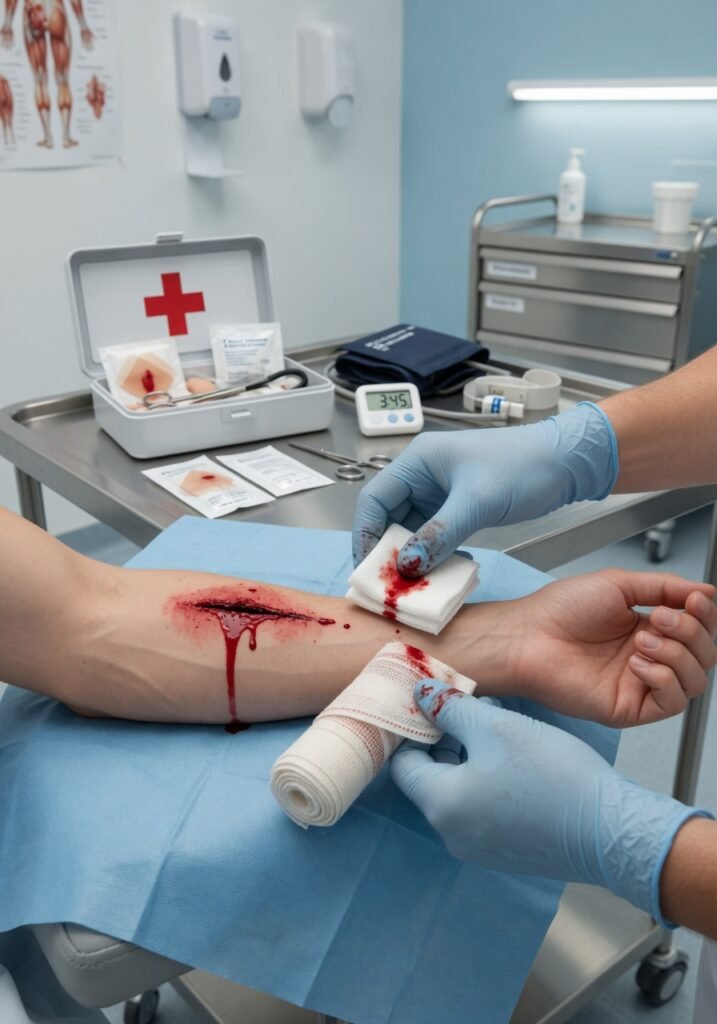

Bleeding First Aid: What You Think You Know Versus What Actually Works
Sarah, a 34-year-old accountant, sliced her hand on a broken glass while washing dishes on a Tuesday evening. Her immediate instinct? Apply pressure with a cloth and elevate the arm—the same advice she remembered from a high school health class two decades ago. But as blood continued seeping through the cloth after three minutes, she panicked. She didn’t realize that her body was actually doing something counterintuitive: the bleeding itself was part of the healing process, and her panic was potentially making it worse by elevating her heart rate and blood pressure.
Here’s what separates casual first aid knowledge from actual clinical understanding: most people believe that stopping bleeding is purely about physical pressure and time. In reality, your body has multiple biological mechanisms working simultaneously—vasoconstriction, platelet aggregation, and clot formation—and improper technique can either help or actively interfere with these processes. The tourniquet, once considered a last resort for battlefield trauma, is now recognized by the CDC as safe for limb wounds when applied within the first hour, yet most people still hesitate to use one. This article explains the science behind what works, why outdated advice persists, and exactly what you should do the next time someone is bleeding.
Key Facts About Bleeding First Aid
- According to the CDC, uncontrolled hemorrhage is the leading preventable cause of death in trauma patients, yet 70% of people cannot correctly apply direct pressure without releasing too early or using insufficient force.
- Elevation of a bleeding limb reduces bleeding by approximately 15-25% when combined with direct pressure, but this effect only matters if pressure is already adequate—elevation alone is nearly useless.
- Modern tourniquets applied within the first 60 minutes carry less than 2% risk of permanent tissue damage, compared to historical rates of 15-20% from improvised tourniquets applied improperly.
- The average adult has about 5 liters of blood; loss of 15% (750 mL) typically causes noticeable symptoms like dizziness, while loss exceeding 40% becomes life-threatening without intervention.
- Hydrogen peroxide, once recommended to clean wounds by creating bubbles, actually damages healthy tissue and impairs clotting—saline irrigation or clean running water is superior by NIH standards.
Understanding the Physiology: What’s Actually Happening When Someone Bleeds
Think of bleeding as a three-act play where your body is both director and performer. The moment a blood vessel tears, the first response is immediate vasoconstriction—the vessel itself contracts, trying to pinch off the flow. This happens in seconds. Simultaneously, platelets in the blood detect the exposed collagen in the vessel wall and begin sticking together like tiny workers assembling a dam. Finally, the coagulation cascade—a sequence of 13 clotting factors—begins weaving fibrin threads through the platelet plug, creating a stable clot.
Here’s what most first aid guides skip: this entire process requires time and an undisturbed environment. When you apply pressure, you’re not just “stopping” bleeding—you’re holding the wound edges together so the platelet plug can form without being washed away by blood flow. If you release pressure after 30 seconds to “check if it stopped,” you’re essentially interrupting the workers mid-project and forcing them to start over. This is why proper pressure takes 10-15 minutes for minor cuts and potentially much longer for deeper wounds. The pressure must be firm (hard enough that you wouldn’t be able to slide your fingernail under the cloth) and continuous.
Causes and Risk Factors: Why Some Bleeds Are Worse Than Others
Obviously, the depth and size of the wound matter. A puncture through skin only takes 3-5 minutes to clot; a laceration through the dermis into subcutaneous tissue may take 15-20 minutes; a wound involving muscle or deeper structures can take 30+ minutes or require stitches. But several factors amplify bleeding risk in ways that aren’t immediately obvious.
Anticoagulation medications like warfarin (Coumadin), dabigatran (Pradaxa), and rivaroxaban (Xarelto) directly impair clot formation. A patient on warfarin might bleed for 45 minutes from a wound that would stop in 10 minutes in someone not taking blood thinners. Aspirin, while safer than warfarin, still increases bleeding time by 15-20% in most people.
Thrombocytopenia—low platelet count—is perhaps the most underappreciated risk factor in civilian first aid contexts. Someone with a platelet count below 50,000/microL due to leukemia, immune thrombocytopenia, or chemotherapy will bleed dramatically longer. A scratch that would barely bother most people can cause concerning oozing for hours.
Alcohol intoxication affects clotting in two ways: it impairs platelet function directly and increases bleeding through blood vessel dilation. The intoxicated patient doesn’t just look like they’re bleeding more—they actually are, at rates 25-40% higher than baseline.
One factor clinicians discuss but first aid sites rarely mention: wound location and orientation. Wounds on the face and scalp bleed profusely because these areas have exceptional blood supply (up to 15 times that of extremities), yet the bleeding often looks more dramatic than it actually is in terms of volume loss. Conversely, wounds across joint lines or those gaping open actually resist clotting because movement keeps breaking the forming clot apart.
Signs and Symptoms: What You’re Actually Observing
Most articles list clinical signs in a sterile way: “bright red blood indicates arterial bleeding.” But what does that actually mean in context? Arterial bleeding spurts in rhythm with the heartbeat—it’s pulsatile, sometimes appearing and disappearing with each pulse. Venous bleeding flows steadily. Capillary bleeding oozes slowly. This distinction matters because arterial bleeding requires more aggressive intervention.
The person who is bleeding experiences anxiety—often disproportionate to the actual severity. Even a minor hand laceration triggers a sympathetic response: increased heart rate, shallow breathing, sometimes lightheadedness. Their perception that the bleeding is worse than it is tends to be self-fulfilling because tachycardia increases blood pressure and makes bleeding continue longer.
Early warning signs of significant blood loss that are often missed: dry mouth appearing before dizziness, a sudden urge to urinate (as sympathetic activation redirects blood flow), and the feeling of coolness in the extremities. By the time someone actually faints from blood loss, they’ve already lost a dangerous amount.
For minor cuts, the person usually notices when bleeding stops—the oozing simply ceases. They might feel tightness in the wound as the clot hardens. For deeper wounds, there might be persistent oozing even after 15 minutes of pressure, which suggests that stitches or professional evaluation are needed.
Diagnosis: Determining Severity and When Professional Help is Necessary
In the first aid context, “diagnosis” isn’t about lab work—it’s about rapid assessment. After you’ve applied pressure and maintained it for 10 minutes, you can cautiously peek at the wound (without removing the bandage completely) to ask: does it still look like it’s bleeding? If blood immediately reappears after gentle pressure is released, it’s not ready. If the bleeding has genuinely stopped, the wound then needs assessment for depth and contamination.
Ask yourself these questions: Can you see yellow subcutaneous fat or deeper structures? (If yes: professional closure needed.) Is the wound longer than 6mm? (Probably needs stitches.) Does it have jagged, irregular edges? (More likely to scar without professional closure.) Was the injury contaminated—rust, dirt, animal saliva? (Needs professional wound exploration and possibly antibiotics.)
The “how long has it been bleeding” question is less important than “does it keep bleeding when pressure is released.” A minor scalp laceration might ooze intermittently for 30 minutes even though it needs no stitches, while a small but deep hand laceration might stop quickly but still require closure to prevent infection and nerve/tendon damage.
One nuance often missed: wounds that initially seem to stop but then resume bleeding hours later often indicate deeper vessel involvement. Any patient who bleeds significantly enough to soak through a bandage should be evaluated, even if the wound looks small on the surface.
Treatment Options: Current Evidence-Based Approaches
Direct pressure with appropriate materials: Cloth, gauze, or even a clean piece of clothing is fine for initial hemorrhage control. Avoid lint-free gauze if you don’t have it available; regular cloth works nearly as well. The key is maintaining firm, uninterrupted pressure for the appropriate duration. Studies in JAMA Surgery show that interrupted pressure (checking the wound every 30 seconds) extends clotting time by up to 40%.
Tourniquet application: For extremity bleeding that doesn’t stop after 10-15 minutes of direct pressure, a tourniquet placed 2-3 inches proximal to the wound saves limbs. The Combat Tourniquet or similar devices are specifically designed for this purpose. Apply it above the wound but below any joints if possible. Tighten until bleeding completely stops, then mark the time it was applied. Modern tourniquets can safely remain in place for 2+ hours in most cases.
Hemostatic agents: Gauze impregnated with kaolin (QuikClot, Celox) or chitosan can dramatically accelerate clotting in severe bleeding. These are standard in emergency rooms and increasingly available for home use. When used correctly, they can reduce bleeding time by 50% for severe wounds.
Elevation and heat: Once pressure is applied, elevating the limb above heart level reduces bleeding by the mechanism mentioned earlier. Applied heat (warm—not hot—compresses) can paradoxically help after the initial clot forms because it relaxes surrounding muscle tension that might otherwise keep the wound gaping.
Sutures versus closure strips: Wounds longer than 6-7mm or deeper than 3mm almost always benefit from professional suturing within 6-12 hours. Butterfly closure strips work for minor lacerations in low-tension areas like the forearm but fail in high-movement areas. Dermabond (cyanoacrylate adhesive) works well for small, clean lacerations on the face or scalp.
Practical Daily Management: Specific Strategies After the Bleeding Stops
The first 24 hours: Keep the wound elevated even after bleeding has stopped. This prevents rebleeding from normal activity increasing blood pressure. Change the dressing if it becomes saturated, but avoid disturbing the forming clot. Apply pressure gently if slight oozing occurs—don’t massage the wound or apply heat initially.
Cleaning protocol: After 24 hours, gently rinse the wound with cool running water or saline solution two to three times daily. Use a soft cloth or gauze. Soap is fine on the surrounding skin but can irritate the wound itself. Pat dry gently—don’t scrub.
Dressing changes: For the first 24-48 hours, keep the wound covered with a clean, dry dressing. After that, exposure to air generally accelerates healing, though keeping it covered protects it from contamination and friction. Remove the dressing once daily to inspect for signs of infection: increasing redness, warmth, pus, or red streaks extending from the wound.
Pain management: Over-the-counter ibuprofen (Advil, Motrin) reduces inflammation and helps with the minor pain of a healing wound. Avoid aspirin for the first 24 hours if possible, as it can prolong bleeding. Acetaminophen (Tylenol) works for pain without affecting clotting.
When to seek care: Don’t wait if you notice spreading redness, warmth, swelling that worsens after day