Last Tuesday, Margaret watched her 6-year-old son go pale at the dinner table, his hand flying to his throat while a piece of hot dog stuck in his airway. She didn’t freeze—she knew exactly what to do. Within ten seconds, she was administering abdominal thrusts, and he coughed up the obstruction. Margaret’s calm, practiced response meant her son went back to eating within minutes instead of heading to the emergency room. Yet most adults have never performed the Heimlich maneuver, and many who have learned it years ago have forgotten the critical steps.
What You Actually Need to Know About Choking
Key Facts About Choking
- The CDC reports that approximately 5,000 Americans die annually from unintentional choking, with about 2,500 of these deaths occurring in children under age 14
- Rescue breathing combined with chest compressions increases survival rates by up to 40% compared to chest compressions alone in witnessed airway obstruction
- The larynx (your voice box) sits lower in children than adults, making them three times more susceptible to complete airway blockage from similar-sized objects
- Foreign body aspiration accounts for roughly 9% of all unintentional injury deaths in children ages 1 to 14 in developed countries
- Successful abdominal thrusts require approximately 6.5 kg of force per thrust—more than most people apply naturally without deliberate effort
The Mechanics: What Happens When Someone Chokes
Think of your airway like a hallway with a single door leading to your lungs. When that door gets blocked—even partially—your body triggers a cascade of responses. First, the vagus nerve detects the obstruction and signals panic. Your heart rate spikes. You try to cough, which works beautifully if the blockage is loose, but if it’s wedged tightly, coughing alone becomes futile.
Here’s what most people don’t realize: there’s actually a window of time between the moment the airway becomes completely obstructed and when brain damage begins. That window is roughly four to six minutes. Your blood is still oxygenated during the first minute or two—you’re not dead yet, just suffocating. The person may lose consciousness before oxygen-deprivation damage occurs, but that doesn’t mean they’re beyond help. Every second matters, and you have a legitimate chance of success if you act before unconsciousness sets in.
Who’s Actually at Risk
Children under five account for the majority of choking deaths, but this isn’t just a pediatric problem. Older adults with dentures, people with neurological conditions affecting swallowing, and those taking medications that dry out the throat are surprisingly vulnerable. Here’s the clinically relevant detail most articles skip: certain psychiatric medications like risperidone and haloperidol increase choking risk by impairing the coordination of swallowing muscles, yet patients and families rarely discuss this side effect with their physicians.
Additional risk factors include eating too quickly, inadequate chewing, alcohol consumption before meals, and foods with particular textures—hot dogs, grapes, nuts, and hard candies top the list. But there’s a subtler risk factor worth noting: anxiety. People who eat anxiously or while distracted tend to swallow larger food portions without proper mastication, essentially pre-selecting themselves for choking risk.
What Choking Actually Looks Like
Complete airway obstruction looks dramatically different from partial obstruction. With a complete blockage, the person cannot cough, cannot speak, cannot make any sound at all. They may make exaggerated breathing attempts with no air movement. Their face reddens, then rapidly turns blue around the lips and fingertips. They may grab their throat—the universal choking sign. Some people maintain consciousness for 30 to 60 seconds before losing it.
Partial obstruction is trickier. The person can cough, sometimes forcefully. They may wheeze or make high-pitched breathing sounds. They might panic and complain of something stuck in their throat. The danger with partial obstruction is complacency—many people believe they can cough it out themselves. Sometimes they do. But sometimes that piece of food shifts with the next swallow or cough and becomes a complete obstruction within minutes.
Diagnosis: Recognizing Choking in Real Time
You don’t need imaging or blood work to diagnose choking. You need your eyes and ears. Is the person coughing? Can they speak or cry? Can you see their chest rising and falling? If they’re coughing forcefully and can speak between coughs, they have a partial airway obstruction. Let them cough. Your job is observation, not intervention—yet.
If they cannot cough, cannot speak, cannot breathe, or are making only high-pitched, ineffective breathing sounds, you have a complete obstruction. This is when you move immediately to the Heimlich maneuver. The diagnosis happens in seconds, and hesitation kills.
The Heimlich Maneuver: Step-by-Step
For a Conscious Adult or Child (Over 1 Year Old)
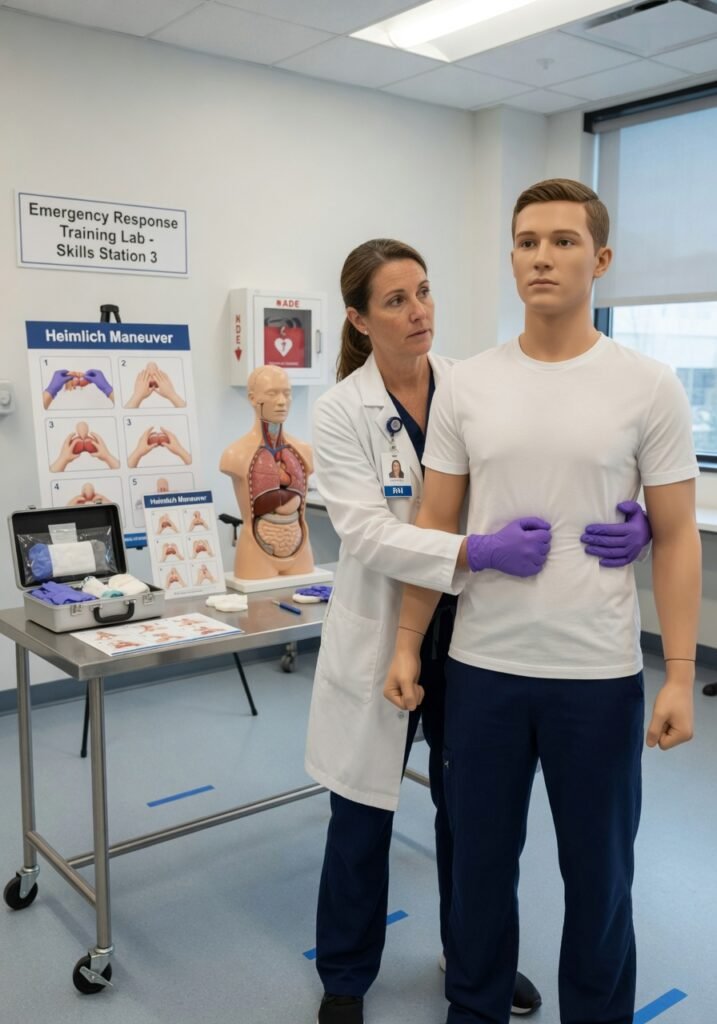
- Position yourself behind the choking person. Wrap your arms around their waist. Your hands should be at roughly the level of their belly button, not their ribs.
- Make a fist with one hand. Place the thumb side of your fist just above their navel and well below the ribcage. This is critical—too high and you risk rib fractures; too low and you miss the diaphragm entirely.
- Grasp your fist with your other hand. Press hard into their abdomen with quick, upward thrusts. You’re trying to force air out of their lungs, which dislodges the object.
- Repeat thrusts rapidly. Don’t pause between thrusts. Continue until the object dislodges or the person becomes unconscious.
For Infants (Under 1 Year Old)
Do NOT use the Heimlich maneuver. Instead, alternate between five back blows (using the heel of your hand to strike between the shoulder blades) and five chest thrusts (using two fingers to push on the chest, just below the nipple line). This is the American Red Cross protocol and has significantly better outcomes than abdominal thrusts in this age group.
If the Person Loses Consciousness
Lower them to the ground and immediately begin CPR with chest compressions. After 30 compressions, open their mouth and perform a finger sweep—insert your fingers and attempt to hook out any visible object. Don’t blindly fish around; this can lodge the object deeper. Then give two rescue breaths, return to compressions, and call 911 if you haven’t already.
Daily Prevention and Risk Reduction
The most underutilized prevention strategy is teaching children to chew properly. That sounds basic, but explicitly instructing kids to chew food 20 times before swallowing reduces choking incidents substantially. Removing distractions during meals—no running around, no screens, no high-stress conversations—gives the nervous system adequate bandwidth for the complex coordination of swallowing.
For older adults, moistening dry foods, taking smaller bites, and never eating while lying down are simple but effective. If someone uses dentures, ensure they fit properly; loose dentures increase choking risk by interfering with tactile sensation of food consistency.
One evidence-based approach many people overlook: texture-modified diets. If someone has had a stroke affecting swallowing or has progressive neurological disease, working with a speech-language pathologist to assess swallowing function and recommend appropriate food textures can prevent aspiration and choking before it becomes an emergency.
Frequently Asked Questions
Should I perform the Heimlich maneuver if someone is coughing?
No. If they’re coughing forcefully, their airway is not completely obstructed, and coughing is actually the most effective way to clear a partial blockage. Intervening with thrusts can lodge the object more deeply. Encourage continued coughing and observe closely, but don’t perform the maneuver yet.
Can you perform the Heimlich on yourself?
Yes. Make a fist above your navel, grasp it with your other hand, and perform upward thrusts into your own abdomen. Alternatively, you can lean over a chair back or table edge and press forcefully. It’s awkward and less effective than having help, but it’s better than nothing.
Will the Heimlich cause injury?
Rib fractures, internal bleeding, and organ damage can occur with improper technique or excessive force in fragile individuals. However, these injuries are far less dangerous than death from asphyxiation. Erring on the side of adequate force is medically justified in a genuine choking emergency.
What’s the difference between choking and swallowing difficulty?
Choking is an acute, sudden airway obstruction from a foreign object. Dysphagia (swallowing difficulty) is a chronic condition where swallowing requires conscious effort and may be painful. Dysphagia increases choking risk but is managed differently—through dietary modifications, speech therapy, and sometimes medications like lozenge-formulated anti-reflux agents.
Should I perform CPR after the Heimlich if the person isn’t breathing?
If the object is dislodged but the person is unconscious and not breathing, yes—begin CPR immediately with 30 chest compressions followed by two rescue breaths, continuing until emergency services arrive or the person begins breathing spontaneously.
When to Call 911
Call emergency services immediately if someone is showing signs of complete airway obstruction, even if you successfully dislodge the object. They need medical evaluation to ensure no esophageal or tracheal damage occurred. Any person who becomes unconscious from choking requires emergency transport, period.
The Bottom Line
Choking is survivable when someone nearby knows how to respond. The Heimlich maneuver is straightforward—position, fist placement, forceful upward thrusts, repeat until success. It takes 30 seconds to learn the correct technique and perhaps another hour to feel genuinely confident. That’s an asymmetrical trade: minimal time investment for potentially life-saving knowledge. Consider taking a certified first aid course from the American Red Cross or American Heart Association. Practice the maneuver mentally or on a dummy. Talk through the steps with family members. Then hope you never need it. But if you do, you’ll be the person who remembers what to do.
Medical Disclaimer
This article is for educational purposes and should not replace professional medical advice. If you suspect choking or airway obstruction, seek emergency medical care immediately by calling 911. The information provided here does not constitute a diagnosis or treatment plan. Always consult with a qualified healthcare provider for medical concerns. First aid techniques should be learned through certified training courses for optimal safety and efficacy.
References
- Centers for Disease Control and Prevention. (2021). “Fatal Unintent