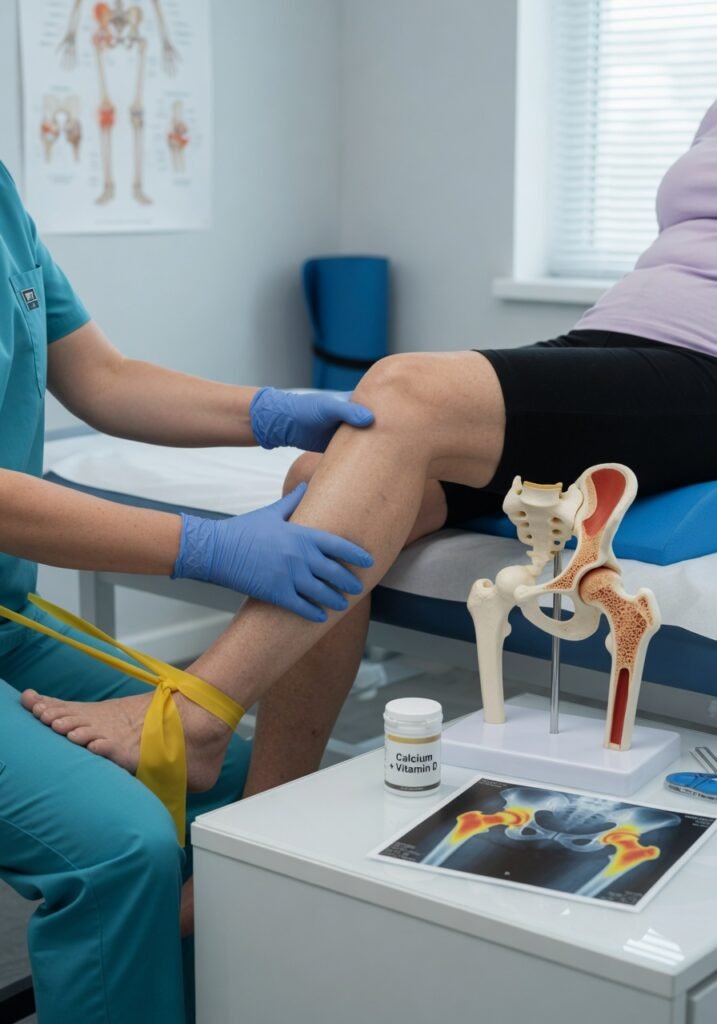

Osteoporosis: What Your Bones Are Telling You Before They Break
Margaret, a 58-year-old accountant, noticed her reading glasses kept slipping down her nose more noticeably over six months. She attributed it to aging, never realizing that losing height—even an inch—was her skeleton quietly announcing a crisis. Research shows that one in three women over 70 will experience an osteoporotic fracture in their remaining lifetime, yet the average person receives their first bone density screening only after a fall has already occurred.
Here’s what catches most people off guard: osteoporosis produces no symptoms while it’s destroying your bones. You won’t feel anything happening. The disease progresses silently, like a financial audit nobody requested, until suddenly a sneeze fractures your rib or stepping off a curb shatters your wrist. The tragedy isn’t the fracture itself—it’s that we have remarkably effective prevention strategies, yet roughly 30 million Americans remain undiagnosed.
Key Facts About Osteoporosis
- Approximately 10 million Americans have osteoporosis, with another 43 million experiencing low bone mass, according to NIH data
- Hip fractures associated with osteoporosis require surgery in 90% of cases and result in permanent disability in 50% of survivors
- Women lose bone density fastest during the first 5-8 years after menopause, dropping up to 20% of total bone mass
- A DEXA T-score of -2.5 or lower defines osteoporosis; between -1.0 and -2.5 is classified as osteopenia
- Medicare covers bone density screening for women over 65 and men over 70, plus anyone with specific risk factors regardless of age
Understanding What’s Actually Happening Inside Your Bones
Your skeleton isn’t inert. It’s a dynamic tissue constantly remodeling itself—breaking down old bone and building new bone. Think of it like a city perpetually renovating its infrastructure. In childhood and early adulthood, new construction outpaces demolition. Peak bone mass occurs around age 30. After that, demolition starts winning the race.
Osteoporosis develops when bone resorption (the demolition phase) outpaces bone formation (the construction phase) too dramatically. The result? Your bones become porous—literally full of tiny holes—and lose both density and structural integrity. A healthy bone looks relatively solid under a microscope. An osteoporotic bone resembles a honeycomb with enlarged chambers and thinner walls. The architectural integrity collapses even though the bone might appear normal-sized.
What makes this process particularly insidious is that it’s partially driven by estrogen deficiency. Estrogen acts like a foreman slowing down the demolition crews. When estrogen levels plummet during menopause, those crews essentially work overtime. Men experience a more gradual decline in bone density because testosterone drops more slowly and less dramatically—which is why osteoporosis typically strikes women a decade earlier.
Why Your Bones Are Failing: Causes and Risk Factors
Some risk factors you cannot modify—these are your foundation. Female sex, age over 50, and family history of osteoporosis create vulnerability. If your mother had a hip fracture, your fracture risk increases substantially. Asian and Caucasian women face higher risk than Black women, though Black women certainly develop osteoporosis and shouldn’t assume they’re protected.
Modifiable factors matter more than most patients realize. Inadequate calcium intake matters, yes, but here’s what gets overlooked: vitamin D deficiency is shockingly common and directly impairs calcium absorption. You can consume 1,200 mg of calcium daily and still fail to build bone if your vitamin D level sits at 20 ng/mL. A CDC analysis found that roughly 35% of Americans have insufficient vitamin D levels.
Physical inactivity deserves mention as perhaps the most underestimated modifiable risk factor. Bones respond to mechanical stress. Sedentary people literally signal their skeleton, “we don’t need you.” The skeleton, obligingly, becomes expendable. Weight-bearing exercise—walking, jogging, dancing, resistance training—directly prevents bone loss. Conversely, prolonged immobility (such as extended bedrest) causes rapid bone deterioration.
One factor that frequently escapes attention: certain medications actively cause bone loss. Systemic corticosteroids like prednisone, even at modest doses used for conditions like rheumatoid arthritis or COPD, accelerate resorption. Similarly, some seizure medications and certain cancer treatments increase fracture risk. If you take chronic corticosteroids, bone density screening becomes essential regardless of age.
Chronic kidney disease, hyperthyroidism, inflammatory bowel disease, and multiple myeloma all compromise bone health through different mechanisms. Excessive alcohol consumption (more than 3 drinks daily) and smoking both accelerate bone loss. Some studies suggest caffeine contributes modestly to bone loss, though the effect pales compared to other factors.
The Subtle Warning Signs You’re Probably Ignoring
Osteoporosis itself causes no pain, no fatigue, no warning sensation. Many patients expect symptoms—they expect their body to announce a problem. It doesn’t. This silence is precisely what makes early detection through screening so valuable.
However, certain signs warrant investigation. Progressive height loss (more than one inch over several years) suggests vertebral compression fractures, even without obvious trauma. Some patients develop a curved upper back posture—a dowager’s hump—from multiple small spinal fractures. Others experience chronic back pain without a clear cause; sometimes this reflects vertebral collapse.
Unexplained fractures merit serious attention. If you fractured your wrist from falling on an outstretched hand, or fractured your hip stepping off a low curb, these are what physicians call fragility fractures. They suggest bone quality has deteriorated significantly. Any fragility fracture warrants immediate bone density evaluation and treatment initiation.
Some patients notice receding gums or loose teeth. Osteoporosis affects the jaw’s bone density just as it affects the spine and hip. Dental problems sometimes precede detection of generalized osteoporosis.
How Doctors Actually Diagnose Osteoporosis
The DEXA scan (dual-energy X-ray absorptiometry) remains the gold standard diagnostic tool. Despite its intimidating name, it’s remarkably simple—you lie fully clothed on a table while a machine scans your hip, spine, and sometimes your forearm. The entire procedure takes 10-30 minutes. Radiation exposure is minimal, roughly 1/10th the dose of a chest X-ray. Most facilities perform the scan in a radiology department or bone health clinic.
Results generate a T-score, which compares your bone density to that of a healthy 30-year-old. A T-score of -1.0 to -2.49 indicates osteopenia (low bone mass). A T-score of -2.5 or lower diagnoses osteoporosis. Some newer imaging techniques like quantitative CT scanning provide three-dimensional assessment, but DEXA remains standard because it predicts fracture risk effectively.
Your doctor might also order basic blood work: calcium, vitamin D, phosphate, alkaline phosphatase, and sometimes thyroid function and kidney function tests. These measurements identify whether nutritional deficiencies or underlying metabolic disease is driving bone loss.
The FRAX calculator is another valuable tool your physician might use. It combines your DEXA T-score with clinical risk factors to estimate your probability of sustaining a major osteoporotic fracture within 10 years. This helps determine whether treatment is necessary based on fracture risk, not bone density alone.
Treating Osteoporosis: What Actually Works
Bisphosphonates remain the first-line pharmaceutical treatment for most patients. Alendronate (Fosamax), risedronate (Actonel), and zoledronic acid (Reclast) slow bone resorption by inhibiting osteoclasts—the cells that break down bone. Taken weekly or monthly orally, or annually by IV infusion, bisphosphonates reduce fracture risk by 30-50% depending on the specific drug and patient population. A landmark JAMA study demonstrated that alendronate reduced hip fracture risk by 51% and spine fracture risk by 48% over three years.
Denosumab (Prolia) works differently—it’s a monoclonal antibody that blocks a receptor on osteoclasts, preventing their activation. Administered as a subcutaneous injection every six months, it’s effective for patients who can’t tolerate oral bisphosphonates or who need more robust treatment. Studies show similar fracture reduction as bisphosphonates.
Selective estrogen receptor modulators like raloxifene (Evista) mimic estrogen’s beneficial effects on bone without the risks of hormone replacement therapy. They’re particularly useful for women who are years past menopause and don’t tolerate bisphosphonates.
For patients with severe osteoporosis or those who’ve already sustained fractures, teriparatide (Forteo), a PTH analog, actually stimulates bone formation rather than merely slowing loss. It’s given as a daily subcutaneous injection for up to two years. The cost is substantially higher than other agents, which usually limits its use to severe cases.
Romosozumab (Evenity) is the newest option—a sclerostin inhibitor that simultaneously increases bone formation and decreases resorption. Given monthly as an IV infusion for one year, it produces rapid increases in bone density, though long-term fracture data is still accumulating.
A critical insight most websites miss: medication choice should align with patient characteristics and preferences. An 72-year-old with esophageal reflux who can’t tolerate oral medications might need IV zoledronic acid or denosumab. A 55-year-old woman with osteopenia might benefit from raloxifene if she also has breast cancer risk factors. Treatment isn’t one-size-fits-all.
Your Daily Strategy for Living With Osteoporosis
Calcium intake matters, but not in the way most people think. The current recommendation is 1,000-1,200 mg daily from all sources. Rather than obsessing over supplement dosing, focus on food sources distributed throughout the day. Your intestines can’t absorb more than 500 mg of calcium at once, so that 1,000 mg supplement taken all at breakfast is largely wasted. Better strategy: 200 mg from yogurt at breakfast, 300 mg from fortified juice at lunch, 300 mg from a glass of milk at dinner, 200 mg from almonds as a snack. Spread it out.
Vitamin D requires 1,000-2,000 IU daily for most adults, more if you’re deficient. Get your level checked—aim for 30-50 ng/mL. Sunlight exposure helps, but northern climates, dark skin, and sunscreen (which you should still wear) all reduce synthesis. Supplement directly.
Weight-bearing exercise isn’t optional—it’s medicine. Walking three times weekly for 30 minutes demonstrably increases or maintains bone density. Resistance training with bands or weights stresses bone even more effectively. If you’re already dealing with osteoporosis or have had fractures, avoid high-impact activities and exercises requiring spinal flexion—consult your physician about what’s safe for your specific situation. Water aerobics and tai chi offer gentle loading without impact risk.
Fall prevention becomes paramount once you’re diagnosed. Remove area rugs, install grab bars in bathrooms, ensure adequate lighting, have your vision and hearing checked, and review your medications—some increase dizziness or confusion. A simple fall that wouldn’t concern a younger person can become catastrophic once your bones are fragile.
Stop smoking and limit alcohol to one drink daily for women, two for men. Both behaviors directly accelerate bone loss. Caffeine is less critical, but excessive consumption (more than 400 mg daily) may modestly increase fracture risk.
Can You Actually Prevent Osteoporosis?
Prevention is