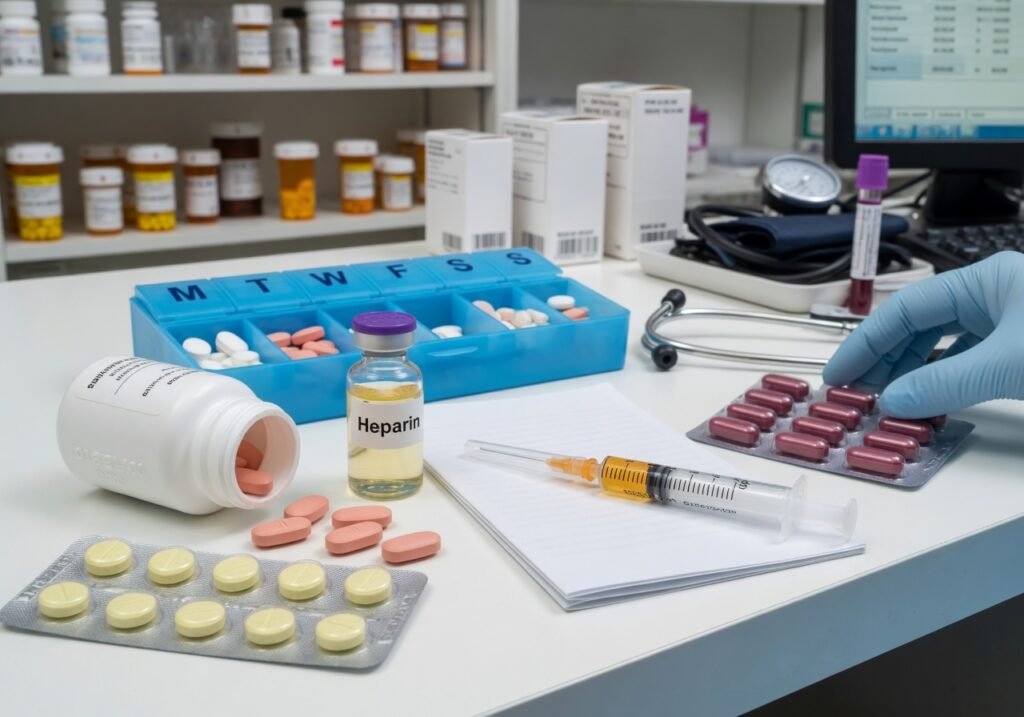
Blood Thinners and Anticoagulants: What Your Doctor Knows That You Might Not
Most people think blood should be thick—that’s just common sense, right? Thicker means it clots better, stops bleeding faster. But here’s what cardiologists and hematologists actually deal with: your blood can become dangerously prone to clotting, and that clot can kill you faster than bleeding out ever would. Sarah, a 52-year-old marketing director, discovered this the hard way when her primary care physician found atrial fibrillation during a routine checkup. She felt fine—no symptoms at all—but her doctor explained that her irregular heartbeat created tiny whirlpools in her left atrium where blood could pool and clot. Without treatment, she faced a 5% annual risk of stroke. She started apixaban that week, and three years later, she’s had zero clotting events. This is the story behind anticoagulant therapy: preventing the invisible threat that your body might be brewing right now.
Key Facts About Blood and Anticoagulation
- Atrial fibrillation affects approximately 2.7 to 6.1 million Americans according to the CDC, and untreated AFib increases stroke risk by 400-500%
- Warfarin (Coumadin), a vitamin K antagonist developed in 1948, still accounts for about 25% of anticoagulant prescriptions despite newer alternatives, because it works for certain patient populations
- Direct oral anticoagulants like apixaban, rivaroxaban, dabigatran, and edoxaban reach therapeutic levels within 2-3 hours, whereas warfarin requires 5-7 days to achieve full effect
- Major bleeding complications occur in approximately 1.5-3% of anticoagulated patients annually, but the stroke risk reduction (typically 60-70% for AFib patients) usually outweighs this risk substantially
- Your blood’s clotting cascade involves 13 different factors and 150+ proteins; anticoagulants interrupt this system at different points depending on the medication class
Understanding How Blood Clotting Works and Why It Goes Wrong
Think of your blood’s clotting system as a carefully orchestrated cascade—literally called the coagulation cascade by physicians. When you cut yourself, a series of proteins activate in sequence, like dominoes falling in precisely the right pattern. Tissue factor kicks off the process, thrombin amplifies the signal, and platelets pile onto the wound site to form a plug. This entire system evolved to keep you from bleeding to death from a papercut.
But here’s the problem: that system doesn’t distinguish between a bleeding wound and a clot forming inside your left atrium where it absolutely shouldn’t. Your heart’s irregular rhythm in AFib creates sluggish blood flow. Sluggish blood is unhappy blood. Unhappy blood activates its clotting machinery. Now you’ve got a thrombus—a stationary clot—that can dislodge and travel to your brain as a stroke. This happens silently. You feel nothing.
Other conditions trigger hypercoagulability too: recent surgery, cancer (which produces procoagulant substances), prolonged immobility like long flights, certain genetic mutations like Factor V Leiden, and even pregnancy-related hormonal changes. Some patients have mechanical heart valves that activate the clotting cascade constantly. Others have suffered a previous DVT or pulmonary embolism and need long-term prevention to avoid recurrence. The underlying mechanism varies, but the principle remains: your body’s protective system has become a threat.
Which Risk Factors Matter Most for You
Not everyone on anticoagulants has the same risk profile. Physicians use the CHA2DS2-VASc score for AFib patients—it adds points for congestive heart failure, hypertension, age over 75, diabetes, previous stroke, vascular disease, age 65-74, and female sex. If your score is 2 or higher for men or 3 or higher for women, anticoagulation typically offers clear benefit.
But there’s a risk factor most articles gloss over: your liver function. Your liver metabolizes most anticoagulants. Patients with cirrhosis, severe hepatitis, or even fatty liver disease may metabolize apixaban and rivaroxaban unpredictably, leading to either insufficient anticoagulation or dangerous accumulation. This is why your doctor orders liver function tests before starting these medications.
Renal function matters enormously too. Dabigatran, apixaban, and edoxaban all depend partly on kidney clearance. Someone with a creatinine clearance below 15 mL/min might not be a candidate for certain anticoagulants, or might need dose adjustments. This is also why your doctor checks your creatinine baseline and annually. Age alone matters less than you’d think—it’s really about organ function.
Signs and Symptoms You Shouldn’t Ignore
Here’s the counterintuitive part: you might feel nothing. That’s actually the problem with many conditions requiring anticoagulation. AFib can be paroxysmal—it comes and goes—and many episodes cause zero symptoms. Patients describe it as palpitations, but some experience shortness of breath, chest discomfort, or just a vague sense that something’s off.
Once you’re on anticoagulation, watch for bleeding that seems unusual or won’t stop: nosebleeds lasting more than 10-15 minutes, bruising from minor bumps that spreads over days, blood in urine or stool, or bleeding gums when you floss. These aren’t automatic reasons to stop the medication—they’re signals to call your doctor immediately. Heavy menstrual bleeding in women on anticoagulants deserves discussion with your gynecologist; sometimes hormonal contraceptives or other solutions help.
An often-overlooked early warning sign: unexplained anemia. Some patients bleed microscopically into their GI tract without realizing it. Their hemoglobin slowly drops. They feel fatigued, but attribute it to stress or age. That fatigue is your body telling you something’s wrong. Blood tests catch this.
How Diagnosis Actually Happens
The diagnostic process depends entirely on why you might need anticoagulation. For AFib, your cardiologist listens to an irregular pulse on exam, confirms it with an EKG showing absent P waves and irregular ventricular rates, and often performs a Holter monitor or continuous monitoring device to catch paroxysmal episodes. They’ll order echocardiography to assess whether your heart’s structure is abnormal and whether you have reduced ejection fraction.
For DVT or pulmonary embolism suspicion, physicians order compression ultrasound (for leg DVT) or CT pulmonary angiography (for suspected PE). These imaging tests either confirm or exclude the diagnosis with high accuracy. For patients with mechanical heart valves or hypercoagulable conditions, diagnosis relies on the clinical situation—the valve placement itself or the positive genetic testing for thrombophilia—rather than imaging.
Your doctor will order baseline labs: complete blood count (to establish your hemoglobin and platelet count), comprehensive metabolic panel (liver and kidney function), and prothrombin time/INR if considering warfarin. If you’re starting a direct oral anticoagulant instead, fewer monitoring labs are needed—usually just annual kidney function checks unless you have renal disease.
Treatment Options and Which One Your Doctor Might Choose
Warfarin was the only option for decades. It inhibits vitamin K-dependent clotting factors (II, VII, IX, X), requiring careful monitoring with INR blood tests every few weeks initially, then monthly or quarterly once stable. Patients must maintain consistent vitamin K intake and watch for interactions with dozens of medications and supplements. Despite these hassles, warfarin remains the choice for patients with severe renal impairment, mechanical heart valves, or antiphospholipid syndrome.
Direct oral anticoagulants (DOACs) changed everything. Apixaban (Eliquis) is a Factor Xa inhibitor dosed twice daily at 5 mg. Rivaroxaban (Xarelto) is also Factor Xa inhibitor but dosed once daily at 20 mg. Dabigatran (Pradaxa) inhibits thrombin directly and is dosed twice daily at 150 mg. Edoxaban (Savaysa) is another Factor Xa inhibitor dosed once daily at 60 mg. Each has slightly different pharmacokinetics and drug interactions, which is why your doctor’s specific choice matters.
DOACs work faster than warfarin, don’t require INR monitoring, and have fewer food interactions. They do carry a slightly higher risk of GI bleeding compared to warfarin, which is why patients with history of GI ulcers need careful discussion. Apixaban and rivaroxaban have the most robust clinical trial data for AFib stroke prevention.
For acute venous thromboembolism, you typically start with parenteral anticoagulation—either low-molecular-weight heparin (enoxaparin) or unfractionated heparin—while transitioning to oral agents. This dual approach prevents thrombus extension while long-acting medications reach steady state.
Daily Management: Practical Strategies That Actually Work
Take your medication the same time every day. This sounds simple but matters for adherence. Some patients set phone reminders; others pair medication with their morning coffee or dinner. Twice-daily medications (apixaban, dabigatran) require more discipline—set two alarms if you need to.
Don’t skip doses to “give your blood a break.” This is a common misconception. Your anticoagulation level drops rapidly with missed doses, creating a window where clots can form. If you forget a dose of once-daily medication, take it as soon as you remember unless it’s almost time for the next dose. For twice-daily medications, the window is shorter—typically 6 hours.
Keep a list of all your medications and supplements. Vitamin E, ginkgo biloba, garlic, and NSAIDs like ibuprofen or naproxen increase bleeding risk when combined with anticoagulants. Acetaminophen is safer for pain. St. John’s Wort decreases warfarin effectiveness. When you see any new physician—dentist, specialist, urgent care—mention you’re anticoagulated.
Track any unusual bleeding and report it. Keep a simple log if you notice nosebleeds, excessive bruising, or blood in urine or stool. Patterns matter more than isolated incidents.
Prevention: What The Evidence Actually Shows
For primary prevention—preventing a first clotting event—the data is narrower than you’d think. Anticoagulation for people with AFib and high CHA2DS2-VASc scores clearly prevents stroke. For people without AFib or other obvious risk factors, routine anticoagulation doesn’t help and increases bleeding risk unnecessarily.
Aspirin was once thought to be protective for stroke prevention in AFib, but large clinical trials have shown it’s significantly inferior to anticoagulation. If you were taking aspirin for stroke prevention, your cardiologist likely switched you to a real anticoagulant.
For secondary prevention—after you’ve had a clot—the story is stronger. Patients with unprovoked DVT or PE should receive extended anticoagulation, typically for at least 3 months and often longer. Patients with provoked events (surgery, immobility) might stop after 3 months. Your thrombosis specialist determines duration based on bleeding risk and recurrence risk.
Frequently Asked Questions About Blood Anticoagulants
Sources & Medical References
HealthTopics.com articles are based on peer-reviewed medical research and guidance from the NIH, CDC, and WHO. See our editorial policy for full sourcing standards.