Cluster Headaches: Why Does the Pain Always Strike at the Same Time Each Day?
Sarah, a 34-year-old graphic designer, started waking up at 2:47 AM with the worst pain she’d ever experienced. It wasn’t just a bad headache—her right eye felt like it was being stabbed, and within minutes her nostril on that side would run and her eyelid would droop. Every night for six weeks, like clockwork, the attacks returned. Then one morning they stopped. Three months later they came back, but this time at 9 PM. Her primary care doctor had dismissed it as migraines. Only when she saw a neurologist did she get answers: cluster headaches, a condition so distinctly patterned that patients can predict their attacks within minutes.
What makes cluster headaches different from anything else is their brutal predictability. The pain doesn’t scatter randomly across your week—it attacks in cycles, with attacks often happening at the same hour each day for weeks or months, then vanishing completely for months or years. This cycling pattern is what defines the condition and what makes diagnosis possible, even when initial tests come back normal.
Key Facts About Cluster Headaches
- Cluster headaches affect approximately 0.1% of the population (about 330,000 people in the United States), according to data published in Cephalalgia, making them 5 times rarer than migraine
- Men are affected 3.5 times more often than women, with typical onset between ages 20-40
- Individual attacks last between 15 to 180 minutes, with most lasting 30-90 minutes of continuous, severe pain
- During an active cluster period, patients experience 1-8 attacks daily, and the entire active episode lasts 2 weeks to 3 months on average
- Approximately 10-15% of patients have the chronic form, where attacks continue year-round without remission periods
Understanding What Actually Happens During a Cluster Attack
Cluster headaches aren’t just migraines that happen to hurt more. The underlying mechanism involves your trigeminal nerve—the major sensory nerve in your face—but with a peculiar timing problem embedded in your brain’s circadian rhythm control center.
Here’s the clearer picture: Your hypothalamus contains a biological clock that normally regulates sleep, hunger, and hormone release. In cluster headache patients, this clock appears to malfunction in a way that triggers the trigeminal nerve repeatedly at the same time each day. When activated, the trigeminal nerve causes blood vessel dilation around the cavernous sinus (a space behind your eye), releasing inflammatory chemicals like calcitonin gene-related peptide (CGRP). This explains why the pain is almost always one-sided and centers around the eye.
Think of it like a fire alarm system that’s wired incorrectly. Instead of going off when there’s actual danger, it activates on a broken timer, often at 2-3 AM when your circadian system naturally dips. Once the alarm triggers, your body’s inflammatory response cascades—vessels swell, nerves fire repeatedly, and you get that unmistakable stabbing sensation.
Causes and Risk Factors: What We Know and What We’re Still Figuring Out
The most significant risk factor is simple: you were born male. The male-to-female ratio of 3.5:1 persists across all age groups and all countries studied, yet we don’t fully understand why. Genetics plays a smaller role than many assume—only about 5% of cluster patients have a family history of the condition, unlike migraine where familial clustering is much stronger.
Smoking is one modifiable risk factor worth mentioning. According to NIH research, 70% of cluster headache patients smoke or have smoked, compared to 18% of the general population. Alcohol consumption, particularly red wine and spirits, can trigger individual attacks during active cluster periods, though it doesn’t cause clusters to start.
Here’s what most articles miss: temporal lobe epilepsy and cluster headaches occasionally co-occur in the same patient, suggesting they may share some underlying neurological wiring problem. Additionally, patients with cluster headaches show abnormalities in the circadian expression of melatonin levels—they produce melatonin at the wrong times of day. This isn’t just an interesting biochemical curiosity; it suggests that melatonin timing therapy might help some patients.
Less commonly discussed but increasingly recognized: obstructive sleep apnea correlates with cluster headache onset in some patients. Whether sleep fragmentation triggers the condition or whether the same underlying brain dysfunction causes both remains unclear, but the association is real enough that sleep studies are worth considering.
Signs and Symptoms: Beyond the Pain
The hallmark pain of cluster headaches is unlike other headache types. Patients describe it as sharp, burning, or like an ice pick being driven through the eye socket. The pain is always one-sided (never bilateral like migraines sometimes are) and concentrates behind or around one eye, though some patients report radiation to the temple or cheek.
What separates cluster from migraine: the autonomic features. While migraines make you want to sit quietly, cluster attacks trigger movement. Patients pace, rock, apply ice, or bang their head against the wall—anything to fight the restlessness. About 80% of cluster patients exhibit this distinctive agitation during attacks.
Accompanying symptoms appear on the same side as the pain:
- Ptosis (drooping eyelid) occurring in 60-70% of attacks
- Conjunctival injection (red, bloodshot eye)
- Nasal congestion or rhinorrhea (runny nose)
- Forehead or facial sweating, often localized to one side
- Miosis (constricted pupil), though this can be subtle
Early warning signs that doctors and patients often overlook include subtle eye tearing 10-20 minutes before pain onset, a mild nasal sensation on the affected side, or vague eye discomfort that precedes the full attack. These prodromal symptoms allow patients to sometimes prepare—by dimming lights or finding a quiet space—before the worst pain hits.
Getting a Diagnosis: What the Process Actually Involves
Diagnosis is clinical, not radiological. Your neurologist will listen carefully for the characteristic pattern: unilateral orbital pain occurring in cycles, lasting 15-180 minutes per attack, happening at roughly the same time each day during active periods. The International Headache Society criteria require at least 5 attacks meeting these specifications.
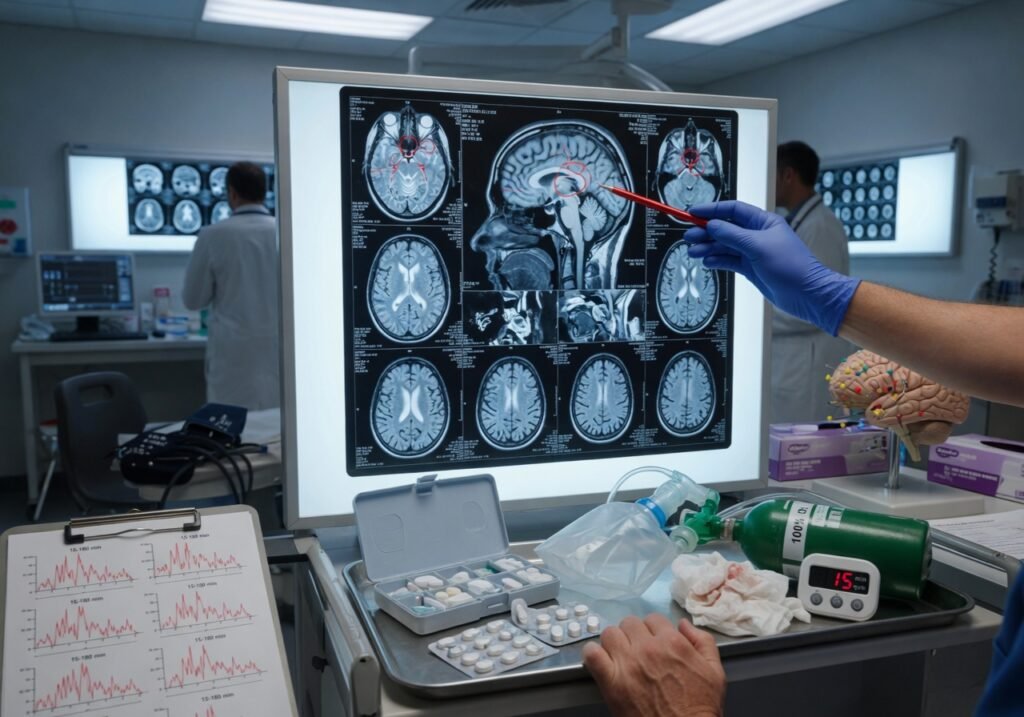
MRI brain imaging is typically ordered not because it diagnoses cluster headaches (it usually shows nothing abnormal), but to exclude mimics like arterial dissection, brain tumors, or cavernous sinus thrombosis. These conditions can present similarly but require different treatment. Most cluster patients undergo at least one imaging study, even though positive findings are rare.
Patients often experience significant diagnostic delay. A JAMA Neurology study found the average time from symptom onset to correct diagnosis was 7 years, partly because cluster headaches are underrecognized and partly because they’re uncommon enough that primary care physicians rarely encounter them. Keeping a detailed attack diary accelerates diagnosis—recording the exact time of onset, duration, associated symptoms, and any triggers gives neurologists clear patterns to recognize.
Treatment Options: What Actually Works
Acute attack treatment focuses on rapid relief. Oxygen inhalation at 100% concentration for 15-20 minutes terminates attacks in about 70% of patients within 15 minutes. This is the fastest option available and requires either a small oxygen tank or a home concentrator. Sumatriptan 6 mg subcutaneously or 20 mg intranasal spray works for 60-70% of patients, though onset is slower (10-15 minutes) than oxygen.
Preventive medications reduce attack frequency during active periods. Verapamil, a calcium channel blocker, is first-line preventive therapy. Doses range from 240-960 mg daily in divided doses, though some patients need up to 1200 mg. Lithium carbonate at 600-1200 mg daily helps certain cluster patients, particularly those with chronic cluster headaches. Topiramate (Topamax) at 100-200 mg daily and valproic acid (Depakote) at 1000-1500 mg daily each work in roughly 50% of patients.
The clinical insight most websites miss: monoclonal antibodies targeting CGRP (erenumab-aooe, given as Aimovig 70 mg monthly) show promise specifically for episodic cluster headaches, with one trial showing complete cessation of attacks in about 30% of treated patients—a remarkable response rate for a single drug. However, insurance coverage for cluster headaches remains restricted in many plans.
For refractory cases, greater occipital nerve blocks using local anesthetic and corticosteroid provide weeks of relief by temporarily suppressing trigeminal nerve activity. Some specialists use sphenopalatine ganglion blocks with similar results.
Daily Management Strategies That Actually Matter
During active cluster periods, avoid known triggers if you’ve identified them. Red wine, alcohol, and vasodilators like nitroglycerin often trigger attacks within an hour in susceptible patients. Some patients discover that seasonal patterns (more clusters in spring or fall) allow them to preemptively start preventive medications.
Maintain consistent sleep schedules. Since attacks often occur at predictable times related to sleep cycles, an erratic schedule can worsen attack frequency. Patients who work night shifts or travel across time zones often report increased cluster activity.
For pain management during attacks, ensure you have your acute medications readily available—nothing is worse than hunting for oxygen when you’re in the worst pain of your life. Keep a small oxygen tank in your car and at work if possible. Have sumatriptan injections or nasal spray within arm’s reach when an attack begins.
Track your attacks meticulously. This isn’t just for diagnosis; knowing your personal pattern helps you recognize if a new preventive medication is actually working or if you’re seeing natural variation in your cluster cycle.
Prevention: The Evidence and Reality
The strongest evidence supports starting verapamil at the first sign of a new cluster cycle beginning. This doesn’t work overnight—it takes 2-3 weeks to reach full effectiveness—so timing matters. If you have a yearly pattern, starting preventive therapy a few weeks before your typical cluster season is more logical than waiting until attacks begin.
Melatonin at 10 mg taken each evening shows mixed but intriguing results in several small trials. The theory is that cluster patients have disrupted melatonin secretion patterns, so supplementation might help reset circadian rhythm dysfunction. It won’t eliminate clusters but may reduce attack frequency by 30-50% in responsive patients. The caveat: larger, high-quality trials are needed.
Avoiding smoking cessation programs during active clusters may paradoxically help, since nicotine’s vasoconstrictive effects might temporarily reduce attack severity (though this obviously doesn’t mean smoking is recommended—quit when you’re in remission).
One preventable mistake: some patients assume their cluster has permanently resolved and stop preventive medications during remission. This is appropriate if you have episodic clusters. But if your cycles are shortening or remission periods shrinking, your condition may be transitioning toward chronic cluster headaches, requiring continuous prevention.
Frequently Asked Questions
Are cluster headaches the same as migraines?
No. While both are severe headaches, cluster headaches are one-sided and come in cycles with attack-free remission periods, whereas migraines are triggered by specific factors and can be bilateral. Cluster attacks cause restlessness and agitation with distinctive autonomic symptoms (drooping eyelid, red eye, nasal congestion), while migraines cause photosensitivity and make people want to lie quietly. Treatment
Sources & Medical References
HealthTopics.com articles are based on peer-reviewed medical research and guidance from the NIH, CDC, and WHO. See our editorial policy for full sourcing standards.