Margaret, a 62-year-old retired teacher, noticed her right hand shaking slightly while holding her morning coffee—nothing alarming at first, maybe just nerves or too much caffeine. But over the next six months, the tremor didn’t improve, and she realized she was moving more slowly, her handwriting had become smaller and cramped, and her face felt oddly stiff. Her doctor ran some tests and confirmed what she’d been dreading: Parkinson’s disease. Now, three months into treatment with carbidopa-levodopa, she’s learning that early detection and the right medication regimen can help her maintain independence for years to come.
Parkinson’s disease affects approximately 1 million people in the United States, according to the NIH, and it develops when dopamine-producing nerve cells in the brain deteriorate. While there’s no cure, understanding the early signs and starting treatment promptly can make a dramatic difference in how the disease unfolds over time.
Key Facts About Parkinson’s Disease
- The average age of onset is 60 years old, though 5-10% of patients develop symptoms before age 50 (early-onset Parkinson’s)
- Men are 1.5 times more likely to develop Parkinson’s than women, according to CDC epidemiological data
- Approximately 90% of Parkinson’s patients experience tremor, while 70% experience bradykinesia (slowed movement) at some point
- The disease progresses at different rates—some patients remain stable for 15+ years with proper treatment, while others experience faster decline
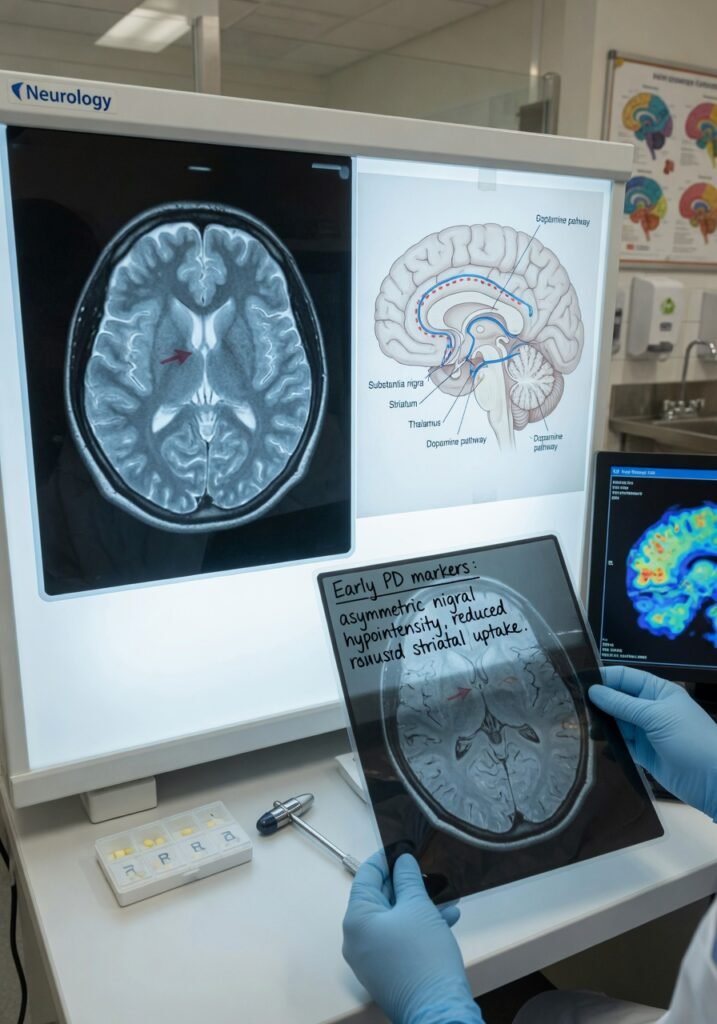
- Loss of dopamine in the substantia nigra region of the brain is the hallmark pathology, with levels dropping 60-80% before symptoms typically appear
Understanding Parkinson’s Disease: What Happens in Your Brain
Think of dopamine as a chemical messenger that helps your brain coordinate smooth, intentional movement. In Parkinson’s disease, the cells that manufacture dopamine in a specific brain region called the substantia nigra start dying off. Unlike a light switch flipping suddenly, this is more like a dimmer gradually getting turned down. Your brain compensates initially—you don’t notice much when you’re losing the first 30% or 40% of dopamine. But once you dip below about 60% of normal levels, the movement problems become noticeable.
What makes this worse is that dopamine doesn’t just control movement—it influences mood, motivation, and how your brain processes reward. That’s why many Parkinson’s patients develop depression or anxiety alongside the motor symptoms. The tremor, stiffness, and slowness you see are just the visible part of a larger neurochemical disruption happening throughout multiple brain regions.
What Actually Causes Parkinson’s Disease
Genetics play a role, but here’s the nuance most health articles skip: having a Parkinson’s gene doesn’t guarantee you’ll develop the disease. About 10-15% of Parkinson’s cases run in families, yet many genetic carriers never get sick. This tells us environment matters hugely. The real story is likely a combination of inherited susceptibility plus environmental exposures.
Pesticide exposure, particularly to compounds like paraquat and rotenone used in agriculture, correlates with increased Parkinson’s risk. People who worked as farmers or lived near agricultural areas for decades show higher disease rates. Head trauma appears on the risk list too—repeated concussions or significant head injuries increase your odds, though a single minor bump doesn’t cause the disease.
One underappreciated risk factor: chronic manganese exposure. Welders and industrial workers exposed to manganese dust can develop a Parkinson’s-like syndrome. The mechanism differs slightly from classical Parkinson’s, but it shows how environmental toxins targeting dopamine systems can trigger neurological damage.
Age remains the strongest predictor—your risk doubles roughly every five years after age 60. Male sex confers additional risk through unclear mechanisms, possibly involving hormonal differences or sex-linked genetic factors.
Early Warning Signs You Shouldn’t Ignore
Most people focus on tremor, and yes, shaking in one hand is the classic presentation. But here’s what catches people off guard: the subtle signs come first and often get attributed to aging or stress.
Bradykinesia—that’s the medical term for abnormal slowness—sneaks up. Your spouse notices you’re moving slowly when getting out of chairs. Buttons become frustrating. Writing your signature requires concentration. You’re not lazy; your brain’s motor commands are traveling through a sluggish neural pathway.
Rigidity creates a sensation of stiffness, particularly noticeable in your neck, shoulders, or legs. Your arm doesn’t swing normally when you walk. Some patients describe it as feeling like they’re moving through invisible resistance.
Facial masking catches many people: your face becomes less expressive, less mobile. You’re not depressed or angry; you just can’t generate the micro-expressions that normally animate human faces. Loved ones sometimes misinterpret this as emotional withdrawal.
The non-motor signs are crucial too. Balance problems, frequent falls, constipation (often preceding movement symptoms by years), sleep disruption, and changes in smell all point toward Parkinson’s. Anosmia—reduced ability to smell coffee, perfume, or other scents—is surprisingly common and often appears early.
How Doctors Actually Diagnose Parkinson’s
There’s no blood test or imaging study that definitively confirms Parkinson’s disease. Your neurologist relies on clinical judgment, which means the diagnosis depends partly on their experience and expertise. They’ll look for at least two of these cardinal features: resting tremor, rigidity, or bradykinesia. They’ll check your postural reflexes—how well you can catch yourself if pulled backward. They’ll assess your gait pattern.
Your doctor might order an MRI to rule out other conditions mimicking Parkinson’s, like normal pressure hydrocephalus or stroke-related parkinsonism. A PET scan or SPECT scan can show dopamine depletion, but insurance often won’t cover these unless diagnosis is already clear.
The most informative test? How you respond to levodopa medication. If your symptoms improve noticeably within days to weeks of starting carbidopa-levodopa, that response actually strengthens the Parkinson’s diagnosis.
Current Treatment Options That Actually Work
Carbidopa-levodopa (Sinemet) remains the gold standard. Levodopa is a precursor to dopamine—your brain converts it into dopamine. Carbidopa prevents levodopa from being converted too early in your body, ensuring more reaches your brain. Most patients start with 25/100 mg tablets three times daily, adjusting doses based on response.
Dopamine agonists like pramipexole (Mirapex) or ropinirole (Requip) directly stimulate dopamine receptors. They’re often started first in younger patients to delay levodopa use, though they carry risks of compulsive behaviors and impulse control problems in some people.
MAO-B inhibitors such as selegiline (Eldepryl) or rasagiline (Azilect) block dopamine breakdown, extending dopamine’s activity. They’re mild and well-tolerated but less potent than other options.
Catechol-O-methyltransferase (COMT) inhibitors like entacapone (Comtan) extend levodopa’s duration of action. Patients taking levodopa frequently combine it with entacapone for smoother symptom control throughout the day.
Deep brain stimulation (DBS) comes into play for advanced cases where medications lose effectiveness or cause troublesome side effects. A neurosurgeon implants electrodes in specific brain regions—usually the subthalamic nucleus—and programs them to deliver electrical pulses that normalize abnormal brain signaling. It’s not a cure, but it can dramatically improve quality of life.
Daily Strategies That Actually Help
Medication timing matters tremendously. Levodopa works best on an empty or nearly empty stomach—taking it with food delays absorption. Space doses consistently; if you normally take it at 8am, 1pm, and 6pm, stick to that schedule religiously. Your brain thrives on predictability.
Exercise transforms outcomes. The journal Neurology published research showing that aerobic exercise three times weekly for 30 minutes slowed cognitive decline in Parkinson’s patients. Treadmill walking, swimming, or cycling engage large muscle groups and appear to boost dopamine system resilience. Why? It’s unclear, but the data is solid.
Physical therapy targeting gait patterns prevents falls. A physical therapist can teach you how to initiate movement when “freezing” occurs—that terrifying moment when your feet lock mid-step. Techniques like stepping over imaginary lines or marching in place can unlock the freeze response.
Occupational therapy modifies your environment. Wider door handles, button hooks, and adaptive clothing remove barriers to independence. Speech therapy helps with swallowing and voice volume; Parkinson’s patients often speak quietly without realizing it.
Sleep hygiene becomes medical necessity, not luxury. Parkinson’s disrupts sleep architecture. Establishing consistent bedtimes, avoiding screens two hours before bed, and discussing sleep problems with your neurologist prevents the cascade of problems that poor sleep triggers.
Can Parkinson’s Be Prevented?
Prevention is where the evidence gets frustratingly uncertain. No single intervention prevents Parkinson’s outright. That said, some factors show promise.
Caffeine consumption correlates with lower Parkinson’s risk in observational studies—people drinking four or more cups of coffee daily show about 60% lower risk compared to non-drinkers. The mechanism likely involves adenosine receptor blocking, but causation hasn’t been proven. This doesn’t mean drinking coffee prevents the disease; rather, coffee drinkers happen to develop it less frequently.
Physical activity throughout life shows protective associations. Avoiding pesticides when possible, particularly if you live near agricultural regions, makes logical sense even if direct prevention isn’t proven.
Some evidence suggests NSAIDs like ibuprofen might lower risk, while estrogen replacement in postmenopausal women shows mixed findings. None of these are definitive prevention strategies—think of them as factors that might slightly shift your odds.
Clinical Insight Most Articles Miss
Parkinson’s disease isn’t a single disease but likely several conditions sharing similar dopamine loss. A patient’s genetic background, environmental exposures, and specific brain regions affected create unique disease presentations. This explains why identical twins with genetic predisposition show different ages of onset and progression rates. Personalized medicine—tailoring treatment to your specific biology—represents the future of Parkinson’s care, but most practices still use one-size-fits-all approaches.
Common Misconception Corrected
Myth: Parkinson’s disease causes dementia and you’ll inevitably lose your mind. Reality: While cognitive changes occur in some patients, particularly later in disease course, many Parkinson’s patients maintain normal cognition for decades. Parkinson’s disease dementia differs from Alzheimer’s pathologically and behaviorally. Early-onset cases, in particular, often progress slowly regarding cognition. Depression, anxiety, and medication side effects can mimic cognitive problems, creating false impressions of decline.
Frequently Asked Questions
Is Parkinson’s disease hereditary?
Genetics contribute to risk, but most Parkinson’s cases (85-90%) occur without a clear family history. Having a parent or sibling with Parkinson’s increases your risk, but doesn’t guarantee you’ll develop it. Genetic variants like LRRK2, GBA, and SNCA mutations confer varying levels
Sources & Medical References
HealthTopics.com articles are based on peer-reviewed medical research and guidance from the NIH, CDC, and WHO. See our editorial policy for full sourcing standards.