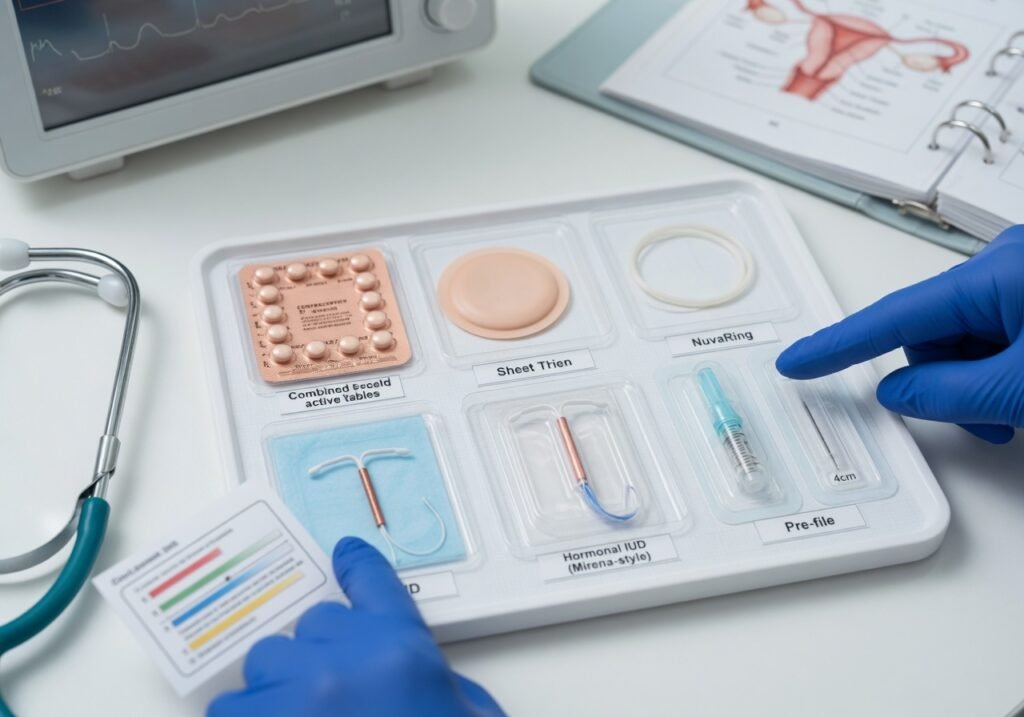

Contraception Compared: All Methods Ranked by Effectiveness
Sarah, 28, came into my office convinced that the birth control pill was her best option because “everyone uses it.” What she didn’t know—and what most patients don’t realize—is that the pill fails in about 9 out of every 100 typical users annually, while an IUD fails in fewer than 1 out of every 100. She’d been comparing contraceptive methods like most people do: based on what friends recommend and what’s easiest to remember. But effectiveness isn’t a simple ranking from best to worst. It’s actually more complicated than that.
Here’s what separates medical reality from common assumptions: the difference between perfect use and typical use is where most patients get misled. A method can be theoretically perfect in a clinical trial, but if real humans forget pills, lose condoms, or don’t insert diaphragms correctly, the real-world failure rate climbs dramatically. I want to walk you through what the data actually shows, which methods work best for different situations, and which ones people consistently overlook.
Key Facts About Contraceptive Effectiveness
- IUDs (copper and hormonal) fail in approximately 0.2-0.8% of typical users annually, making them among the most reliable reversible methods available, according to CDC data.
- The birth control pill has a 9% annual failure rate with typical use, but only 0.3% with perfect use—a 30-fold difference that most patients don’t understand when making decisions.
- Subdermal implants like Nexplanon have a 0.05% failure rate and require zero user action after insertion, yet only about 2-3% of American women use them despite this reliability.
- Male condoms have an 18% annual failure rate with typical use, largely due to inconsistent application, storage in hot wallets, or breakage during use—far higher than most men assume.
- Fertility awareness methods (tracking ovulation) have failure rates between 24% and 24% with typical use according to JAMA reporting, making them unreliable for those who cannot tolerate unintended pregnancy.
Understanding How Contraception Actually Works in Your Body
Think of contraception like security for your reproductive system. Some methods are like bouncers at the door (barrier methods—condoms, diaphragms). Some disrupt the entire system so an intruder can’t survive (hormonal pills and implants that prevent ovulation). Some make the environment hostile to invaders (copper IUDs create an inflammatory response that immobilizes sperm). And some just lock the door entirely (sterilization).
The pill works by preventing your pituitary gland from signaling your ovaries to release an egg. It thickens cervical mucus as a backup. The hormones—either progestin alone or a combination of estrogen and progestin—essentially tell your body “we’re already pregnant, no need to ovulate.” Your menstrual cycle continues somewhat normally, but without the ovulation part, there’s nothing for sperm to fertilize.
IUDs work differently. Copper IUDs (like Paragard) create a chemical environment that immobilizes sperm and prevents implantation. Hormonal IUDs (Mirena, Skyla, Kyleena) release a steady dose of progestin directly into your uterus, thickening cervical mucus and sometimes preventing ovulation. The key difference? IUDs require almost no continued action from you. You get it inserted and forget about it for 3-12 years depending on the type.
Hormonal implants work like a sustained-release delivery system. Nexplanon is a single plastic rod about the size of a matchstick inserted under the skin of your arm. It releases progestin continuously for three years. Your body chemistry doesn’t change as dramatically as with pills—the hormone concentration stays steadier, which is why effectiveness is higher.
Which Factors Determine Which Method Works for You
Effectiveness depends partly on biology and partly on human behavior. Let me break down the factors that actually matter:
Your tolerance for hormones
Some women experience breakthrough bleeding, mood changes, or weight fluctuations on hormonal contraceptives. Others feel fine. There’s no way to predict this without trying. If you’ve had hormonal side effects before, you’ll want to consider non-hormonal options like copper IUDs or barrier methods.
Your ability to remember
This might sound obvious, but it’s the biggest practical difference. If you forget to take pills more than twice a year—and honestly, most people do—your failure rate jumps. If you travel across time zones frequently, pill timing gets complicated. If you take antibiotics or anticonvulsants, some pills become less effective. If your life is chaotic, methods requiring zero remembering (IUDs, implants) are genuinely better for you, not just in theory but in reality.
Your menstrual bleeding pattern preferences
Copper IUDs typically increase menstrual bleeding and cramping. Hormonal IUDs and implants often reduce bleeding significantly or stop it entirely. Some women love amenorrhea (no periods). Others find it unsettling. This isn’t a minor side effect—satisfaction with your method depends partly on whether you can tolerate changes to your cycle.
Frequency of sexual activity and number of partners
This is what most articles dance around but should state plainly: if you have multiple partners or inconsistent sexual activity, barrier methods with another backup method make sense. If you’re in a committed monogamous relationship and concerned primarily about pregnancy, a highly effective reversible method like an IUD or implant makes more sense. Partner STI status and your own sexual health screening should factor into decisions about barrier method use.
Cost and insurance coverage (the overlooked factor)
This matters more than doctors sometimes admit. A copper IUD costs $500-1200 upfront but lasts 10 years. A year of pills costs $50-300 depending on insurance. If you pay out-of-pocket, the IUD seems expensive until you calculate the actual cost per month. Many insurance plans cover IUDs at 100% now, but not all. If you can’t afford the upfront cost of an implant or IUD, a pill you can actually take regularly beats a method you can’t access.
What You’ll Actually Experience With Each Method
Birth control pills
Day-to-day life involves remembering to take a pill at roughly the same time daily. Within the first few months, some women experience nausea (often improves after a few cycles), breast tenderness, or mood changes. Many experience lighter, more regular periods. Some notice water retention or mild headaches. About 30% of women have spotting between periods in the first three months.
IUDs (both types)
Insertion feels like intense menstrual cramping for 30-60 seconds—not unbearable for most, but definitely uncomfortable. Some women take ibuprofen beforehand. For copper IUDs, expect heavier periods and worse cramping for the first few months; this often improves but may persist. For hormonal IUDs, spotting is common for 3-6 months, then many women have much lighter periods or none at all. After insertion, you feel nothing. You check the strings monthly to confirm it’s in place. That takes 30 seconds.
Subdermal implants
Insertion is quick and causes minimal discomfort. Your arm will be slightly sore and might bruise. After insertion, you have a small lump under your skin you can feel but usually can’t see. Within weeks, you stop noticing it exists. Irregular bleeding is common in the first months; some women then have no periods, others have frequent spotting. The unpredictability of bleeding patterns is the main reason some women dislike implants despite their reliability.
Condoms
Zero systemic effects. No hormones, no cramping, no forgetting a pill at 11 PM. The tradeoff is that they require action each time and are less effective than other methods. Sensitivity concerns are real for some people. Most people fail to use them perfectly—putting them on after some contact, not checking expiration dates, storing them improperly.
Ranking Methods by Actual Effectiveness (Typical Use)
This is the ranking that matters because it reflects real life, not ideal conditions:
- Subdermal implants (Nexplanon): 0.05% annual failure rate — Essentially perfect. It works whether you remember it or not.
- Copper IUD (Paragard): 0.8% annual failure rate — Highly reliable. Requires checking strings but no other action.
- Hormonal IUDs (Mirena, Skyla, Kyleena): 0.2-0.8% depending on type — Nearly as reliable as copper. Mirena is slightly more reliable than smaller variants.
- Birth control pill: 9% annual failure rate — Common but only if used perfectly. Typical users skip pills, take them at inconsistent times, or don’t account for interactions.
- Birth control patch: 9% annual failure rate — Same as pills, but one advantage: you change it weekly so fewer opportunities to forget.
- Hormonal vaginal ring: 9% annual failure rate — Same failure rate as pills, but you insert it and it works for three weeks before changing.
- Injectable contraceptive (Depo-Provera): 6% annual failure rate — Better than pills partly because you only need to remember to get an injection every 12 weeks.
- Male condoms: 18% annual failure rate — Significant real-world failures from improper use, breakage, or inconsistent application.
- Fertility awareness methods: 24% annual failure rate — Highly operator-dependent. Requires consistent tracking and discipline.
- Spermicide alone: 28% annual failure rate — Not a primary method anymore due to poor effectiveness.
- Withdrawal: 22% annual failure rate — Unreliable due to pre-ejaculate containing sperm and difficulty with consistency.
Making the Right Choice for Your Situation
Here’s the clinical insight most articles miss: the “best” method is the one you’ll actually use correctly and keep using. A copper IUD is objectively more effective than pills, but if the thought of an object in your uterus causes severe anxiety, you won’t use it. Conversely, if you’re someone who absolutely cannot remember daily tasks, the most reliable pill in the world won’t work as well as an implant that requires zero memory.
If you want maximum reliability and can tolerate an invasive procedure
Get an IUD or implant. Subdermal implants are especially good if you want no menstrual bleeding. Copper IUDs are good if you want to avoid hormones entirely. Hormonal IUDs split the difference—effective and usually make periods lighter.
If you need backup contraception or have specific concerns
Using condoms plus another method (called “dual protection”) reduces failure risk significantly. This is especially appropriate if you’re not in a mutually monogamous relationship or haven’t both been recently screened for STIs.
If hormones concern you
Copper IUDs are non-hormonal and effective. Barrier methods (condoms, diaphragms) are non-hormonal but less reliable. Note: “hormonal side effects” from a copper IUD are not actually from hormones—they’re from the copper itself, which causes an inflammatory response. This is different from hormonal methods’ side effects but can still be uncomfortable.