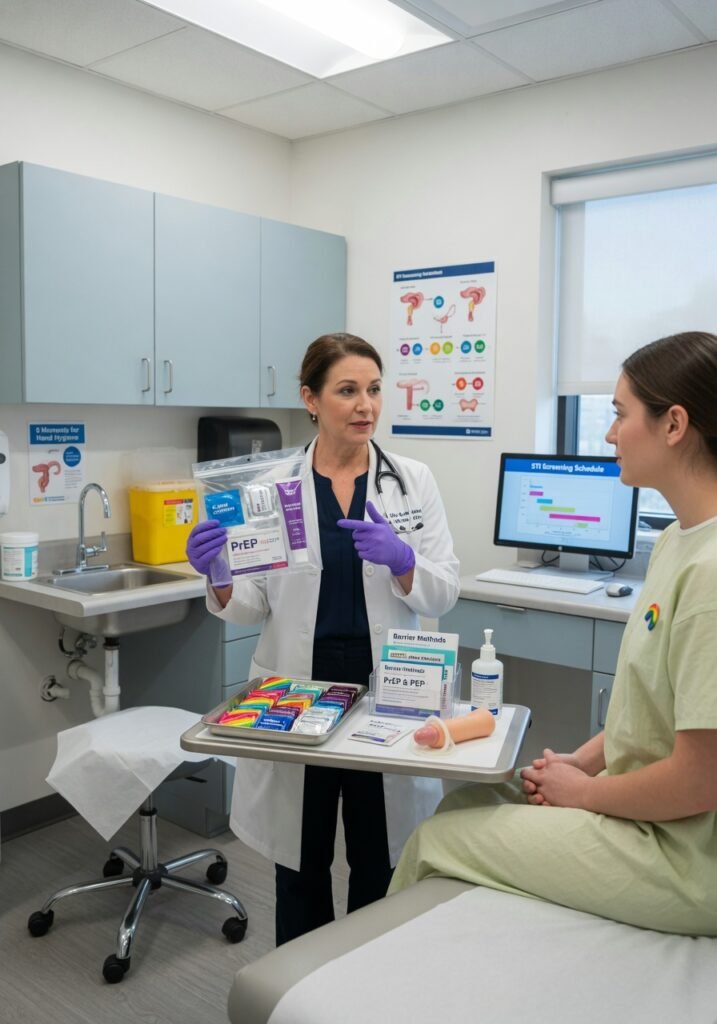
Does condom use really cut STI transmission risk in half, or is that oversimplified?
That’s the question Marcus asked his doctor after finding out his girlfriend tested positive for chlamydia despite using condoms “most of the time.” The answer matters because condoms don’t just reduce risk—they eliminate transmission for many infections when used consistently and correctly. But the word “most” is where prevention fails. Marcus’s situation reveals something most people don’t fully grasp: STI prevention isn’t about one perfect method. It’s about understanding which infections require which precautions, knowing when you’re actually vulnerable, and making decisions that match your real behavior, not some idealized version of it. This guide walks you through what actually works in sexual health protection, why current approaches sometimes fail, and what you need to do differently.
Key Facts About STI Prevention
- Latex condoms reduce gonorrhea transmission risk by approximately 96% when used consistently and correctly, according to CDC surveillance data, yet typical-use effectiveness drops to 82% due to improper application or inconsistent use
- The NIH reports that 1 in 5 Americans has an active STI at any given time, with young adults aged 15-24 accounting for nearly half of all new infections despite representing only 25% of the sexually active population
- PrEP (pre-exposure prophylaxis) with tenofovir/emtricitabine reduces HIV transmission risk by 99% when taken daily, as demonstrated in the JAMA 2015 IPERGAY trial, yet fewer than 20% of eligible individuals are currently using it
- Partner notification within 48-72 hours of diagnosis increases the likelihood of early treatment and reduces reinfection rates by 65%, yet only 34% of patients inform all partners, according to CDC contact-tracing studies
- Vaccination against HPV prevents 95% of cervical cancers and 90% of anal cancers when administered before sexual debut, yet adult vaccination rates remain below 15% for those over 26
Understanding STI Prevention: What’s Actually Happening
Think of sexual transmission like water flowing through a system of pipes. The infection—bacteria, virus, or parasite—travels through mucosal surfaces: the urethra, cervix, rectum, throat, or urethral opening. Some infections need direct contact with broken skin or mucosal membranes to establish infection. Others are incredibly efficient and can establish footholds with minimal breaching. Your body’s natural defenses—vaginal acidity, urethral flow, immune cells in genital tissue—normally handle minor exposures. But when the pathogen load is high, mucosal defenses are compromised, or exposure is repeated, infection becomes likely.
Prevention works at multiple points in this chain. Condoms create a physical barrier that keeps semen, vaginal fluids, and pre-ejaculate (where viral particles concentrate heavily) away from mucous membranes. PrEP floods your bloodstream with antiretroviral drugs so if HIV penetrates the epithelial barrier, it gets destroyed before establishing infection. Regular screening catches asymptomatic infections before they spread. Vaccines train your immune system to recognize and destroy invaders before they cause disease. Each layer independently imperfect, collectively powerful—if you actually use them.
Causes and Risk Factors: Beyond the Obvious
The primary risk factor is obvious: unprotected penetrative sex with someone who has an STI. But there’s something clinicians see that rarely makes it into patient education: substance use during sexual activity significantly increases STI acquisition, not because drugs “cause” STI directly, but because alcohol and certain drugs impair judgment about partner selection, reduce condom use, and increase the number of partners in a given timeframe. A study published in Drug and Alcohol Dependence found that sexual encounters involving alcohol or marijuana showed 3.2 times higher rates of unprotected intercourse.
Other major factors include multiple concurrent partners (though the actual risk is less about number and more about overlap—serial partners you use protection with pose far less risk than one current partner you don’t protect against), age under 25 (your immune system’s still developing its sexual-health-specific responses), anatomic factors like cervical ectopy in young women (immature cells are more vulnerable to certain pathogens), and previous STI history (suggests either patterns of unprotected sex or inconsistent protection use).
Here’s the overlooked piece: relationship power dynamics. Partners who can’t negotiate condom use—because of economic dependence, relationship fear, or cultural factors—face dramatically higher STI risk regardless of other precautions. A patient who’s afraid to ask her partner to use a condom won’t benefit from knowing about PrEP or vaccinations.
Signs and Symptoms: What You’ll Actually Notice
Many STIs produce no symptoms whatsoever. Chlamydia, gonorrhea, HPV, and early HIV often establish infection silently. When symptoms do appear, they vary wildly by infection type and anatomic site.
For urethritis (inflammation of the urethra, usually from gonorrhea or chlamydia in men), expect dysuria—burning with urination that feels sharp and concentrated—often accompanied by urethral discharge that might be clear, cloudy, or yellowish. The discharge appears 2-7 days after exposure. In women with cervicitis, symptoms might be absent or include vaginal discharge, pelvic pain with deep penetration, or breakthrough spotting between periods.
Herpes simplex presents with prodromal tingling 24-48 hours before vesicles appear. The blisters are exquisitely painful—touching them is like touching a nerve ending directly. This pain often precedes the visible lesions by hours, meaning people frequently think they have a blister when they just have the sensation. First episodes are worse than recurrences; recurrent herpes often announces itself through a single tender spot that heals without ever developing obvious blisters.
Syphilis has three stages. Primary syphilis starts as a painless ulcer (chancre) exactly where the spirochete entered—genitals, mouth, anus, or even fingers. People dismiss it because it doesn’t hurt. Secondary syphilis shows up weeks later with systemic symptoms: rash (including on palms and soles, which is pathognomonic), fever, lymphadenopathy, and constitutional symptoms that mimic viral illness. Tertiary syphilis, if untreated, causes neurosyphilis or cardiovascular damage years later.
The critical insight clinicians know but most articles don’t explain: you can be contagious for days or weeks before symptoms appear. The moment you become aware something’s wrong is often long after you’ve potentially transmitted it.
Diagnosis: The Actual Testing Process
Diagnosis depends on infection type. For bacterial STIs like chlamydia, gonorrhea, and mycoplasma, nucleic acid amplification tests (NAATs) are the gold standard—sensitive >95%, specific >99%. Your doctor swabs the urethra, cervix, rectum, or pharynx depending on exposure history, or you provide a first-void urine sample. Results typically return in 24-72 hours.
Herpes serology (blood test for HSV-1 and HSV-2 antibodies) takes 2-4 weeks after exposure to turn positive, so acute infection requires direct visualization or PCR of vesicular fluid. Syphilis uses RPR or VDRL screening tests (non-treponemal) followed by FTA-ABS or TP-PA (treponemal-specific) confirmation. Most people don’t realize that “syphilis negative” means you need TWO tests coming back negative—the screening test plus the confirmatory test.
HIV diagnosis involves a fourth-generation antigen/antibody test that detects both HIV antibodies and p24 antigen. The window period—time between infection and detectable antigen—is roughly 18-45 days. This is why people who’ve had potential exposures need follow-up testing at 6 weeks and 3 months, not just once. HPV isn’t routinely tested in asymptomatic individuals; we screen for HPV’s consequences using Pap smears (cervical cells) or HPV DNA tests.
The patient experience most clinics handle poorly: they don’t discuss your actual sexual history to determine which tests you need. Asking only “Are you sexually active?” misses crucial information about anatomy involved. Rectal exposure is common but rarely screened for unless the patient brings it up, yet the rectum harbors STIs differently than the urethra or cervix.
Treatment Options: What Actually Cures These Infections
Bacterial STIs respond excellently to antibiotics. Chlamydia and mycoplasma genitalium clear with azithromycin (though resistance is emerging, making doxycycline increasingly preferred). Gonorrhea currently requires ceftriaxone 500mg intramuscularly as a single dose—oral options have become ineffective due to widespread resistance. Syphilis responds to benzathine penicillin G 2.4 million units intramuscularly as a single injection for primary, secondary, or early latent disease; more advanced disease needs multiple doses.
Viral STIs don’t disappear—your immune system controls them, but they establish latency. Herpes simplex responds to acyclovir 400mg three times daily or valacyclovir 500mg twice daily; suppressive therapy (taking antivirals daily regardless of symptoms) reduces transmission to partners by 50% and outbreak frequency by 70%. HIV requires combination antiretroviral therapy—typically an integrase inhibitor like dolutegravir plus two nucleoside reverse transcriptase inhibitors. Undetectable viral loads (below 50 copies/mL) mean untransmittable virus, essentially curing the transmission risk even if the virus persists in latent reservoirs.
HPV has no cure, but cervical precancerous lesions respond to cryotherapy, loop electrosurgical excision (LEEP), or laser ablation. Genital warts respond to podophyllotoxin, imiquimod, sinecatechins, or cryotherapy.
Here’s what changes outcomes: partner notification and simultaneous treatment. If your partner doesn’t get treated, you’ll reinfect each other. Testing for cure is critical—some infections require post-treatment testing 3-4 weeks after completing antibiotics to confirm eradication.
Practical Daily Management: Strategies That Actually Work
If you have a diagnosed STI: Take medications exactly as prescribed, even if symptoms vanish after day two. Complete the entire course. If you’re taking doxycycline, don’t lie down for 30 minutes afterward (pill-induced esophagitis is genuinely painful). Notify partners from the past 60 days for bacterial infections, past 12 months for viral infections. Don’t have sex until cleared by your provider—for bacterial infections, that’s usually 7 days after treatment completion or 7 days after partner treatment begins, whichever is later.
If you’re preventing infection: Use condoms consistently. “Mostly” doesn’t work. This means from start to finish of every sexual encounter, every time. Store them at room temperature (car glove boxes destroy them). Check expiration dates (older condoms become brittle). Water or silicone-based lubricant helps prevent breakage; oil-based lubricant degrades latex. Use a new condom for each act—no switching between partners mid-encounter without a fresh one.
Consider PrEP if you’re HIV-negative but have ongoing risk: unprotected sex with untested partners, multiple partners, diagnosis of another STI (which predicts future risk), or partners with unknown HIV status. It requires monthly provider visits initially, then every 3 months, plus adherence to daily medication.
Get vaccinated: HPV vaccine (Gardasil 9) if you’re under 45 and haven’t completed the series. Hepatitis A and B vaccines if not immune. Mpox vaccine if you’re MSM (men who have sex with men) or have had multiple partners in recent months.
Regular screening is essential. Annual testing for anyone sexually active with new or multiple partners. Testing at the start of any new relationship, plus 6-8 weeks after (to catch window periods). If diagnosed with one