
“`html
Crohn’s Disease: What Your Doctor Wants You to Understand About Living With This Condition
Sarah, a 34-year-old marketing manager, spent three years chalking up her cramping and diarrhea to stress before her gastroenterologist found ulceration throughout her small bowel. Research shows that approximately 780,000 Americans have Crohn’s disease, yet the average time from first symptom to diagnosis stretches to 6-7 years—meaning many people suffer unnecessarily while their intestinal lining deteriorates silently. What most patients don’t realize is that Crohn’s isn’t just about bathroom frequency; it’s an autoimmune condition where your body literally attacks its own digestive tract as if it were a foreign invader, and the inflammation can burrow through all layers of the bowel wall, sometimes creating fistulas or abscesses that feel like a betrayal of your own anatomy.
Key Facts About Crohn’s Disease
- Peak incidence occurs between ages 15-35, with a secondary peak after age 60, though diagnosis at any age is possible
- About 25% of people with Crohn’s have a family member with IBD, according to the NIH, suggesting genetic vulnerability plays a substantial role
- The disease affects men and women equally, but women may experience worse symptoms during menstruation due to hormonal fluctuations affecting gut permeability
- Roughly 75% of patients eventually require surgery because medical management alone cannot prevent strictures, fistulas, or perforation
- Crohn’s can affect any part of the digestive tract from mouth to anus, but the terminal ileum and colon are involved in 90% of cases
Understanding Crohn’s Disease: The Mechanism Behind the Inflammation
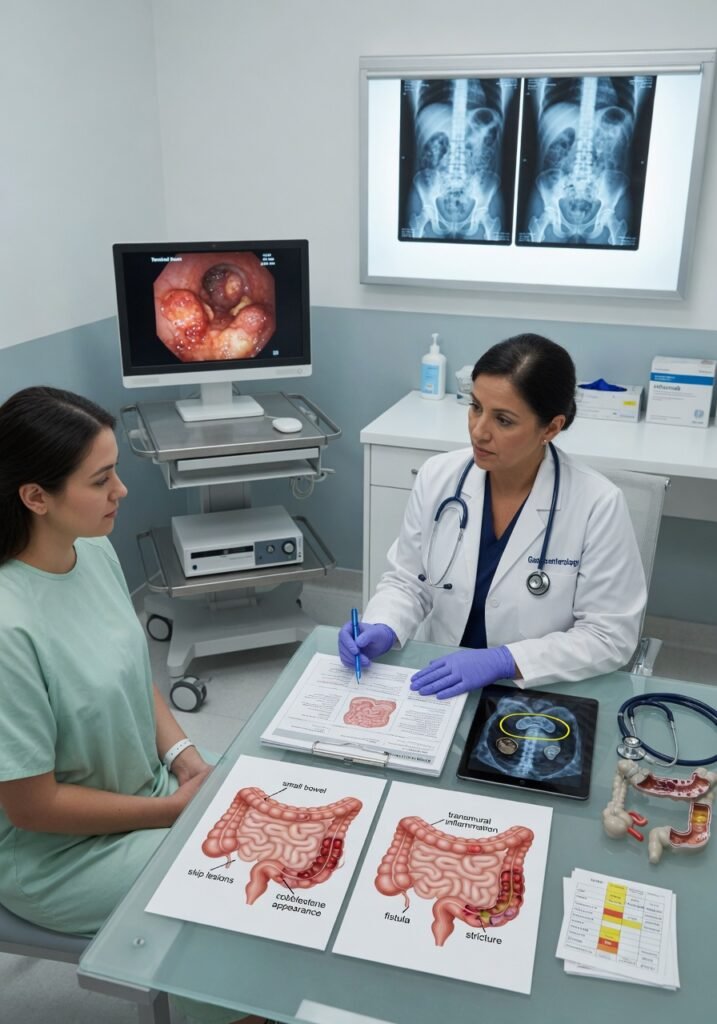
Your intestinal lining functions like a selective bouncer at a nightclub—it allows beneficial nutrients through while blocking harmful pathogens and toxins. In Crohn’s disease, this bouncer becomes overzealous and starts treating normal food particles and beneficial bacteria as threats. Your immune system launches a full assault, flooding the intestinal wall with inflammatory cells and cytokines like TNF-alpha and IL-6. Unlike ulcerative colitis, which inflames only the innermost lining, Crohn’s inflammation penetrates through all layers—the mucosa, submucosa, muscularis, and serosa. This transmural inflammation is why Crohn’s patients face complications like fistulas (abnormal tunnels between bowel segments) and strictures (scarred narrowings) that ulcerative colitis patients typically avoid.
The disease doesn’t march uniformly down your intestines either. You’ll have patches of inflamed tissue alternating with normal sections—we call this “skip lesions.” One segment of your small bowel might be angry and ulcerated while the next inch appears completely normal. This patchy pattern makes Crohn’s diagnosis trickier and explains why some patients have symptoms that seem to come from nowhere and vanish mysteriously.
Causes and Risk Factors: Genetics Meets Environment
Crohn’s disease develops when three elements collide: genetic susceptibility, an aberrant immune response, and environmental triggers. The genetic component is substantial—if both your parents have Crohn’s, your lifetime risk climbs to roughly 36%. Scientists have identified over 240 genetic variants associated with the disease, particularly in genes affecting bacterial sensing and immune regulation.
Environmental factors matter enormously. Growing up in developed nations increases risk compared to developing countries, suggesting that excessive hygiene and processed foods prime the immune system for overreaction. Smoking increases Crohn’s risk by 4-fold and worsens disease activity—one of the few modifiable factors where the data is bulletproof. Antibiotic exposure in childhood seems to disrupt the microbiome in ways that increase susceptibility, though this remains an area of active research. Diet high in processed foods and low in dietary fiber correlates with increased risk.
Here’s what most articles miss: psychological stress doesn’t cause Crohn’s, but it profoundly influences flare patterns. The gut-brain axis is bidirectional—your intestinal inflammation releases inflammatory signals that reach your brain, while your brain’s stress response increases intestinal permeability and shifts your microbiota composition toward more pro-inflammatory bacteria. It’s not in your head, but your head and gut are talking constantly.
Signs and Symptoms: Beyond the Bathroom
Most people associate Crohn’s with diarrhea, but the symptom spectrum is wider and more unpredictable. Abdominal pain often precedes any change in bowel habits by weeks or months—patients describe it as sharp, crampy, colicky discomfort that migrates around the abdomen depending on which intestinal segment is inflamed. This cramping can be so severe it mimics appendicitis or bowel obstruction, leading to unnecessary emergency department visits.
The diarrhea in active Crohn’s differs from normal loose stools. It’s often urgency-driven, sometimes accompanied by blood or mucus, and occurs primarily after eating. You might have 4-6 bowel movements daily when flaring, but the stool consistency varies—some days liquid, other days pasty. Rectal bleeding ranges from microscopic (visible only in stool tests) to obvious bright red blood on the toilet paper.
Weight loss sneaks up silently. Inflammation increases caloric needs while simultaneously reducing absorption and increasing protein loss in the stool. A patient might lose 10-15 pounds over a few months despite eating normally or even compensating with extra food. Fatigue accompanies active inflammation—not the tiredness from poor sleep but a deep, persistent exhaustion from your body fighting internal warfare.
Early warning signs that get overlooked: mouth ulcers (aphthous stomatitis), joint pain that migrates between knees and ankles, skin manifestations like erythema nodosum (painful red nodules on the shins), and eye inflammation. These extraintestinal manifestations occur in roughly 30% of Crohn’s patients and sometimes appear before obvious gut symptoms develop. Many patients see rheumatologists or dermatologists for years before anyone connects these symptoms to intestinal disease.
Diagnosis: The Path From Suspicion to Certainty
Your gastroenterologist starts with your history and physical exam, then orders blood work. They’re looking for elevated inflammatory markers—C-reactive protein (CRP) and erythrocyte sedimentation rate (ESR)—plus evidence of anemia and nutritional deficiencies. Fecal calprotectin, a protein released by intestinal immune cells, helps distinguish IBD from irritable bowel syndrome; levels above 250 micrograms per gram suggest active intestinal inflammation.
Colonoscopy remains the gold standard. Your doctor advances a camera through the entire colon and into the terminal ileum, looking for cobblestoning (irregular mucosa with deep ulcerations), aphthous ulcers, or strictures. Biopsies from multiple segments confirm granulomas—the noncaseating granulomas present in about 50% of Crohn’s cases are essentially your immune system’s calling card.
But colonoscopy alone misses disease in the small bowel, which Crohn’s affects frequently. Many patients need capsule endoscopy (swallowing a pill-sized camera that transmits images as it travels through your small intestine) or cross-sectional imaging. Magnetic resonance enterography shows inflammation, edema, and fibrosis without radiation exposure. Some centers now use computed tomography enterography as an alternative when MRI isn’t available or tolerated.
Treatment Options: From Maintenance to Rescue Therapy
Crohn’s management is stepwise and individualized based on disease severity and location. Mild-to-moderate disease localized to the colon might respond to mesalamine (5-aminosalicylic acid), available as Asacol, Pentasa, or Apriso depending on delivery mechanism. These medications reduce inflammation but work modestly and have largely been superseded by more potent agents.
Corticosteroids like prednisone induce remission in 60-80% of patients with moderate-to-severe disease but carry real risks with long-term use—bone loss, infection, mood disturbance, hyperglycemia. They’re induction therapy, not maintenance. Most gastroenterologists use them to rapidly control flares, then taper off while starting immunosuppressive agents.
Immunosuppressive medications like azathioprine (Imuran) and 6-mercaptopurine prevent relapse once remission is achieved. They require monitoring for bone marrow suppression and hepatotoxicity but cost substantially less than biologic therapies and work well for many patients. The problem? They take 8-12 weeks to become effective, which is why steroids provide bridge therapy.
Biologic medications represent the current standard for moderate-to-severe disease. TNF-alpha inhibitors like infliximab (Remicade), adalimumab (Humira), and golimumab (Simponi) block a key inflammatory molecule. About 60-70% of patients respond initially, though roughly 30-40% develop secondary loss of response over time. Newer biologics targeting different pathways—vedolizumab (Entyvio) blocking gut-specific lymphocyte trafficking, ustekinumab (Stelara) inhibiting IL-12 and IL-23—offer alternatives when TNF inhibitors fail.
Janus kinase inhibitors like tofacitinib (Xeljanz) represent the newest class, offering oral dosing instead of injections or infusions. They work through a different mechanism and show promise for TNF inhibitor-experienced patients.
Practical Daily Management: Strategies That Actually Work
Dietary management requires precision. During flares, a low-residue diet—avoiding high-fiber foods, nuts, seeds, and cruciferous vegetables—reduces mechanical irritation. This means white bread instead of whole wheat, peeled fruits, and well-cooked vegetables. During remission, gradually reintroduce fiber-rich foods and monitor tolerance. Keep a symptom diary linking specific foods to flares; triggers vary tremendously between individuals. Lactose intolerance affects 50-70% of IBD patients due to reduced lactase expression, so trial dairy elimination if bloating and diarrhea worsen after cheese or milk.
Hydration is critical during active disease when diarrheal losses climb. Plain water isn’t enough—you need electrolytes. Oral rehydration solutions designed for cholera patients (like WHO solution) work better than sports drinks for replenishing sodium and potassium losses. During remission, adequate hydration prevents kidney stones, which occur at elevated rates in Crohn’s patients due to increased oxalate absorption in the diseased bowel.
Work with your gastroenterologist on medication adherence. The most effective biologic therapy fails if you skip doses. Set phone reminders for weekly or biweekly injections. Attend follow-up appointments even when feeling well—many patients flare because they skip maintenance therapy thinking they no longer need it. Crohn’s typically requires lifelong management, not cure.
Screen for complications proactively. Annual bone density screening (DXA scan) should begin in your 40s or earlier if you’ve required multiple corticosteroid courses. Vitamin B12 deficiency occurs from terminal ileum disease or surgical resection; many patients need annual B12 injections. Monitor for anemia through regular complete blood counts. Ask your doctor about screening colonoscopy intervals—patients with long-standing Crohn’s face elevated colorectal cancer risk and may need surveillance every 1-2 years instead of the standard 10.
Prevention: Reducing Flare Frequency
True prevention of Crohn’s in genetically susceptible individuals remains impossible—no intervention reverses the fundamental immune dysfunction. However, reducing flare frequency is achievable. Smoking cessation is mandatory; continuing to smoke while taking immunosuppressive therapy is contradictory and accelerates disease progression.
NSAIDs like ibuprofen and naproxen reliably trigger or worsen flares in many Crohn’s patients by increasing intestinal permeability and promoting inflammation. Acetaminophen is safer, though