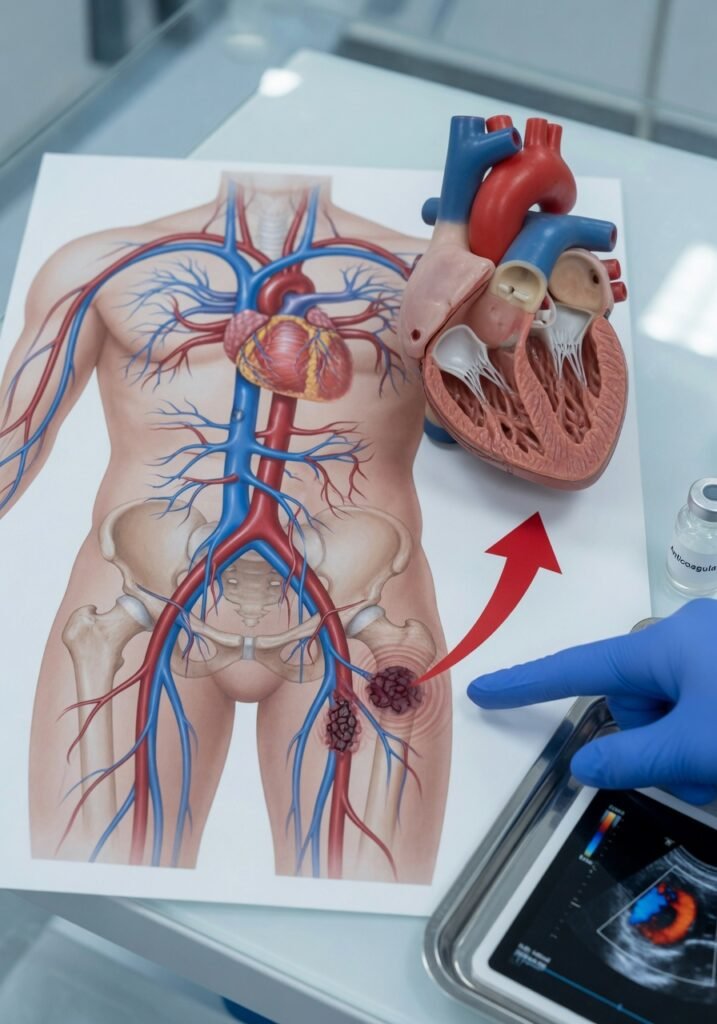

Deep Vein Thrombosis: What Really Happens When Blood Clots Form in Your Legs
If you’ve recently had surgery or spent weeks immobilized after an injury, you might wonder: why do doctors keep mentioning blood clots as a risk? What makes a clot in my leg so dangerous that airlines print warnings about it on long-haul flights? The answer hinges on something most people don’t realize: a blood clot in a deep vein isn’t just sitting there harmlessly. It can break loose, travel to your lungs, and become life-threatening within hours. This is deep vein thrombosis (DVT), and understanding it means recognizing the difference between a bruise and a medical emergency.
Key Facts About DVT
- Between 300,000 and 600,000 Americans develop venous thromboembolism annually, with DVT accounting for the majority of cases, according to CDC data.
- Approximately 33% of people with untreated proximal DVT progress to pulmonary embolism, a potentially fatal complication.
- The Virchow’s triad—venous stasis, endothelial injury, and hypercoagulability—explains why certain conditions create clot risk; all three factors don’t need to be present for DVT to develop.
- DVT in the popliteal vein or higher carries significantly greater PE risk compared to calf vein thrombosis, which may resolve spontaneously in 5-10% of cases.
- Cancer patients have a 4-7 fold increased risk of developing VTE compared to the general population, making DVT screening standard practice in oncology.
Understanding DVT: The Mechanics Behind the Clot
Think of your veins as highways where blood flows toward your heart. In deep veins—the larger vessels buried beneath muscle in your legs—that flow should be constant and unobstructed. But sometimes the traffic stops. When blood slows or pools in these deep veins, platelets and fibrin begin sticking together, forming a clot that adheres to the vein wall. This isn’t the same as a surface clot on a cut; it’s happening inside a vessel where there’s enormous pressure pushing against it.
The danger isn’t the clot itself so much as what happens next. That clot is sitting in a pressurized environment. If a piece breaks free—which physicians call embolization—it travels upstream toward the lungs. When it lodges in a pulmonary artery, blood can’t reach those lung tissues, oxygen exchange fails, and your heart has to work against a suddenly occluded artery. This is pulmonary embolism, and it kills between 60,000 and 100,000 Americans annually.
Causes and Risk Factors: Beyond the Obvious
You’ve probably heard that surgery and long flights increase DVT risk. That’s true. But the real culprits work through three mechanisms: blood stasis (slow flow), vein damage, and increased clotting tendency. Surgery causes all three—trauma damages vessel walls, anesthesia slows circulation, and the body’s inflammatory response amplifies clotting factors. Immobility does something similar; when you don’t move, blood pools in calf veins like water backing up behind a dam.
Cancer deserves special mention because it’s profoundly underrecognized. Tumors secrete tissue factor and cancer cells directly activate coagulation cascades. A patient diagnosed with pancreatic cancer has roughly six times the VTE risk of someone without cancer. This isn’t academic—it changes screening protocols and anticoagulation duration.
Here’s the less-discussed factor: estrogen. Oral contraceptives and hormone replacement therapy increase clotting risk by 3-4 fold. Combined with smoking, the risk jumps to 35 fold. This isn’t anti-hormone rhetoric; it’s pharmacology. Ethinyl estradiol and medroxyprogesterone change hepatic synthesis of clotting factors. Women starting birth control should know their family history of clots matters more than most realize.
Other contributors include inherited thrombophilias (Factor V Leiden affects 5% of Caucasians), recent trauma, central venous catheters, cardiac disease, obesity, and thrombophilia from malignancy. Previous VTE carries the highest recurrence risk—roughly 30% within 10 years if anticoagulation is stopped.
Signs and Symptoms: What You’ll Actually Notice
DVT doesn’t always announce itself dramatically. Some people experience nothing until a piece breaks off. But typically, you’ll notice leg swelling—calf or thigh, sometimes both. The affected limb feels heavier. Skin may appear slightly red or darker than the other leg, and the area might feel warm to touch. Some patients describe a cramping sensation, though they often mistake it for a muscle strain.
An overlooked early warning: asymmetry. If one calf is noticeably larger than the other, measure both at the same point. A difference greater than 3 centimeters warrants investigation. Measure again the next day; DVT swelling typically progresses. Some patients report calf tenderness (Homan’s sign—pain with foot dorsiflexion) but this isn’t reliable enough to rule anything in or out.
The timeline matters. Symptoms usually appear within the first two weeks after a triggering event like surgery. If you had an operation, sat immobilized for days, or just got back from a flight, any leg swelling in that window deserves urgent evaluation.
Diagnosis: The Testing Process
Your doctor will start with compression ultrasound, which is the gold standard for DVT diagnosis. It’s non-invasive, radiation-free, and directly visualizes whether veins collapse under gentle pressure (normal) or remain open (clot present). The ultrasound specifically assesses the popliteal vein and common femoral vein first because clots here carry highest PE risk. If the sonographer sees a thrombus, you have your diagnosis.
D-dimer blood testing sometimes precedes ultrasound. This measures fibrin breakdown products; elevated levels suggest clotting somewhere, though the test is non-specific and frequently positive in hospitalized patients, post-surgical patients, and cancer patients. A negative D-dimer in a low-probability scenario essentially rules out DVT, but a positive one requires imaging confirmation.
CT angiography or venography might be needed if ultrasound is inconclusive or if you can’t tolerate compression ultrasound. Venography—the old standard—involves injecting contrast and directly visualizing veins, but ultrasound has made it largely historical.
Treatment Options: Stopping the Clot and Preventing Complications
Anticoagulation is the foundation. You’re not dissolving the clot (that’s thrombolysis, reserved for massive PE); you’re preventing it from growing and preventing embolization while your body’s natural fibrinolytic system breaks it down over weeks to months.
Unfractionated heparin (UFH) started via intravenous infusion is the traditional first-line for proximal DVT, particularly if you have renal failure or need rapid reversibility. Low-molecular-weight heparin (enoxaparin, dalteparin) given subcutaneously is increasingly preferred in non-massive cases because dosing is predictable and monitoring is simpler.
Fondaparinux, a direct Factor Xa inhibitor, is another parenteral option that some institutions prefer. Within days, you transition to an oral anticoagulant—either warfarin (requiring INR monitoring) or a direct oral anticoagulant (DOAC) like rivaroxaban or apixaban. These DOACs have largely replaced warfarin for DVT because they don’t require INR checks and have predictable pharmacokinetics.
How long do you stay on anticoagulation? Provoked DVT (triggered by surgery or immobility) typically requires 3 months. Unprovoked DVT suggests 6-12 months minimum, and recurrent or cancer-associated clots may require indefinite anticoagulation. This individualization is crucial—stopping too early risks recurrence; continuing unnecessarily increases bleeding risk.
Thrombolysis with alteplase or other tissue plasminogen activators is considered for limb-threatening iliofemoral DVT or acute massive PE, but it carries bleeding risk and isn’t routine. Retrievable IVC filters are occasionally placed if anticoagulation is contraindicated, but they’re temporary measures, not solutions.
Practical Daily Management
Compression stockings—specifically, Class II or III medical compression stockings (20-30 mmHg or higher)—help reduce post-thrombotic syndrome, the chronic leg pain and swelling that affects 20-50% of DVT survivors. They’re uncomfortable but evidence-supported. Wear them daily for at least two years if you can tolerate them.
Leg elevation matters. When sitting, keep your affected leg at heart level. This reduces pooling and swelling. Avoid prolonged dependent positioning; every few hours, lie down for 15 minutes with your leg elevated above your heart.
Walk regularly—not hard exercise, but steady walking. Movement activates the calf muscle pump, which pushes blood back toward your heart. Thirty minutes of walking daily accelerates DVT resolution. Avoid sitting for more than 90 consecutive minutes without standing and moving.
Stay hydrated. Dehydration concentrates blood, increasing viscosity and clotting risk. Drink adequate water, particularly if you’re prone to DVT.
Watch for anticoagulation side effects. On warfarin, unexplained bruising or blood in urine means your INR may be too high. On DOACs, the same signs warrant immediate evaluation. Any major bleeding requires emergency care.
Prevention: What Actually Reduces Risk
If you’re having surgery, sequential compression devices (pneumatic boots that rhythmically inflate around your calves) are standard perioperatively. They reduce DVT risk by roughly 50%. After surgery, early mobilization is your best defense—walking within hours of surgery, if tolerated, dramatically lowers clot incidence.
For long flights (>4 hours), get up and walk every 2-3 hours. Aisle seats help. Avoid alcohol and sleeping pills, which encourage immobility. Properly fitted compression socks may help, though evidence is modest. If you have multiple risk factors, discuss chemical prophylaxis—a single dose of enoxaparin before a long flight can reduce VTE risk in high-risk travelers.
If you’re starting oral contraceptives and have a personal or family history of clots, discuss alternative contraception or discuss anticoagulation risk-benefit with your gynecologist. The absolute risk is still low (3-4 per 10,000 users yearly), but it’s not zero.
After DVT, recurrence prevention depends on why it happened. If provoked by surgery, your risk after anticoagulation ends is low. If unprovoked, discuss extended anticoagulation; some patients benefit from indefinite therapy. If you smoke, quitting is non-negotiable.
Frequently Asked Questions
Sources & Medical References
HealthTopics.com articles are based on peer-reviewed medical research and guidance from the NIH, CDC, and WHO. See our editorial policy for full sourcing standards.