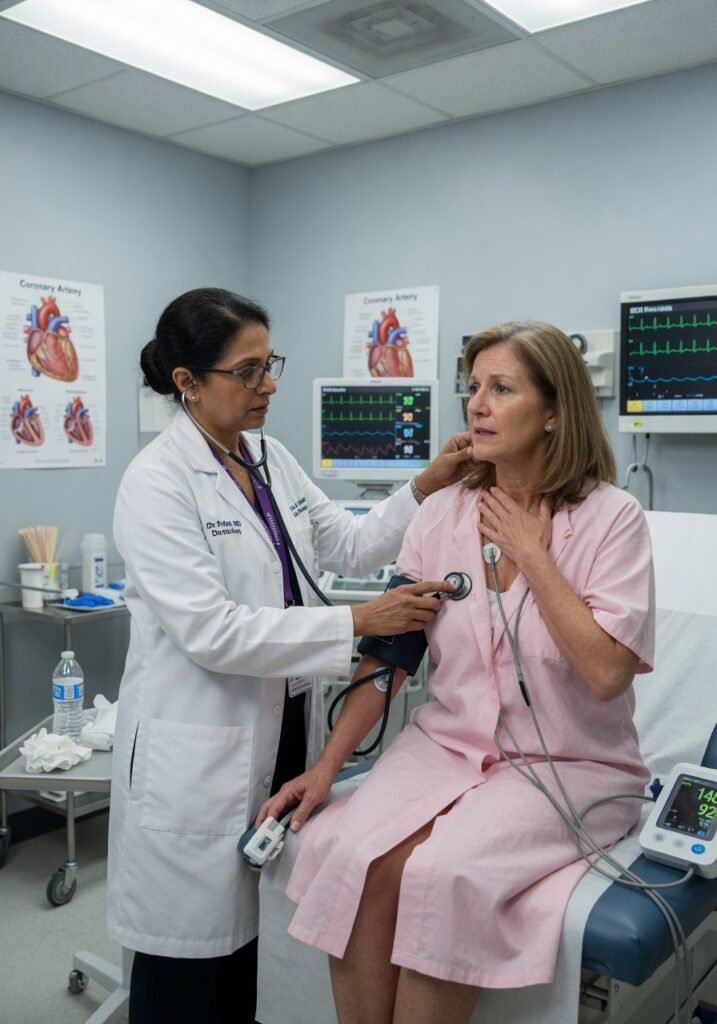
Sarah, a 52-year-old accountant, woke up at 3 AM with what felt like severe indigestion—a persistent pressure in her upper abdomen that radiated into her back. She’d been under stress at work and had skipped her morning walk for two weeks. The pressure eased after she took antacids, so she went back to bed. Six hours later, she collapsed in her kitchen. Most people imagine heart attacks as sudden, crushing chest pain accompanied by someone clutching their heart and falling to the ground. That’s actually the male presentation in textbooks. Women’s heart attacks often feel like something else entirely—fatigue that won’t quit, jaw pain, nausea, or that indigestion Sarah experienced. The result? Women delay seeking help by an average of 37 minutes longer than men do, and they’re more likely to be initially misdiagnosed.
Key Facts About Heart Attacks in Women
- According to the CDC, cardiovascular disease causes 1 in 5 female deaths in the United States—more than breast cancer, though women perceive breast cancer as the greater threat
- Women under 50 who have a heart attack are twice as likely to die in the hospital compared to men of the same age, partly due to delayed diagnosis
- Spontaneous coronary artery dissection (SCAD) accounts for up to 35% of heart attacks in women under 60, yet most hospitals don’t screen for it routinely
- The NIH reports that women experience angina (chest pain from reduced blood flow) for an average of 5.2 years before a heart attack occurs, providing a critical window for intervention
- Postmenopausal women experience a steep increase in heart attack risk within 8-10 years after menopause due to declining estrogen’s protective effects on blood vessels
Understanding What Actually Happens During a Heart Attack
Your heart is essentially a muscular pump receiving its own blood supply through coronary arteries—these are like the plumbing system feeding the plumber’s own house. When a coronary artery becomes blocked (usually by a blood clot lodged in a area of arterial plaque), the heart muscle downstream from that blockage starts suffocating. That tissue begins to die within minutes. The pain or discomfort you feel is actually the heart muscle’s distress signal—but here’s what most articles skip over: women’s hearts sometimes respond to blocked arteries differently. In women, the endothelium (the inner lining of blood vessels) can constrict or become inflamed in response to stress or hormonal shifts, restricting blood flow without necessarily forming a complete blockage. This creates a phenomenon called coronary microvascular dysfunction, which produces angina symptoms but doesn’t always show up on standard angiography. It’s like having a traffic jam in the side roads when all the highways appear clear.
Causes and Risk Factors You Should Know
The traditional risk factors apply to women too—high blood pressure, high cholesterol, diabetes, smoking, sedentary lifestyle, obesity. But women have additional risk factors that get far less attention. Gestational diabetes or preeclampsia during pregnancy increases lifetime heart attack risk by 30-50%. Autoimmune diseases like lupus and rheumatoid arthritis accelerate plaque buildup in women specifically. Hormonal birth control increases blood clot risk, particularly in women who also smoke. And perhaps most overlooked: chronic stress and depression carry as much weight as diabetes in women’s heart attack risk, yet women rarely discuss mental health history with their cardiologists.
The postmenopausal period represents a biological inflection point. Estrogen protects arteries by keeping them flexible and reducing inflammation. Once that hormone drops, women’s cardiovascular risk profile suddenly resembles men’s—except women often have spent 10-15 years in a somewhat protected state, so their preventive care lags behind their actual risk level.
Signs and Symptoms Women Actually Experience
Classic crushing substernal chest pain does happen in women. But equally common scenarios: jaw pain that feels like dental problems (and women schedule dentist appointments instead of ER visits), shoulder blade discomfort that feels muscular, nausea with or without vomiting, extreme fatigue that feels like the flu, or that indigestion that doesn’t respond well to antacids. Some women report a sense of impending doom—literally an anxiety that something is very wrong, even when they can’t identify physical pain.
The timeline matters. Warning signs might appear weeks before an actual heart attack. About 70% of women with an impending heart attack report new or worsening angina in the month preceding the acute event. You might notice you can’t walk as far as you used to without feeling tired or short of breath. You might sweat excessively during routine activities. You might feel palpitations—an awareness of your heartbeat that wasn’t there before. These early signs are valuable. They’re your window to get evaluated before an acute event.
How Doctors Diagnose Heart Attacks
When you arrive at an emergency department reporting heart attack symptoms, you’ll receive an electrocardiogram (EKG) within 10 minutes—that’s the standard. But here’s the clinical reality: some women with active heart muscle damage show normal or ambiguous EKGs initially. So doctors also draw blood tests measuring troponin, a protein released when heart muscle dies. Troponin levels help confirm whether the heart has actually been injured. If troponin is elevated, you have a heart attack. If it’s normal but your symptoms and EKG are suspicious, you’ll likely be admitted for serial troponin tests (repeated every 3 hours) and stress testing or angiography (a catheter inserted into groin or arm arteries to visualize exactly where blockages exist).
Angiography is the definitive test. It shows whether coronary arteries have plaque or clots. It also reveals whether you have SCAD (spontaneous coronary artery dissection), where the artery wall spontaneously tears—something more common in women and easily missed if the cardiologist isn’t specifically looking for it. Imaging might also show coronary microvascular dysfunction, where the smaller arteries appear to spasm under stress.
Treatment Options and What Works
If you’re having an active heart attack with a blocked coronary artery, the goal is to restore blood flow immediately. Primary percutaneous coronary intervention (PCI)—essentially angioplasty plus stent placement—is the gold standard. A cardiologist threads a catheter to the blockage, inflates a balloon to crush the plaque, then leaves behind a stent (a tiny metal scaffold) to keep the artery open. This should happen within 90 minutes of hospital arrival, ideally.
If angiography is impossible or PCI fails, you’ll receive fibrinolytic therapy—medications like alteplase or tenecteplase that dissolve the clot. It’s less effective than PCI but can save the heart when PCI isn’t immediately available.
After the acute phase, medications become your maintenance therapy. You’ll almost certainly receive aspirin (irreversibly preventing platelet clumping), a P2Y12 inhibitor like clopidogrel (Plavix) or ticagrelor (Brilinta) to prevent stent thrombosis, a beta-blocker like metoprolol or carvedilol to reduce heart workload and oxygen demand, an ACE inhibitor like lisinopril or enalapril to reduce afterload and improve survival, and a statin like atorvastatin to stabilize plaque and reduce cholesterol. Women with reduced ejection fraction (the percentage of blood the heart pumps with each contraction) may also receive aldosterone antagonists like spironolactone.
Cardiac rehabilitation—supervised exercise combined with education about diet, stress management, and medication adherence—reduces mortality by about 13% and improves quality of life substantially. Yet women enroll in cardiac rehab less frequently than men do, partly because they weren’t told it existed.
Practical Daily Management Strategies
Take your medications exactly as prescribed. Stopping aspirin or clopidogrel prematurely is one of the worst things you can do—stents can thrombose within days if antiplatelet therapy stops. Set phone reminders if you struggle with adherence. Know your blood pressure target (usually under 130/80 for post-heart-attack patients) and check it weekly at home, not just at doctor’s visits—home readings are more reliable.
Attend cardiac rehabilitation. Seriously. You’ll learn how to exercise safely, which is crucial because many women become decondititioned and anxious after a heart attack, creating a downward spiral. Supervised exercise under cardiac nurse monitoring lets you rebuild strength without fear.
Manage stress deliberately. Meditation, yoga, or therapy—pick something and actually do it. Emotional stress and anger substantially increase cardiac event risk in post-heart-attack patients.
Track your sodium intake and keep it under 2,000 mg daily if you have heart failure symptoms (shortness of breath, leg swelling, weight gain). Salt drives fluid retention, which burdens your weakened heart.
Schedule follow-up stress testing or coronary angiography as your cardiologist recommends. Don’t skip these. Repeat blockages happen, and catching them before they cause a second heart attack is the whole point.
Prevention: What Actually Reduces Risk
The evidence is clear on some points and less clear on others. Stopping smoking within days eliminates most excess risk—literally within weeks, not years. That’s perhaps the single most powerful intervention. Controlling blood pressure with medications (target under 130/80) reduces subsequent events. Taking a statin reduces recurrent heart attack risk by roughly 25%. Exercising 150 minutes weekly at moderate intensity reduces risk. These aren’t theoretical—they’re outcomes measured in randomized controlled trials.
Mediterranean diet patterns (high in fish, olive oil, vegetables, legumes) show benefit in prospective studies. Aspirin is recommended for secondary prevention (after one heart attack) but for primary prevention in women without prior disease, the benefit is questionable and bleeding risk is real—discuss with your doctor rather than self-starting it.
Hormone replacement therapy, once thought protective, actually slightly increases heart attack risk in some studies. So if you’re considering HRT for menopause symptoms, weigh that consideration carefully with your gynecologist and cardiologist.