Exercise-Induced Asthma: What You’re Actually Experiencing When Workouts Trigger Breathing Problems
Sarah, a 28-year-old runner, believed her exercise-induced asthma meant she had to quit running altogether. Her primary care doctor had told her she was “just out of shape” and needed to build endurance. Three years later, after being evaluated by a pulmonologist who performed a methacholine challenge test, she learned the truth: she wasn’t unfit—her airways were reacting to the physical demands of exercise with genuine bronchospasm. Within weeks of starting albuterol inhaler use before her runs, her symptoms disappeared and she completed her first half-marathon.
The common misconception is that exercise-induced asthma means you shouldn’t exercise. That’s backwards. The actual truth is that exercise-induced bronchoconstriction (EIB) is a treatable airway condition where vigorous physical activity causes temporary narrowing of the airways, and with proper management, most people can exercise normally—even at competitive levels. Many elite athletes have EIB.
Key Facts About Exercise and Airway Responses
- Approximately 8-20% of people with asthma experience exercise-induced bronchoconstriction, but 5-10% of the general non-asthmatic population may also have EIB according to research published in the Journal of Asthma
- Cold, dry air exposure during outdoor winter running increases EIB risk by roughly 40-50% compared to warm, humid conditions
- Symptoms typically appear 5-15 minutes after starting exercise and peak around 5-10 minutes after stopping
- About 50% of athletes with allergic rhinitis also develop exercise-induced symptoms during high-pollen seasons
- Pre-treatment with a short-acting beta-2 agonist like albuterol prevents symptoms in 80-90% of susceptible individuals when used 15 minutes before activity
Understanding What Happens in Your Airways During Vigorous Exercise
When you exercise hard, your body demands more oxygen. Your breathing rate increases dramatically—you might go from 12-16 breaths per minute at rest to 40-60 breaths per minute during intense activity. This is where things go sideways for people with EIB.
Think of your airways like a tube that can adjust its diameter. In people with exercise-induced bronchoconstriction, the smooth muscle surrounding these tubes overreacts to the rapid breathing and air temperature changes. The mechanism involves a few culprits: rapid airflow drying out the airways, hyperventilation causing water loss from the bronchial walls, and in some cases, inflammatory mediator release (like histamine) triggered by the physical stress. The airways clamp down—we call this bronchoconstriction—which narrows the passages and makes breathing harder.
Your body is essentially treating vigorous exercise like a threat and triggering a protective response that backfires. The good news? This isn’t permanent damage. Once you stop exercising and your breathing normalizes, the airway constriction typically resolves within 30-60 minutes on its own. But during that window, you feel chest tightness, wheezing, shortness of breath, or that awful sensation of not being able to catch your breath.
What Actually Causes Exercise-Induced Bronchoconstriction
The primary culprit is hyperventilation combined with airway drying. When you breathe rapidly and deeply during exercise, especially in cold or dry conditions, you’re bypassing the upper airway’s normal humidifying function. The inhaled air hits your lower airways dry and at odd temperatures, which triggers the constriction reflex.
Environmental factors matter enormously. Cold air is a major trigger—ski athletes and winter runners have particularly high rates of EIB. Chlorine exposure in competitive swimmers is another well-known trigger, with some studies showing 8-10% of competitive swimmers developing EIB. Dry conditions, low humidity, and pollution all worsen symptoms.
Here’s what most articles miss: allergic sensitization amplifies EIB risk during high-pollen seasons, even in people whose allergies are otherwise well-controlled. If you have allergic rhinitis and only notice exercise-triggered symptoms in spring or fall, seasonal pollen exposure might be priming your airways to overreact. That’s why some patients develop EIB seasonally rather than year-round.
Risk factors include pre-existing asthma (which significantly increases EIB likelihood), a family history of asthma, smoking exposure, and certain sports. Endurance sports that involve sustained hard breathing—distance running, cycling, cross-country skiing—trigger EIB more often than sports with intermittent effort like baseball or tennis. Interestingly, swimming, despite chlorine exposure, causes less bronchospasm than running in cold air, probably because swimmers breathe warm, humid air near the water surface.
Recognizing the Actual Symptoms
Most people describe a tightness in the chest during hard exercise, as if they can’t quite catch their breath. Some notice wheezing—an audible whistling sound when breathing. Others report a dry cough that starts during the workout and persists for 10-20 minutes afterward. A few describe throat tightness or neck burning with exertion.
The overlooked early warning sign is reduced exercise tolerance. You previously could run 30 minutes comfortably, but lately you’re fatigued and short of breath by 20 minutes. That’s not just being “out of shape”—it might be EIB developing.
Some athletes experience exercise-induced laryngeal obstruction (EILO), which feels similar but involves the vocal cords tightening rather than the lower airways—it’s easy to confuse with asthma but requires different management. This is why specialist evaluation matters.
How Doctors Actually Diagnose This
The diagnosis starts with your history. I ask: when exactly do symptoms start? What type of exercise triggers them? Does it happen in cold weather but not warm? Are you better or worse with allergy seasons? Do other family members have asthma?
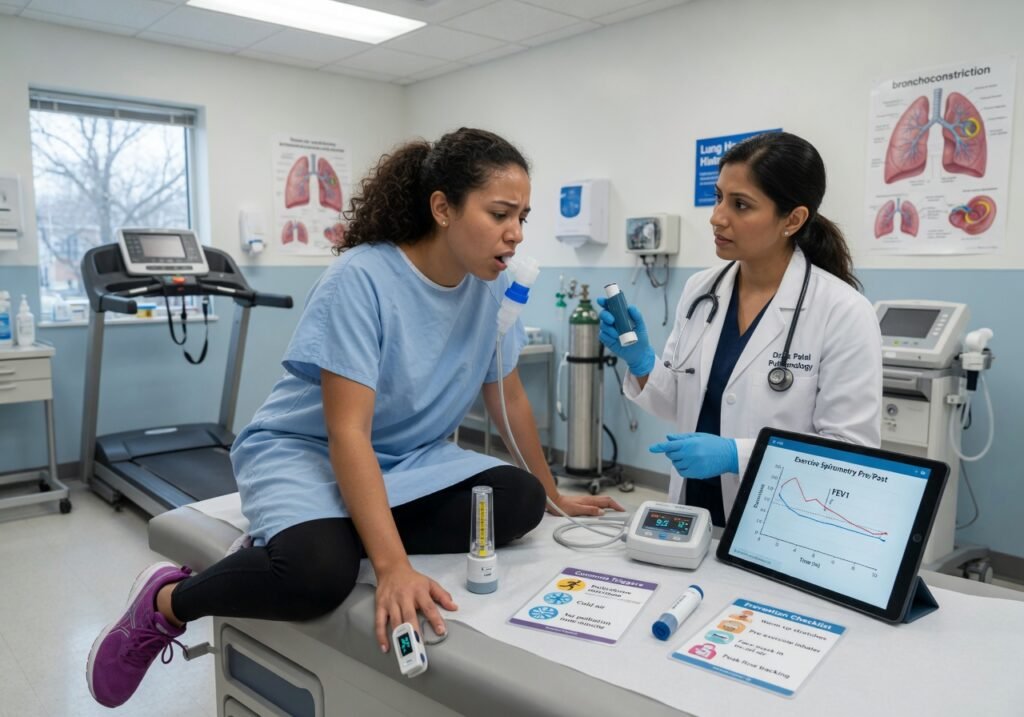
If EIB seems likely, we typically perform spirometry—that’s the test where you blow into a machine that measures how much air your lungs hold and how fast you can exhale. We get a baseline measurement, then have you exercise hard (usually running on a treadmill for 6-8 minutes at 80-90% of your maximum heart rate) or ride a stationary bike, then immediately retest. A drop of 10% or more in FEV1 (forced expiratory volume in 1 second) suggests EIB.
Some specialists use a methacholine challenge test instead. You inhale increasingly concentrated doses of methacholine, which causes airway constriction in sensitive individuals. It’s more sensitive than exercise testing, though less specific to the actual exercise trigger.
Expect the diagnosis process to take 30-60 minutes total. The spirometry itself takes just minutes, but the exercise portion and recovery observation take longer. Bring water and be prepared to work hard during the exercise phase.
Treatment Options That Actually Work
The first-line treatment is a short-acting beta-2 agonist like albuterol (salbutamol in some countries) or levalbuterol. You use it 15 minutes before exercise. These medications relax the smooth muscle around your airways within minutes and the effect lasts 4-6 hours. This works in 80-90% of people with EIB, which is why it’s the standard approach.
If you’re exercising regularly and needing your rescue inhaler before every session, we sometimes add a longer-acting controller. Long-acting beta-2 agonists like formoterol, or inhaled corticosteroids like fluticasone propionate, can reduce EIB frequency and severity when used regularly. Some people benefit from leukotriene receptor antagonists like montelukast, especially if they have concurrent allergies.
For athletes in competitive settings, it’s worth knowing that albuterol use before competition is allowed in most sports organizations (you just need to declare it), but dosing matters—excessive use can actually cause problems.
Sodium cromoglycate (cromolyn sodium), an older medication, works well for EIB prevention and has no systemic side effects, but it’s less convenient than albuterol and has become harder to find in the U.S.
Practical Daily Management: What Actually Works
Use your albuterol inhaler 15 minutes before starting exercise—not during. This gives it time to work. Most people need just 2 puffs. Make sure you’re using the inhaler correctly: shake it, hold it upright, seal your lips around it, press down while inhaling slowly, and hold your breath for 10 seconds. Poor inhaler technique reduces effectiveness by half.
Warm up gradually before intense activity. A 10-minute easy warm-up before you go hard actually helps by gradually increasing airway temperature and humidity. Don’t just start sprinting cold.
In cold weather, cover your mouth and nose with a scarf or mask designed for athletes. This pre-warms and pre-humidifies incoming air. Neck gaiters and balaclava-style masks are your friend in winter running.
Stay hydrated. Dehydration worsens EIB symptoms, possibly because it affects mucus production in your airways. Drink water or a sports drink before and after exercise.
If you swim, rinse your goggles before putting them on and consider shorter pool sessions if chlorine is a major trigger. Some competitive swimmers rotate between pools with different chlorination systems.
Track your symptoms in an exercise log. Note the temperature, humidity, air quality (is the pollen count high?), the type of exercise, and whether you had symptoms. This helps identify your specific triggers and predict when you’ll need your inhaler most.
Prevention: What the Evidence Shows
Regular exercise actually reduces EIB symptoms over time. I know that sounds contradictory, but consistent training helps condition your airways and body. Most people find their symptoms improve after 4-6 weeks of regular activity, even without medication.
Environmental modifications work. On high-pollen days or during cold snaps, either use your inhaler prophylactically or adjust your exercise intensity. Going for a gentle jog in winter might not trigger symptoms, but a hard tempo run will.
Managing concurrent conditions prevents EIB flare-ups. If you have allergic rhinitis, controlling that with intranasal corticosteroids or antihistamines reduces your overall airway reactivity. If you have reflux, treating that helps—stomach acid can trigger bronchoconstriction.
Avoid high air pollution days if possible. Ozone and particulate matter worsen EIB. Check your local air quality index before hard outdoor workouts during summer months.
The nuance here: prevention doesn’t mean avoiding exercise. It means using your inhaler properly, being smart about environmental conditions, and building fitness gradually. Most people with EIB reach and maintain excellent fitness levels.
Frequently Asked Questions
Sources & Medical References
HealthTopics.com articles are based on peer-reviewed medical research and guidance from the NIH, CDC, and WHO. See our editorial policy for full sourcing standards.