General Anesthesia: What Actually Happens When You “Go Under”
You’re scheduled for surgery tomorrow morning, and the anesthesiologist mentions “general anesthesia” like it’s routine. But what does that actually mean? One moment you’re counting backwards from ten, and the next—you’re waking up in recovery with no memory of three hours passing. Is your brain just sleeping? Are you dreaming? Why can’t you remember anything?
General anesthesia isn’t sleep at all. It’s a carefully controlled state of unconsciousness where your brain essentially stops processing sensory information and forming memories. We’ve learned more about how it works in the past fifteen years than in the previous century, yet most patients still think it’s just “being asleep.” Understanding what’s happening to your body—and your brain—during surgery can ease anxiety and help you prepare better for what comes next.
Key Facts About General Anesthesia
- Approximately 21 million Americans receive general anesthesia annually for surgical procedures, according to the CDC
- The amnesia produced by anesthetic drugs is so profound that you won’t form new memories even though your eyes may be open and reflexes intact during induction
- Recovery from general anesthesia takes roughly 15 minutes for light anesthesia but can extend 45-60 minutes for deeper surgical cases involving multiple agents
- Propofol and sevoflurane account for more than 80% of induction and maintenance anesthesia in operating rooms across North America
- Serious complications occur in fewer than 1 in 100,000 cases with modern monitoring, but post-operative nausea affects 20-30% of patients without preventive medication
How General Anesthesia Actually Works in Your Body
Imagine your brain as a concert hall with thousands of musicians playing different instruments—some loud, some soft, all coordinating to create awareness and memory. General anesthesia doesn’t silence the orchestra; it turns off the audience. Your neurons keep firing. Your heart keeps beating. But the conscious “you” isn’t receiving or recording any of it.
When an anesthesiologist administers propofol intravenously (the white liquid many call “milk of amnesia”), it crosses the blood-brain barrier within seconds and binds to GABA receptors—the brain’s primary brake system. This amplifies inhibitory signals and suppresses excitatory ones. Your brain activity on an EEG monitor shifts from the busy pattern of wakefulness to slower, more synchronized waves. Consciousness doesn’t fade gradually like falling asleep; it switches off like a light.
The difference between general anesthesia and natural sleep fascinates neuroscientists because while both involve unconsciousness, the neural mechanisms differ profoundly. During natural sleep, your brain cycles through predictable stages. During general anesthesia, your entire cortex essentially goes offline. This is why you don’t dream, why you experience retrograde amnesia (forgetting events before anesthesia), and why you can’t remember the recovery room even though you were technically awake and responding to commands.
Once unconscious, the anesthesiologist maintains this state using one or more agents: inhalational gases like sevoflurane, additional doses of propofol, or opioids like remifentanil. Nitrous oxide was historically used but has fallen out of favor in many centers due to potential complications. Meanwhile, muscle relaxants may be administered to paralyze your muscles during surgery—but don’t confuse this with being asleep. You’re unconscious from the anesthetic agents, not from paralysis.
Who Needs General Anesthesia and Why It Matters
Not all surgery requires general anesthesia. Minor procedures like skin biopsies or wart removal use local anesthesia—numbing the area without affecting consciousness. But when surgeons need to access your abdomen, thorax, or brain; when procedures take more than 30 minutes; or when patient movement could compromise safety, general anesthesia becomes necessary.
Your medical history shapes whether you’re a good candidate. Certain conditions increase risk—severe obesity, sleep apnea (which affects airway management), severe liver disease, malignant hyperthermia susceptibility, and uncontrolled hypertension all require special consideration. One risk factor many articles skip over is a history of difficult intubation. If a previous anesthesiologist documented that your anatomy made inserting the breathing tube challenging, the next anesthesiologist needs this information before you even arrive at the operating room. This gets missed because it’s not in your primary care chart—it’s buried in old operative records.
Age matters too. Very elderly patients metabolize anesthetic drugs more slowly, meaning they stay unconscious longer and may experience more post-operative confusion. Conversely, young children require weight-based dosing and different drug selections. Pregnancy changes how drugs are distributed in your body. Diabetes, kidney disease, and heart conditions all influence which anesthetic agents an anesthesiologist chooses.
What You’ll Actually Experience
Pre-operative anxiety is real and understandable. You’ll be taken to the pre-operative area where an IV gets placed—often the most uncomfortable part. The anesthesiologist reviews your medical history, medication list, and previous anesthetic experiences. They explain the plan: induction with propofol or etomidate, maintenance with sevoflurane gas or IV agents, and reversal medications at the end.
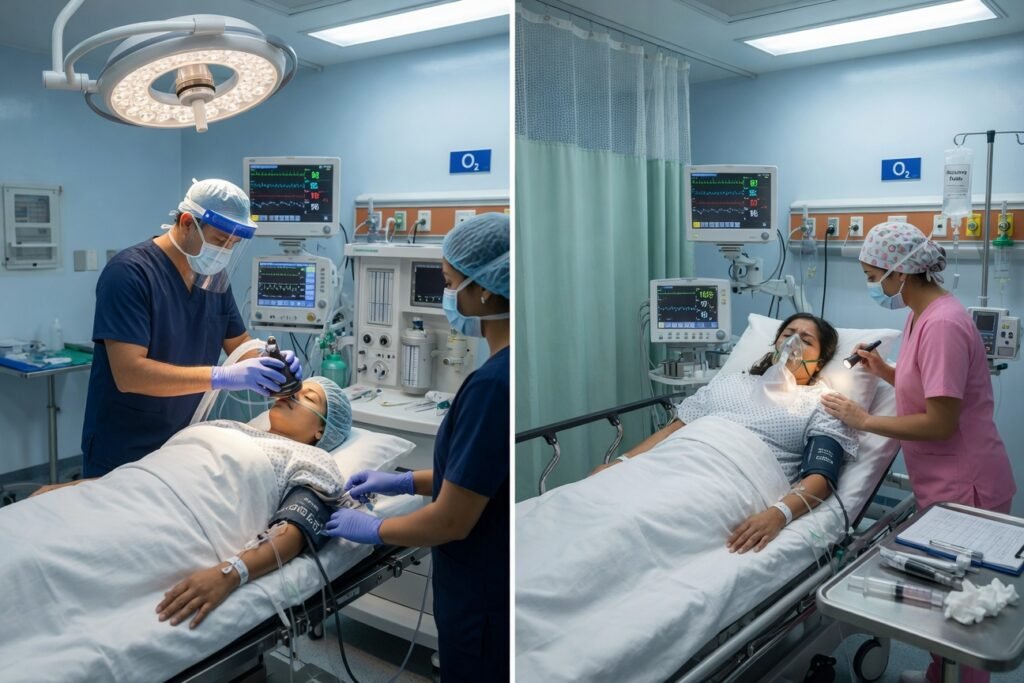
You enter the operating room. It’s colder than you expected and busier than you imagined—monitors beeping, people moving, surgical lights overhead. The anesthesiologist applies oxygen via mask and says, “This will help relax you before we start the medicine.” Then comes the IV push of induction agent. Some patients report a metallic taste or warmth traveling up their arm. Others feel nothing. Then—nothing. No sensation of time passing. No awareness. No dreams.
What happens next is unconsciousness while your team monitors everything. They watch your heart rate on the cardiac monitor, blood pressure every few minutes, oxygen saturation with a pulse oximeter, and end-tidal carbon dioxide (a marker of breathing adequacy). They listen to your lungs with a stethoscope. Modern operating rooms use bispectral (BIS) monitoring, which tracks brain electrical activity to prevent accidental awareness during surgery—an exceedingly rare complication that nonetheless terrifies patients.
As surgery ends, the anesthesiologist reduces or stops infusions. Your body metabolizes and eliminates the drugs. Consciousness returns in reverse order: first your brainstem reflexes, then eye-opening, then ability to follow commands, finally your higher cognitive functions. You might not recognize family members standing beside you immediately. You might say things you won’t remember. You’ll feel groggy, possibly nauseated, possibly experiencing the strange sensation of a sore throat from the breathing tube.
Managing Recovery and Common Concerns
Post-operative nausea and vomiting (PONV) happens in roughly one-quarter of patients, more commonly in women, patients prone to motion sickness, and those receiving opioids. Your anesthesiologist uses anti-nausea medications like ondansetron or metoclopramide during surgery specifically to prevent this. If you still feel queasy afterward, tell your recovery nurse—additional medications work quickly.
Sore throat from intubation resolves within 48-72 hours. Throat lozenges and honey-based cough drops help more than most people realize. Cognitive fog—the “anesthesia hangover”—typically clears within 24 hours, though driving or operating machinery shouldn’t resume until the next day.
Some patients experience post-operative delirium, especially the elderly. This isn’t dementia; it’s temporary confusion that resolves as the drugs clear. Let your family know this is possible. It’s frightening when it happens, but it’s not permanent.
One practical tip most articles miss: eat something light when you’re cleared to eat. Your stomach will tolerate bland foods better than nothing at all, and small amounts of carbohydrates help stabilize your blood sugar after fasting.
Rare But Real Complications
Malignant hyperthermia is a pharmacogenetic disorder where exposure to certain anesthetics triggers a dangerous hypermetabolic crisis. It’s rare (1 in 3,000 to 1 in 100,000 cases depending on the population), but if you have family members who experienced it, alert your anesthesiologist immediately. Safe alternatives exist.
Anaphylaxis to anesthetic drugs happens but is exceptionally uncommon. Awareness under anesthesia—actually waking up during surgery—occurs in roughly 1 to 2 per 1,000 cases, and is even rarer with modern BIS monitoring. Aspiration of gastric contents during intubation is preventable through proper pre-operative fasting protocols.