Why Does Your Chest Pain Feel Different Than Last Time? Understanding the Distinction Between Heart Attack and Anxiety
Sarah, a 52-year-old accountant, felt a crushing pressure across her sternum while sitting at her desk on a Tuesday morning. It wasn’t the sharp stabbing she’d experienced during a panic attack six months prior. This pressure radiated down her left arm and felt heavy, like someone was standing on her chest. She initially dismissed it as indigestion, took an antacid, and waited. Forty-five minutes later, her jaw began aching. That combination—the persistent heaviness, the radiation, the jaw pain—triggered something in her memory. She called 911.
The difference between a true cardiac emergency and other conditions often comes down to pattern recognition. A heart attack isn’t always the Hollywood version of sudden, dramatic collapse. Sometimes it’s a creeping sensation that feels almost like pressure or heaviness rather than pain. Understanding these distinctions, knowing how your body typically behaves under stress, and recognizing when something feels fundamentally different can literally mean the difference between surviving a myocardial infarction and suffering permanent heart damage or death.
Key Facts About Heart Attack Emergency
- According to the CDC, approximately 805,000 people suffer a heart attack annually in the United States, with one occurring roughly every 40 seconds
- The first hour after symptom onset—the “golden hour”—determines whether myocardial tissue survives or undergoes necrosis; every 30-minute delay to reperfusion increases 30-day mortality by approximately 7.5%
- Women experience heart attacks differently than men in 42% of cases, often reporting fatigue, shortness of breath, and nausea as primary symptoms rather than chest pain
- STEMI (ST-elevation myocardial infarction) requires primary percutaneous coronary intervention within 120 minutes of first medical contact for optimal survival outcomes
- Aspirin administration within the first 24 hours of acute myocardial infarction reduces mortality by approximately 23%, making it one of the most time-sensitive interventions
Understanding What Actually Happens During a Heart Attack
Your heart is essentially a muscular pump with its own blood supply. The coronary arteries—right, left anterior descending, and left circumflex—deliver oxygen-rich blood to the myocardium. When one of these arteries becomes suddenly blocked by a blood clot, that section of muscle loses its oxygen supply. Think of it like turning off blood flow to a neighborhood; without oxygen delivery, the cells begin to die within minutes.
This isn’t a gradual process. Within 20 minutes of complete arterial occlusion, irreversible damage begins. Within 4 hours, the majority of myocardial loss has occurred. This is why cardiologists emphasize the time factor so relentlessly—you’re literally watching heart tissue die in real time. The body’s inflammatory response kicks in immediately, causing swelling and additional stress on the already-compromised area. Your heart rhythm can destabilize. Your blood pressure may plummet. Your nervous system floods your body with stress hormones, which paradoxically increases your heart’s oxygen demand at precisely the moment it’s getting the least supply.
The sensation you experience depends on which artery is blocked and how much tissue is affected. A right coronary artery occlusion might feel like jaw or neck pain. A left anterior descending occlusion typically produces the classic substernal chest pressure. The unpredictability is part of what makes heart attacks so dangerous—people misinterpret their symptoms because the presentation varies so widely.
Causes and Risk Factors You Should Know
The traditional risk factors remain dominant: hypertension, hyperlipidemia, smoking, diabetes, and family history. But here’s what most articles miss—the interaction between risk factors matters more than the individual factors themselves. A 45-year-old with well-controlled hypertension and normal cholesterol faces a dramatically different risk than a 45-year-old with the same blood pressure and cholesterol who smokes and has untreated sleep apnea.
Speaking of sleep apnea, this is the underappreciated risk factor. Untreated obstructive sleep apnea increases myocardial infarction risk by 30% according to NIH studies, yet it remains undiagnosed in roughly 80% of moderate-to-severe cases. The repeated oxygen desaturations throughout the night create chronic stress on the coronary system.
Emotional stress and anger actually precipitate heart attacks. Studies published in JAMA show that intense anger in the two hours preceding symptom onset increases heart attack risk 8.5-fold. Chronic psychological stress elevates cortisol and activates the sympathetic nervous system, promoting atherosclerotic plaque rupture.
Other contributors: cocaine use (causes coronary vasospasm), certain medications like stimulants, severe anemia, hyperthyroidism, and in women specifically, the postmenopausal period. Pregnancy-related heart attacks remain rare but are increasing. Autoimmune conditions like lupus increase coronary risk substantially.
Signs and Symptoms: What Patients Actually Experience
The chest discomfort in myocardial infarction has specific qualities. It’s usually described as pressure, squeezing, heaviness, or tightness rather than sharp stabbing pain. It often radiates—to the left arm, both arms, the jaw, the neck, or the back. It might feel like someone is sitting on your chest. It typically lasts more than 15 minutes and doesn’t improve with positional changes or antacids.
Associated symptoms matter. Shortness of breath, diaphoresis (cold sweating), nausea, lightheadedness, or unexplained fatigue accompanying chest pressure raises the likelihood considerably. Some patients experience isolated jaw pain or dental discomfort. Others report only severe fatigue or generalized weakness.
The overlooked early warning: episodes of exertional chest discomfort that resolve with rest over the preceding days or weeks. This is angina pectoris—the heart telling you its blood supply is inadequate. Many patients experience unstable angina (angina at rest or with minimal exertion) before a full MI occurs. These are warning shots. They deserve urgent evaluation and should never be ignored.
Women frequently describe their cardiac symptoms differently. Fatigue is often the dominant symptom, sometimes described as exhaustion out of proportion to activity level. Shortness of breath without chest pain occurs commonly. Nausea and vomiting can be primary complaints, especially in diabetic women where silent ischemia is more frequent.
Diagnosis: The Tests and Timeline
When you arrive at an emergency department with chest pain, several things happen simultaneously. You’ll have a 12-lead electrocardiogram performed within 10 minutes—this is a critical diagnostic tool. The EKG shows whether the ST segment is elevated (indicating STEMI, a complete arterial blockage requiring immediate intervention) or whether changes suggest non-STEMI (NSTEMI) ischemia.
Cardiac biomarkers become important. Troponin I and troponin T are proteins released when myocardial cells die. A high-sensitivity troponin assay can detect myocardial necrosis within 2-3 hours of symptom onset. However, troponin can be negative initially in the first few hours, so serial measurements (repeated testing) may be necessary. Myoglobin and CK-MB rise earlier but are less specific.
Coronary angiography—where a catheter is threaded into the coronary arteries and contrast is injected—is the gold standard for diagnosis and simultaneous treatment. This is performed emergently in STEMI cases (within 120 minutes of first medical contact) and urgently in NSTEMI cases (within 24-72 hours depending on risk stratification).
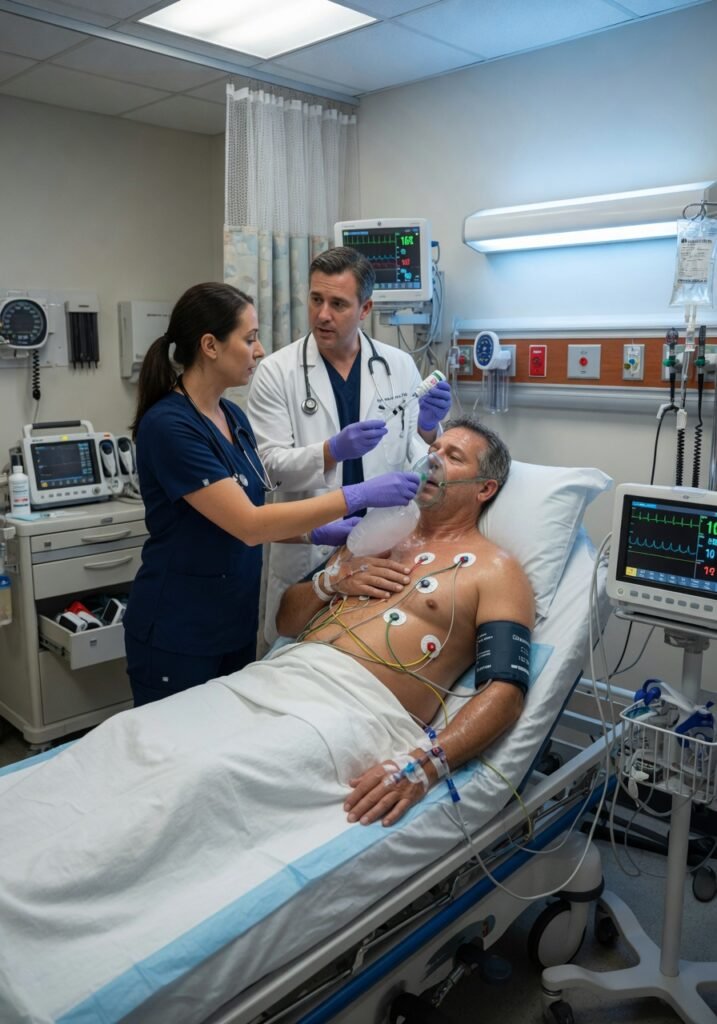
From your perspective as a patient, the diagnostic process feels like controlled chaos. You’re hooked to monitors. Nurses are inserting IV lines. Doctors are asking rapid questions about your symptoms. Blood is being drawn. You might receive aspirin immediately (we’re talking chewed or IV forms for faster absorption, not swallowed tablets). If you have an EKG showing STEMI, you’ll be told you’re going to the catheterization lab. This happens fast.
Treatment Options for Acute Heart Attack
Immediate management involves dual antiplatelet therapy. Aspirin (chewed or IV) combined with a P2Y12 inhibitor—either clopidogrel (Plavix), prasugrel (Effient), or ticagrelor (Brilinta)—prevents additional platelet aggregation. These medications work synergistically to prevent the clot from growing while definitive treatment is arranged.
Anticoagulation with unfractionated heparin or low-molecular-weight heparin prevents clot extension. Some patients receive fondaparinux. The choice depends on your kidney function and whether you’re heading directly to the catheterization lab.
For STEMI, primary percutaneous coronary intervention (PCI) is the preferred reperfusion strategy. A catheter advances to the blocked artery, and a balloon dilates the vessel or a stent is placed to restore blood flow. Time from diagnosis to balloon inflation should ideally be 90 minutes. Door-to-balloon time is tracked and reported publicly because it directly correlates with survival.
Fibrinolytic therapy with alteplase (tPA) or tenecteplase can be used if PCI isn’t available within 120 minutes. These medications dissolve the clot chemically rather than mechanically. They’re faster to administer but slightly less effective than PCI.
After the acute phase, you’ll receive beta-blockers (metoprolol, carvedilol), ACE inhibitors (lisinopril, enalapril), and statins (atorvastatin, rosuvastatin). Beta-blockers reduce heart rate and contractility, decreasing oxygen demand. ACE inhibitors improve long-term survival by reducing ventricular remodeling. Statins reduce inflammation and stabilize remaining plaques.
Practical Management During and After a Cardiac Emergency
If you suspect you’re having a heart attack right now, call 911 immediately. Not your doctor. Not your spouse to drive you. 911. Paramedics can begin treatment en route, perform EKGs in the ambulance, and alert the receiving hospital to prepare the catheterization lab. You gain 20-30 minutes compared to driving yourself or waiting for a family member.
Chew aspirin immediately if available and you’re not allergic (325 mg standard strength). Take it with water. If you’re on nitroglycerin prescribed for angina, take one tablet under your tongue.
Loosen tight clothing. Sit or lie down. Try to stay calm, though this feels absurd to suggest when your chest is crushing. Your anxiety will increase your heart rate and oxygen demand, potentially worsening the situation. Deep breathing helps: in through your nose for four counts, out through your mouth for four counts.
After hospital discharge, cardiac rehabilitation is essential, not optional. These supervised programs combine monitored exercise, education about medications and dietary changes, and psychological support. Participation reduces six-month mortality by approximately 27%. Attend every session.
Take your medications exactly as prescribed. Missing doses of antiplatelet therapy dramatically increases restenosis risk. Don’t assume you can stop clopidogrel after three months because you “feel better.” Premature discontinuation of dual antiplatelet therapy is a leading cause of stent thrombosis.
Prevention: What Actually Works
The aspirin debate has settled somewhat. Daily aspirin for primary prevention (people without prior MI) no longer shows a clear benefit in recent trials published in The Lancet. For secondary prevention (people who’ve had an MI), it remains standard. The bleeding risk offsets the benefits in asymptomatic people.
Statins work in both primary and secondary prevention. They reduce LDL cholesterol and also stabilize arterial plaques through anti-inflammatory mechanisms. The number needed to treat varies with baseline risk.
Blood pressure control matters profoundly. Keeping systolic pressure below 130 mm Hg (tighter than the old 140