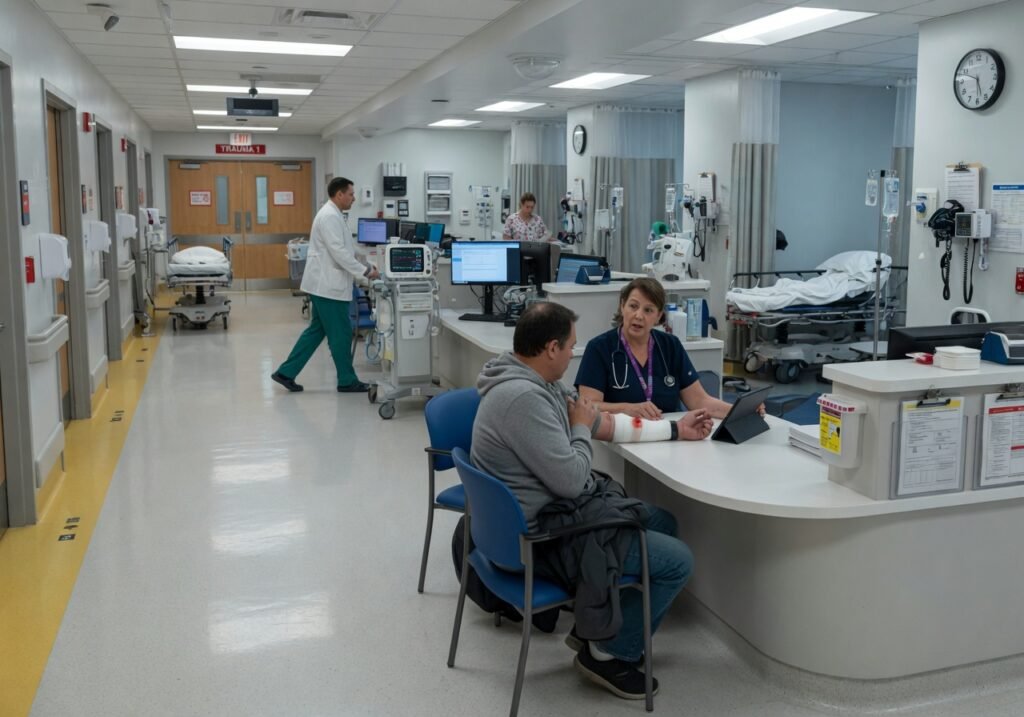
Hospital Emergency Department: What to Expect
Sarah, a 47-year-old accountant, arrived at her local hospital’s emergency department at 9 PM on a Tuesday with chest discomfort. She expected to be seen within minutes—after all, it was “emergency.” Instead, she waited two hours in the lobby before triage, then another ninety minutes in a hallway bed before a physician examined her. What most people don’t realize is that emergency departments aren’t actually designed around urgency in the way patients imagine. They’re designed around acuity: a patient having a stroke gets a CT scanner immediately, while someone with moderate chest pain gets sorted into a queue based on what’s genuinely life-threatening right now. The emergency department is less a “fix me quickly” place and more a “sort by danger level, allocate scarce resources, and stabilize” place. Understanding this difference changes everything about what you should expect when you walk through those doors.
Key Facts About Hospital Emergency Departments
- The CDC reports that U.S. emergency departments had 139.9 million visits in 2017, with the average wait time before seeing a physician around 40 minutes, though critically ill patients bypass this wait entirely
- Approximately 10-15% of ED visits result in hospital admission; most patients are discharged home after stabilization or minor treatment
- The median time from arrival to departure for admitted patients is roughly 3 hours, while discharged patients average closer to 2.5 hours total
- Overcrowding is driven primarily by admitted patients awaiting inpatient beds rather than arrival volume—a patient stable enough to admit but blocking an ED bed creates a bottleneck
- Chest pain, abdominal pain, and shortness of breath account for nearly 40% of all ED visits, with only 15-20% of chest pain complaints being acute coronary syndrome
Understanding How Hospital Emergency Systems Actually Work
Think of the emergency department like airport security at a major hub. The TSA doesn’t process everyone in order of arrival—they process by threat level. Someone with a weapon goes to different screening than someone with a questionable liquid. Similarly, the ED uses a triage system (usually the Emergency Severity Index, or ESI) that categorizes patients into five levels: immediate resuscitation, emergent (high risk), urgent (moderate risk), minor, and non-urgent. A patient having a myocardial infarction moves through multiple treatment pathways simultaneously—EKG within 10 minutes, troponin blood draw, cardiology consultation requested—while a patient with a sprained ankle waits because the resources available are finite and the stakes are genuinely different.
Here’s what most health websites miss: the ED is designed to rule out death or disability, not to cure your condition. This distinction matters enormously. If you come with abdominal pain, the ED’s job is to determine whether you have appendicitis, a perforated bowel, or ectopic pregnancy—conditions that will kill you without intervention. If it’s gastroenteritis or constipation, you’ll be sent home with instructions. This isn’t failure; it’s appropriate allocation. Your primary care physician or a gastroenterologist will investigate chronic abdominal issues, but those don’t belong in an emergency setting once life-threatening causes are excluded.
Causes and Risk Factors for ED Visits
Not all emergency department visits are created equal. The reasons people arrive fall into several distinct categories, and understanding which category you’re in shapes what happens next.
Acute medical emergencies like chest pain, stroke symptoms, severe shortness of breath, and altered mental status drive immediate treatment. These are the “red light” conditions where time literally impacts outcome.
Injury and trauma represent 12-15% of ED visits. Motor vehicle accidents, falls (particularly in elderly patients), and assaults follow predictable patterns depending on age group—falls dominate in adults over 65, assaults in younger men, motor vehicles across all groups.
Infectious presentations including fever, severe sore throat, and suspected meningitis send many patients to the ED, though the vast majority aren’t meningitis or severe bacteremia. A fever of 103°F and neck stiffness might be viral meningitis or might be influenza with a migraine—the ED needs to exclude the worst possibility.
One overlooked risk factor: medication access barriers. Patients without regular prescriptions sometimes use the ED for medication refills or to obtain antibiotics, even when the presenting complaint has resolved. This isn’t moral failure—it’s a system gap. If someone can’t see their doctor and has no insurance, the ED becomes their de facto primary care.
Psychiatric and behavioral crises—suicidal ideation, acute psychosis, severe anxiety—are legitimate ED presentations, though many EDs lack adequate psychiatric capacity and create hallway situations that are ethically problematic.
Signs and Symptoms: What Brings People In
The symptoms that land people in the ED are usually unmistakable when they’re genuinely emergent. Chest pain radiating to the jaw and left arm, sudden slurred speech, shortness of breath at rest, uncontrolled bleeding—these aren’t subtle. The real diagnostic challenge comes with the ambiguous presentations: chest pain that’s pleuritic (worse with breathing), abdominal pain that’s come and gone for weeks but suddenly worsened, or dizziness that might be orthostatic or might be cardiac.
Early warning signs often overlooked include:
- Subtle personality or mental status changes in elderly patients (might indicate infection, stroke, or medication toxicity rather than “normal aging”)
- One episode of syncope even if the patient “feels fine now” (cardiac arrhythmias can be intermittent)
- Shortness of breath with exertion that’s slowly worsening over weeks, not a sudden acute onset
- Headache with fever in any patient, especially if photophobia is present (meningitis can present less obviously than medical TV shows suggest)
- Nausea with sweating in women over 50, particularly if there’s any exertional component (atypical presentation of acute coronary syndrome)
Diagnosis: How the ED Actually Evaluates You
The diagnostic process in the ED is parallel, not sequential. You don’t get triaged, then wait for a doctor, then get an EKG after the doctor sees you. A chest pain patient gets an EKG within minutes of arrival, before or simultaneously with physician evaluation. This matters because time-to-EKG is a quality metric—if you’re having a heart attack and presentation to EKG exceeds 10 minutes, that’s considered a system failure.
What you’ll actually experience: arrival, brief triage assessment by a nurse (vital signs, chief complaint, allergies), then placement in a waiting area or bed depending on acuity. If you’re high acuity, you go immediately to a monitored bed. If you’re moderate or low acuity, you wait. When you see the physician or advanced practice provider, they’ll take a focused history, perform a physical exam, and order tests. Those tests run in parallel—blood work, imaging, EKGs all happen simultaneously if indicated. The diagnostic criteria used vary by condition. For myocardial infarction, it’s primarily EKG changes plus elevated troponin (a heart enzyme). For stroke, it’s imaging to rule out bleeding plus clinical presentation. For appendicitis, it’s imaging plus lab values plus clinical assessment.
The diagnostic tests you might encounter: EKG (quick, safe, shows heart electrical activity), troponin and other cardiac biomarkers via blood draw, chest X-ray (radiation exposure is minimal—about equal to 10 days of background radiation), CT scanning (higher radiation but exquisite detail for many conditions), and ultrasound (no radiation, operator-dependent).
Treatment Options and What Works
ED treatment is stabilization-focused. For acute coronary syndrome, that means aspirin, anticoagulation with unfractionated heparin or low-molecular-weight heparin like enoxaparin, beta-blockers such as metoprolol, and nitroglycerin if blood pressure tolerates it. The goal is preventing clot extension while getting you to the catheterization lab. For stroke, it’s thrombolytics like alteplase if you’re within the time window and imaging has excluded bleeding, or mechanical thrombectomy in some cases. For severe sepsis, it’s antibiotics—broad-spectrum initially, narrowed once cultures return—plus aggressive fluid resuscitation and vasopressors if needed.
Common ED medications include:
- Morphine or hydromorphone for severe pain
- Ondansetron (Zofran) for nausea
- Albuterol nebulizer treatments for asthma or COPD exacerbations
- Antibiotics like ceftriaxone for presumed bacterial infections
- Diphenhydramine or prednisone for allergic reactions
What works best for whom depends on diagnosis. Someone with uncomplicated gastroenteritis needs IV fluids and antiemetics, then discharge home. Someone with acute coronary syndrome needs percutaneous coronary intervention at a capable center. Someone with a simple laceration needs wound exploration, irrigation, and sutures. The treatments aren’t interchangeable—they’re diagnosis-specific.
Practical Daily Management: Navigating the ED Experience
If you need to go to the ED, bring your insurance card, photo ID, and a list of current medications (take a photo with your phone if you can’t write it down). If you’re going for something non-emergent but urgent, understand that waits happen—the ED prioritizes by acuity, not arrival time. If you’re waiting and your condition worsens, tell a staff member immediately; acuity can change.
Wear comfortable, easily removable clothing. You’ll likely need an EKG and possibly imaging, so avoid excessive zippers and metal. If you have a regular physician or cardiologist, mentioning their name helps ED staff understand your baseline and context. Don’t minimize symptoms to avoid “wasting their time”—EDs exist for this. Conversely, don’t exaggerate; ED staff are experienced at parsing real from performative distress.
Bring a support person if possible. They can help with history, advocate if you become drowsy from pain medication, and drive you home. If you’re admitted, they can help with logistics while you’re being evaluated. If you’re discharged, ask about follow-up explicitly: “Should I see my primary care doctor this week? What if this pain returns?” Get discharge instructions in writing.
Prevention: What Actually Reduces ED Visits
The most straightforward prevention is seeing a primary care physician regularly. According to NIH data, patients with established primary care relationships have lower ED utilization rates, fewer unnecessary admissions, and better chronic disease control. This isn’t magical—it’s because preventive care catches problems earlier. Blood pressure control prevents stroke. Diabetes management prevents diabetic ketoacidosis. Anticoagulation in atrial fibrillation prevents cardioembolic stroke.
For acute presentations, prompt recognition and response matters. Chest pain lasting more than a few minutes warrants an EKG, full stop. Sudden neurologic change warrants imaging. Uncontrolled bleeding warrants pressure and evaluation. The threshold for “go to the ED” should be low when actual emergent symptoms exist.
Prevention also includes avoiding unnecessary visits. If you have a chronic condition like asthma or diabetes, managing it actively prevents exacerbations. If you have moderate illness—mild fever, mild abdominal discomfort—call your primary care doctor or urgent care first. They can often manage it without ED evaluation. But if you’re uncertain whether something is serious, the ED is the right place to be. That’s what it’s for.
Frequently Asked Questions
Sources & Medical References
HealthTopics.com articles are based on peer-reviewed medical research and guidance from the NIH, CDC, and WHO. See our editorial policy for full sourcing standards.