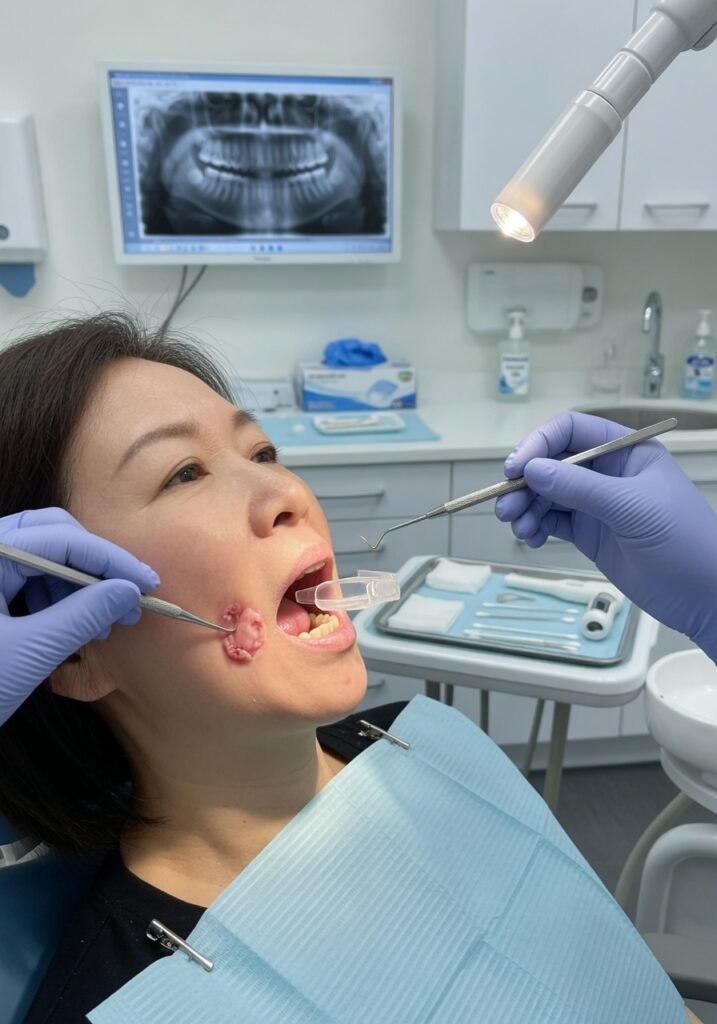
Marcus, a 54-year-old construction supervisor, noticed a persistent sore on the inside of his cheek that wasn’t healing after three weeks of careful attention. He figured it was just a canker sore from his dental work, but his dentist took one look and ordered a biopsy the same day. The pathology report confirmed what neither of them wanted to hear: squamous cell carcinoma of the oral cavity, caught early enough that his treatment options were still favorable.
Oral cancer kills approximately one person every hour in the United States, yet many people couldn’t identify the early warning signs if they appeared in their own mouth. The difference between Marcus’s outcome and a worse one often comes down to recognizing what shouldn’t be ignored and acting quickly.
Key Facts About Oral Cancer
- The National Cancer Institute reports approximately 54,540 new cases of oral and pharyngeal cancer diagnosed annually in the United States, with a 5-year survival rate of 68% when caught at early stages versus 39% for late-stage disease.
- Men are diagnosed with oral cancer at roughly twice the rate of women, though the gap is narrowing due to changing risk factor patterns.
- Tobacco use and heavy alcohol consumption together create a synergistic risk—meaning the combined danger is far greater than either factor alone, increasing risk by up to 35-fold according to JAMA Oncology data.
- HPV-related oral cancers now represent approximately 70% of oropharyngeal cancers in developed nations, shifting the demographic profile of who gets diagnosed.
- More than 90% of oral cancers are squamous cell carcinomas, with the remainder including adenocarcinomas, melanomas, and sarcomas, each requiring different treatment approaches.
Understanding Oral Cancer: What’s Actually Happening
Think of your mouth’s lining like a protective factory floor. Under normal circumstances, the cells that coat your mouth regenerate in an orderly fashion—old ones shed, new ones arrive, everyone stays in line. Oral cancer begins when that system breaks down. Cells start copying themselves without the usual stop signals, accumulating genetic damage faster than your body can repair or eliminate them.
The cells don’t just sit there being dysfunctional. They invade deeper tissues, trigger new blood vessel formation to feed their growth, and eventually develop the ability to migrate elsewhere. This is why a small sore in your mouth can become a serious threat if ignored. The location matters too—cancers on the floor of the mouth or under the tongue tend to be more aggressive because they have easier access to blood vessels and lymph nodes that can carry cancer cells throughout your body.
Causes and Risk Factors: Beyond the Obvious
Tobacco remains the single most important modifiable risk factor. Smoking cigarettes, cigars, or pipes exposes your mouth to over 7,000 chemicals, roughly 250 of which are harmful and about 69 proven carcinogens. Smokeless tobacco (chewing tobacco and snuff) is equally dangerous, often creating direct contact with oral tissues for extended periods. The carcinogens in tobacco directly damage DNA in mouth cells, making malignant transformation more likely.
Alcohol operates differently. It doesn’t contain carcinogens itself, but it damages the protective barrier of your mouth and increases cell permeability, allowing carcinogens to penetrate deeper. Someone who drinks heavily and uses tobacco has exponentially higher risk than either behavior alone.
HPV-16 and HPV-18 deserve special attention because they’re often overlooked in conversations about oral cancer. If you contracted genital HPV, you likely have oral HPV too—many sexually active adults do. The virus integrates into your mouth’s cells, producing oncoproteins that disable your cell’s natural tumor suppressors. HPV-positive oral cancers tend to occur in younger, non-smoking populations, which catches people off guard. Getting the HPV vaccine (Gardasil 9) protects against the cancer-causing strains if you haven’t been exposed yet.
Other risk factors include chronic irritation from sharp teeth or ill-fitting dentures, a history of head and neck radiation therapy, immunosuppression (whether from medications or HIV), and nutritional deficiencies. One factor most articles miss: chronic use of mouthwash containing high alcohol concentrations (over 27%) may increase risk slightly over decades, though the data remains mixed. Daily use of high-alcohol mouthwash probably isn’t wise if you have other risk factors.
Signs and Symptoms: What You’re Actually Looking For
Early oral cancer doesn’t always announce itself dramatically. Many people feel something before they see it—an area that feels slightly different when your tongue passes over it, maybe a vague numbness or burning sensation that seems out of proportion to what you observe.
A sore or ulcer that doesn’t heal in two to three weeks is your first red flag. Unlike typical canker sores that come and go, cancerous lesions persist. They might appear red, white, or a mixture (called erythroleukoplakia), or they might look deceptively innocent. The key is persistence, not appearance.
You might notice difficulty swallowing, though this is more common with advanced disease. Earlier, you might just notice swallowing feels slightly odd on one side, or food catches in a particular spot. Persistent ear pain referred from the mouth is another subtle sign. Unexplained facial swelling, loosening teeth without clear dental cause, or a lump in your neck deserve investigation.
Some patients describe a feeling of thickness in their tongue or mouth, or hoarseness that lasts more than three weeks. Numbness in your lower lip or chin specifically can indicate nerve involvement. These symptoms matter because they’re the ones people often dismiss as minor annoyances rather than medical concerns.
Diagnosis: The Process and What to Expect
Your dentist or physician will begin with a visual and tactile exam. They’re looking at color, texture, whether borders are well-defined or irregular, whether the lesion feels hard or soft. They’ll palpate your neck for lymph nodes. If something concerning appears, they won’t wait around—a biopsy is the only way to know definitively whether cells are malignant.
The biopsy procedure is straightforward. Using local anesthetic, your provider takes a small tissue sample—often just a few millimeters—from the suspicious area. You might feel pressure and hear a small clicking sound if they use a punch biopsy tool, but significant pain is rare. The sample goes to a pathologist who examines it under a microscope, looking at cell structure, growth patterns, and genetic markers.
If cancer is confirmed, staging comes next. This determines how far the disease has spread and guides treatment planning. You’ll likely have imaging—CT scan, MRI, or PET scan—to evaluate whether cancer has spread to lymph nodes or distant sites. The TNM system (tumor size, node involvement, metastasis presence) assigns a stage from I (most localized) to IV (most advanced).
Treatment Options: What Works and When
Early-stage oral cancers (Stage I and II) often respond well to single-modality treatment. Surgical resection—removing the tumor with adequate surrounding margin—is frequently the first-line approach. Your surgeon removes the cancer and enough normal tissue around it to ensure microscopic disease isn’t left behind. For small tumors, this might mean a relatively minor outpatient procedure. Larger tumors may require more extensive surgery and potential reconstructive work.
Radiation therapy uses high-energy photons to damage cancer cell DNA. Modern techniques like intensity-modulated radiation therapy (IMRT) target tumors precisely while sparing surrounding tissues. This reduces side effects compared to older approaches. Radiation works well for early stages and is sometimes combined with surgery.
Chemotherapy plays a larger role in advanced disease. Cisplatin remains the backbone drug for oral cancer, often combined with 5-fluorouracil (5-FU) or cetuximab (an EGFR inhibitor). These drugs circulate throughout your body, targeting cancer cells wherever they are. Cisplatin causes significant side effects—nausea, hearing loss, kidney stress—so careful monitoring during treatment is essential.
Newer immunotherapy drugs like nivolumab and pembrolizumab (checkpoint inhibitors) have expanded options for recurrent or metastatic disease. These medications help your immune system recognize and attack cancer cells. They work best in tumors with high PD-L1 expression, which your pathology report will identify.
Most Stage III and IV patients receive multimodal therapy—surgery combined with radiation, or chemotherapy combined with radiation. Your specific plan depends on tumor location, size, grade, and your overall health.
Practical Daily Management After Diagnosis
During treatment, managing side effects directly impacts your ability to complete therapy. Radiation causes dry mouth that can last months or years afterward—use saliva substitutes like Biotene or prescription pilocarpine. Keep your mouth meticulously clean with soft toothbrushes and fluoride rinses to prevent radiation-induced cavities.
If you’re receiving chemotherapy, mouth sores (oral mucositis) are nearly inevitable. Use a bland diet, avoid acidic foods and drinks, and rinse with salt water several times daily. Palifermin (Kepivance), a growth factor medication, reduces mucositis severity if given preventively. Swallow small amounts frequently rather than large meals.
Nutrition becomes critical. Cancer treatment often reduces appetite while increasing caloric needs. Work with a registered dietitian. Protein intake prevents muscle loss during treatment. If swallowing is difficult, smoothies with protein powder, peanut butter, and fruit work well.
Maintain dental care but pause routine work during active treatment. After treatment ends, see your dentist every three to six months for surveillance.
Prevention: What Evidence Actually Shows Works
The most straightforward prevention is avoiding tobacco and limiting alcohol. If you use tobacco, cessation programs—whether behavioral counseling, nicotine replacement, or medications like varenicline—reduce your risk substantially within five years of quitting.
HPV vaccination prevents 70-90% of HPV-related cancers if given before exposure. The CDC recommends it through age 26 for all individuals, and through age 45 for some adults. If you have risk factors for oral HPV, discussing vaccination with your provider is worthwhile.
Sun exposure increases lip cancer risk, so use SPF 30+ lip balm outdoors. Eat a diet rich in fruits and vegetables—the antioxidants genuinely do reduce risk. Maintain oral hygiene and see your dentist annually; they’re often the first to spot suspicious changes.
Self-examination takes two minutes monthly. Use good lighting and look at all surfaces of your mouth. Feel your cheeks, tongue, floor of mouth, and hard palate with your fingers. Note any bumps, sores, or color changes. Anything persisting beyond three weeks warrants professional evaluation.
Frequently Asked Questions
Can oral cancer spread quickly?
Some oral cancers are more aggressive than others, but spread typically occurs over weeks to months, not days. HPV-positive oropharyngeal cancers sometimes appear more advanced at diagnosis because they grow in areas you can’t easily see. This is why waiting more than three weeks to evaluate a persistent sore is risky—early tumors are smaller and more treatable.
Is oral cancer always a death sentence?
Absolutely not. Early-stage oral cancer has a 5-year survival rate above 80%, and many patients live decades after treatment. Even advanced cancers are often controllable long-term with modern treatment. Your prognosis depends heavily on stage at diagnosis, tumor characteristics, and how well you tolerate treatment.
Will I lose my ability to eat or speak after treatment?
Sources & Medical References
HealthTopics.com articles are based on peer-reviewed medical research and guidance from the NIH, CDC, and WHO. See our editorial policy for full sourcing standards.