Tooth Decay: How Cavities Actually Form and What You Can Do About It
Sarah, a 34-year-old accountant who religiously brushes twice daily, discovered a small brown spot on her molar during a routine checkup. Her dentist explained she’d already lost 40% of the enamel thickness in that area—yet she’d felt absolutely nothing. Research shows that untreated tooth decay affects approximately 26% of U.S. adults aged 20 to 64, making it one of the most common chronic diseases according to the CDC, far surpassing diabetes in prevalence. What most people don’t realize is that a cavity doesn’t announce itself with pain until the decay has already penetrated deep into the tooth structure. By then, you’re looking at fillings, root canals, or extraction—not prevention. Understanding the actual mechanism of how cavities form, well before you feel them, changes everything about how you protect your teeth.
Key Facts About Tooth Decay
- Cavity formation takes 6 months to 2 years of repeated acid exposure on the same tooth surface, meaning early intervention is critical
- The pH threshold for enamel demineralization is 5.5—foods and beverages below this acidity directly dissolve tooth structure
- Only 64% of American adults visit a dentist annually, yet the JAMA Dentistry journal reports that regular professional fluoride applications reduce cavity risk by 29% in high-risk individuals
- Streptococcus mutans, the primary decay-causing bacterium, colonizes teeth within the first 18-24 months of life, establishing a lifetime risk baseline
- Saliva flow rates below 0.5 mL per minute dramatically accelerate cavity formation—a factor that increases with age, medications, and autoimmune conditions
Understanding How Tooth Decay Actually Develops
Let’s walk through what’s literally happening in your mouth. Your teeth are locked in an ongoing biochemical war. Streptococcus mutans and other acidogenic bacteria live in dental plaque—that sticky biofilm you feel when you don’t brush. These bacteria metabolize dietary sugars and starches, producing lactic acid as a byproduct. That acid pools against your enamel, dropping the pH immediately surrounding the tooth below 5.5. At this threshold, your enamel minerals (primarily calcium hydroxyapatite) begin dissolving back into the saliva in a process called demineralization.
Here’s the part most people miss: your saliva actually fights back. Calcium, phosphate, and fluoride ions in your saliva attempt to remineralize the enamel—rebuilding what the acid dissolved. This is a dynamic balance happening constantly throughout the day. The problem is when that acid exposure lasts too long or happens too frequently. After just 20 minutes of acid attack, if the pH hasn’t risen again, the demineralization outpaces remineralization. Do this repeatedly, day after day, and you’ve created a microscopic hole that eventually becomes visible as a brown or white spot. That spot is no longer solid enamel—it’s porous, weakened crystal structure. The decay then spreads laterally and deeper, underneath apparently healthy enamel, until it reaches the softer dentin layer beneath. Once decay hits dentin, it spreads exponentially faster because dentin is substantially less mineralized than enamel.
Causes and Risk Factors That Actually Matter
The obvious culprits are sugary foods and drinks, obviously. But which ones accelerate decay most aggressively? Sticky substances that linger on teeth—caramel, dried fruit, peanut butter—create longer acid-producing environments than foods that wash away quickly. Carbonated beverages like cola, energy drinks, and even diet soda pose a dual threat: phosphoric and citric acids lower pH directly, while any residual sugar feeds bacteria. Sipping these drinks throughout the day is worse than drinking them in one sitting because you’re cycling through repeated acid attacks.
Dietary acids themselves matter independently of sugar. A 2019 NIH study on dental erosion found that regular consumption of citrus fruits, apple juice, and vinegar-based foods lowered cavity risk in some individuals while increasing erosion susceptibility in others—the distinction depending on enamel thickness and saliva buffering capacity. This is the nuance your dentist should discuss but often doesn’t.
Now, here’s what gets overlooked: medication-induced dry mouth is a cavity accelerant that rivals poor hygiene. Antihistamines, antidepressants, beta-blockers, and dozens of other common medications suppress salivary flow. Without adequate saliva, you lose your natural antimicrobial and remineralizing defense system. Someone on an antihistamine for allergies who brushes meticulously might develop cavities faster than someone with inconsistent brushing but normal saliva production. Similarly, conditions like Sjögren’s syndrome or chemotherapy-related xerostomia (dry mouth) create high-risk profiles that demand aggressive prevention protocols.
Genetics load the gun; lifestyle pulls the trigger. Some people have naturally thinner enamel or lower salivary buffering capacity—meaning their saliva is less effective at neutralizing acids. Fluorosis history, previous cavities, crowded teeth (harder to clean between), and a family history of early tooth loss all indicate elevated risk. Smokers develop cavities at roughly 1.5 times the rate of non-smokers, partly due to reduced salivary flow and impaired immune function in the mouth.
Signs and Symptoms You’re Experiencing
Pain is a late-stage symptom. By the time a cavity hurts, decay has likely reached the dentin or pulp. What should you actually notice earlier?
White or chalky spots on your teeth—particularly along the gum line or between teeth—are demineralization in action. These spots feel slightly rougher than surrounding enamel if you run your tongue across them. Brown discoloration, even if painless, indicates active decay. Some people notice slight sensitivity to cold water or sweets, but sensitivity is unreliable as an early warning sign; some cavities never produce sensitivity.
A less obvious symptom: catching your tongue or floss on the same spot repeatedly. Cavities create irregular edges and small crevices that trap floss. Food catching in one specific area of your mouth, particularly if it wasn’t happening previously, suggests structural change. Slight visible pitting or a small hole visible to the naked eye means decay is well-established.
Halitosis (bad breath) specifically concentrated near one tooth, rather than general bad breath, can indicate cavity-related bacterial overgrowth or early abscess formation. Some patients describe a slightly unpleasant taste in one localized area—not everywhere in the mouth, but specifically where decay is developing.
How Your Dentist Diagnoses Tooth Decay
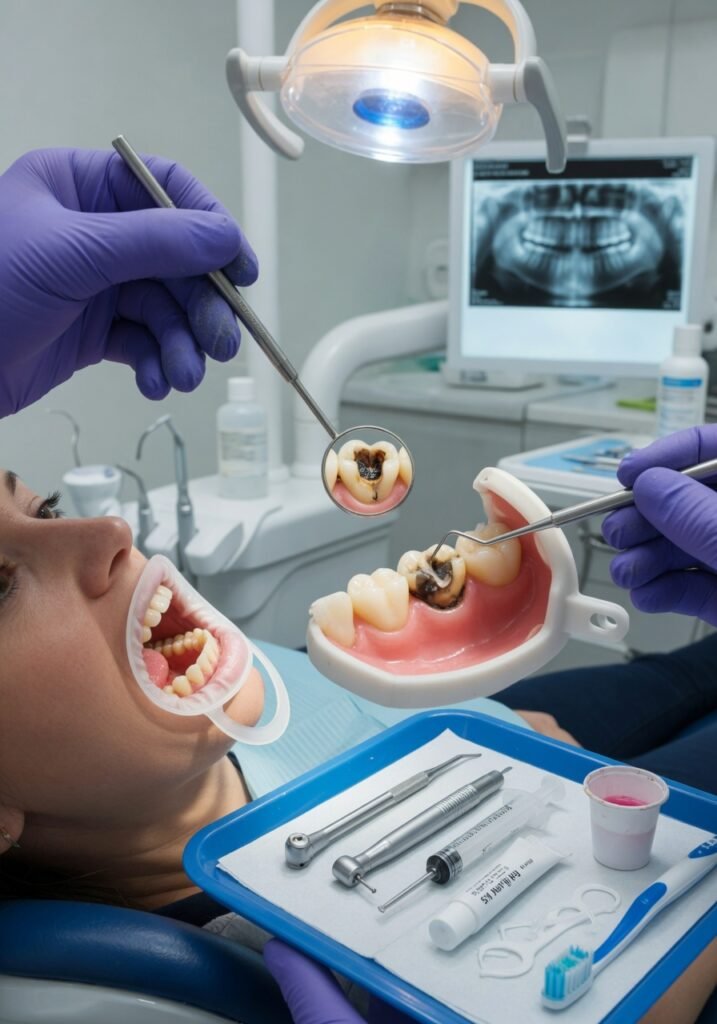
During examination, your dentist uses a combination approach. Visual inspection under good lighting catches brown spots and obvious cavities, but early white-spot lesions can be hard to spot. Your dentist will dry your tooth with compressed air to make subtle demineralization visible—wet teeth hide these early signs. They’ll probe suspect areas with a dental explorer (a thin, sharp instrument), feeling for stickiness or catch—decayed areas feel slightly tacky. Modern dentists may use laser fluorescence devices like the DIAGNOdent, which detects mineral loss before it’s visible.
Bitewing X-rays are essential because they reveal decay between teeth and underneath existing fillings, areas impossible to see clinically. Digital radiographs deliver about 80% less radiation than older film, making them low-risk. Your dentist assesses decay depth and proximity to the pulp, which determines treatment approach. Some practices use cone-beam computed tomography (CBCT) for complex cases, though this is overkill for routine cavity detection.
They should also assess your risk category. High-risk patients get more frequent professional fluoride applications or different prevention strategies than low-risk patients. This risk assessment considers frequency of cavities, your current hygiene quality, dietary habits, and saliva flow rate—though most dentists don’t formally measure saliva unless xerostomia is obvious.
Treatment Options for Existing Cavities
Resin composite fillings are standard for small to moderate cavities. Your dentist removes decayed tooth material, cleans the cavity, applies an etching acid to roughen the surface, then bonds composite resin into place and hardens it with a UV light. Modern composites like Filtek Supreme and Tetric EvoCeram bond effectively and match tooth color well, though they require a dry field to set properly. The entire process takes 20-45 minutes depending on cavity size and location.
For larger cavities approaching the pulp, your dentist might recommend amalgam (silver) fillings instead. Amalgam requires less precision than composite and lasts longer in high-stress areas like molars, though tooth-colored composites now dominate for cosmetic reasons. Neither filling type is perfect—composites can wear in high-stress areas; amalgam is a visual reminder of the cavity.
When decay reaches the pulp (the nerve), root canal therapy becomes necessary. Your endodontist removes the infected pulp tissue, cleans and shapes the root canal system with tiny files, then fills it with gutta-percha (a rubber-like material). Success rates for conventional root canal therapy exceed 85% according to the American Association of Endodontists, though retreatment may be needed if infection persists. Root canal costs run $800-2,500 depending on tooth location and complexity.
Severely decayed teeth that can’t be restored with filling or root canal require extraction. This should be avoided when possible because losing a tooth creates cascading problems: shifting of adjacent teeth, bite changes, and bone loss in the jaw over time. If extraction is necessary, replacement with an implant ($2,000-6,000), bridge, or denture is recommended.
Practical Daily Management Strategies
Stop sipping. This is critical and underemphasized. Consuming a sugary or acidic beverage in one sitting causes one acidic event. Sipping that same beverage throughout your workday causes 6-8 separate acid events. Your saliva can recover between discrete events but fails if you’re continuously reexposing your teeth. Water, unsweetened tea, or milk are your friends between meals.
Timing your brushing matters more than you think. Brush immediately after meals containing sugar or acid. However—and this is counterintuitive—if you’ve consumed acidic food like orange juice or a sport drink, wait 30 minutes before brushing. Acids temporarily soften enamel; brushing immediately can cause microabrasion. Rinse with water or a fluoride mouthwash first.
Fluoride toothpaste concentration matters. Adult toothpastes contain 1,000-1,500 ppm (parts per million) fluoride; children’s formulas are lower. Using at least 1,450 ppm fluoride toothpaste twice daily reduces cavity incidence by approximately 24% compared to non-fluoridated toothpaste in clinical trials. Spit out excess toothpaste rather than rinsing aggressively—residual fluoride continues protecting your teeth for hours.
Floss between teeth daily. Cavities form between teeth more frequently than on biting surfaces because plaque accumulates there and brushing can’t reach. Water flossers work better than traditional floss for people with dexterity issues, though both are effective if used properly. Dental tape (flatter than string floss) is easier to maneuver for many people.
If you have xerostomia or high cavity risk, discuss xylitol-containing products with your dentist. Xylitol is a sugar alcohol that some bacteria can’t metabolize effectively, reducing acid production. Xylitol gum or lozenges after meals have shown modest benefit (approximately 15% cavity reduction) in high-risk populations, though it’s not a substitute for fluoride or proper hygiene.
Prevention: What Actually Works According to Evidence
Professional fluoride applications in your dentist’s office are several times more concentrated (5,000-10,000 ppm) than over-the-counter products. These reduce cavity incidence by 29-37% in high-risk patients when applied twice yearly