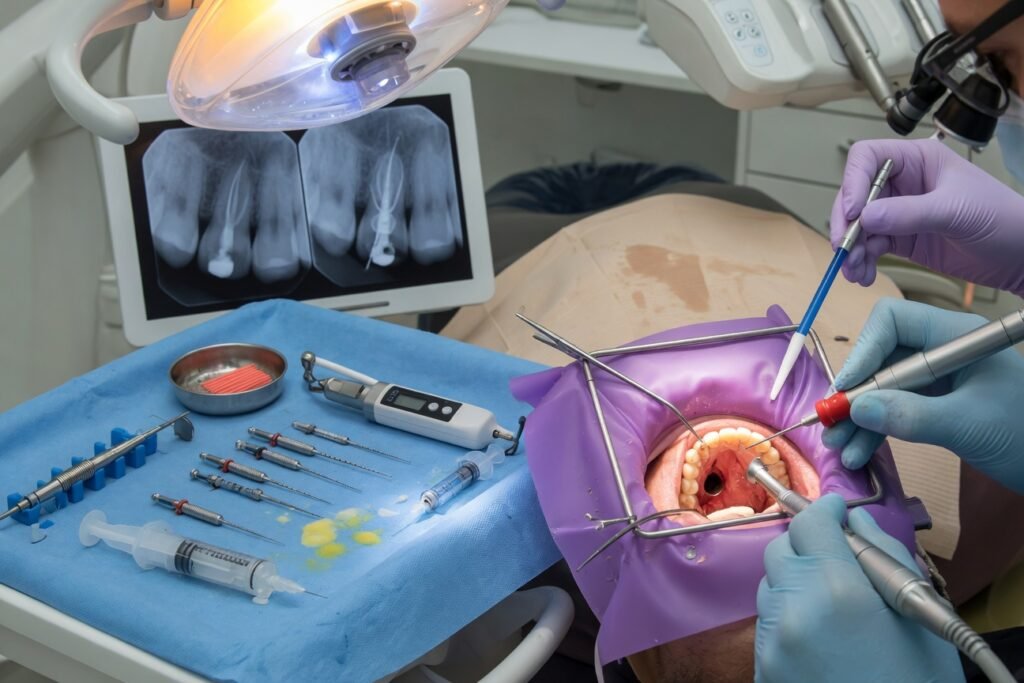
Root Canal Treatment: What Actually Happens During Your Procedure and Why Recovery Isn’t What You’ve Heard
Sarah, a 42-year-old accountant, came to my office convinced she needed a root canal because her tooth hurt when she bit down. She’d heard horror stories from friends about excruciating pain during the procedure itself and weeks of suffering afterward. Here’s what surprised her: the root canal procedure was actually less uncomfortable than the tooth extraction she had done five years earlier. And her recovery? She was back to eating normally within three days. The misconception that root canal treatment is inherently more painful than tooth loss persists because the root of the tooth—the nerve-containing chamber deep inside—sounds scary. The truth is simpler: when a root canal is performed properly with modern anesthesia, patients experience minimal pain during treatment. The real discomfort came before the procedure, from the infected pulp itself, not from the endodontic treatment that removes it.
Key Facts About Root Canal Treatment
- According to the CDC, approximately 15.1 million endodontic procedures (including root canals) are performed annually in the United States, with a 95% success rate when completed properly.
- The root canal procedure itself typically lasts 30 to 90 minutes depending on tooth complexity, though molars often require longer treatment than anterior teeth.
- Modern rotary instrumentation and electronic apex locators (devices that measure exact root length) have reduced procedural time by approximately 40% compared to hand-file techniques used a decade ago.
- Pain management during root canal treatment relies on local anesthesia (typically lidocaine with epinephrine), with supplemental techniques like intraligamentary injection used in approximately 8-12% of cases when initial anesthesia fails.
- Post-operative sensitivity following root canal treatment resolves in 80-90% of patients within two weeks; persistent pain beyond four weeks occurs in fewer than 5% of cases and usually indicates either incomplete pulp removal or untreated canals.
Understanding Root Canal Treatment: What’s Actually Happening Inside Your Tooth
Your tooth isn’t solid. Inside the hard white enamel and yellow dentin sits a chamber containing the pulp—a collection of blood vessels and nerves that kept your tooth alive as it developed. Once your tooth erupted and matured, that pulp became less essential. Think of it like the umbilical cord after birth: vital during development, but no longer necessary once the structure is established.
When bacteria invade the pulp chamber—through a deep cavity, a crack, or even from repeated trauma—the immune system responds with inflammation. The pulp swells, pressure builds inside a confined space (the tooth structure doesn’t stretch), and those nerves start firing pain signals. This is why an infected tooth can hurt so intensely: you’re experiencing inflammatory pressure, not just infection. A root canal removes the inflamed pulp tissue entirely, eliminating the source of pain and halting the infection’s progression before it creates an abscess at the root tip.
The procedure involves three phases: access, instrumentation, and obturation. First, the dentist creates an opening through the crown surface to reach the pulp chamber. Second, using progressively larger files (stainless steel or nickel-titanium instruments), they clean and shape the root canals. Third, they fill those canals with gutta-percha—a biocompatible rubber-like material—and sealer cement to prevent future reinfection. It’s methodical, not brutal.
What Causes the Need for Root Canal Treatment?
The most obvious culprit is untreated decay. A cavity that reaches the pulp chamber is the path bacteria use to colonize the pulp space. But decay isn’t the only way teeth get infected. Trauma matters more than most patients realize. A tooth that’s been knocked, hit, or even orthodontically moved too aggressively can develop pulp necrosis—essentially a slow death of the nerve tissue. You might not notice it happening; necrotic teeth don’t always hurt initially because the nerve is dying, not inflamed. The problem surfaces months or years later when bacteria colonize the dead tissue.
Repeated dental work on the same tooth increases risk substantially. Each time a filling is placed or replaced, the tooth loses a tiny bit more structure and the pulp gets closer to exposure. A tooth with three or four existing fillings is at higher risk for eventual root canal need. Bruxism—grinding your teeth at night—creates microtrauma over time. The constant stress can inflame the pulp chronically, eventually pushing it toward necrosis.
Here’s what most websites skip: iatrogenic pulpitis from aggressive polishing or over-instrumentation during routine dental work does happen. When a dentist uses a burr near the pulp at high speed without adequate water cooling, or places a restoration too close to the pulp chamber, they can damage the pulp thermally or mechanically. It’s rare with modern techniques, but it occurs. Acidic diets that cause erosion, especially in patients who consume energy drinks or citric acid supplements, can gradually expose the pulp over years. Periodontal disease can also lead to pulp involvement when the infection spreads from the root surface into the pulp chamber through lateral canals.
Signs and Symptoms You Might Need Root Canal Treatment
Sharp, shooting pain when you bite down on a specific tooth is the classic presentation, but it’s actually not the most common one. More often, patients describe a constant, dull aching in the jaw around a tooth, sometimes radiating to the temple or ear. The pain might wake you at 3 AM because lying down increases blood pressure in your head, intensifying the inflammatory pressure inside the tooth.
Sensitivity to hot liquids that lingers for 30 seconds or longer after you remove the stimulus suggests pulp inflammation. Cold sensitivity that resolves quickly (a second or two) is usually just dentinal hypersensitivity, but prolonged hot sensitivity raises red flags. Discoloration—a tooth that gradually darkens from white to gray or brown—indicates pulp necrosis. This happens because dead tissue inside the tooth degrades and stains the dentin from within.
A pimple-like bump on the gum above the tooth’s root means an abscess has formed. Don’t wait if you notice this; it’s a sign of active infection spreading beyond the root tip. Some patients experience no pain whatsoever, discovering the problem only during a routine X-ray when their dentist spots a dark shadow at the root tip—evidence of bone loss from chronic low-grade infection. This silent progression is insidious. A tooth might be infected for months without obvious symptoms.
Early warning signs most articles miss: gum recession around a specific tooth (can expose lateral canals to bacteria), a tooth that feels slightly high in the bite compared to others (early inflammatory swelling), or a tooth that appears longer than its neighbors (because the gum has pulled away slightly from chronic inflammation).
How Root Canal Treatment Is Diagnosed
Your dentist starts with questions: Where does it hurt? When did it start? What makes it worse? Then comes percussion testing—they tap each tooth gently with an instrument. An infected tooth typically causes sharp pain with tapping because the inflamed tissue around the root tip is sensitive to pressure.
Thermal testing uses cold and sometimes heat applied to the tooth surface to assess pulp response. A tooth with healthy pulp responds to cold quickly and returns to normal promptly. A dying pulp responds slowly or not at all. Vitality testing (electric pulp testing) sends a small current through the tooth; a vital pulp conducts electricity and the patient feels a tingling sensation at a predictable current level.
X-rays are essential, not optional. A periapical radiograph shows the roots, root tips, and surrounding bone. Your dentist looks for a dark halo around the root tip—bone loss indicating infection—or a tooth root that appears darker than neighboring roots (suggesting necrosis). Cone beam computed tomography (CBCT) provides 3D imaging and is increasingly used for complex cases with multiple canals or suspected anatomical variations.
The diagnostic process itself is usually straightforward and uncomfortable only if the tooth is severely inflamed. Some patients worry that testing will worsen the infection or spread it, but that’s unfounded. Gentle examination and X-rays cause no harm.
Root Canal Treatment: What to Expect
Modern root canal therapy uses local anesthesia, typically lidocaine with epinephrine (1:100,000 concentration). The epinephrine constricts blood vessels, keeping anesthetic in place longer and providing a bloodless field. If initial anesthesia doesn’t work—which happens in about 10% of inflamed teeth because the inflammatory tissue lowers the pH, reducing anesthetic effectiveness—your endodontist has alternatives. Supplemental intraligamentary injection (a small amount of anesthetic placed alongside the tooth root through the periodontal ligament) often succeeds when block anesthesia alone doesn’t.
After anesthesia takes effect (usually 5-10 minutes), the dentist isolates the tooth with a rubber dam—a thin latex barrier that keeps the tooth dry and prevents saliva contamination. This isolation is crucial for success. They access the pulp chamber, often using an ultrasonic tip to locate calcified canals. Once canals are located, files of increasing diameter and stiffness progressively enlarge and shape them. Modern nickel-titanium rotary files rotate continuously and conform to the natural curve of the canal, reducing breakage and improving efficiency.
Sodium hypochlorite solution irrigates the canals throughout, dissolving organic debris and disinfecting. Some practitioners use chlorhexidine as an additional antimicrobial rinse. The goal is complete pulp removal and disinfection. Once the canals are shaped to size, they’re filled with gutta-percha and sealer cement using either a lateral condensation technique (packing multiple small gutta-percha points) or vertical condensation (heat-softened core with auxiliary points). The access opening is then sealed with composite resin.
The entire procedure is painless because the nerve is anesthetized. What you feel instead is pressure, vibration, and sometimes heat from the file friction. Many patients describe it as “weird but not painful.” Expect the appointment to last 60-90 minutes for a molar, 30-45 minutes for a front tooth.
Recovery and Post-Treatment Discomfort
Here’s the honest part: some soreness in the hours and days after root canal treatment is normal. The tooth and surrounding tissue have been manipulated, irrigated with chemical solutions, and the inflammatory process is still resolving even though the pulp is gone. Post-operative pain typically peaks within 12-24 hours and resolves within 3-7 days.
Over-the-counter analgesics work well. Ibuprofen (Advil, Motrin) at 400-600mg every 6-8 hours is more effective than acetaminophen for inflammatory pain and is the first choice. Some practitioners prescribe ibuprofen 600mg with acetaminophen 500mg combined for better pain control. Avoid chewing on the treated tooth until it’s permanently restored; the tooth is now brittle without the hydration that the living pulp provided, and chewing can cause fracture.
If pain worsens after three days, or if you develop facial swelling, persistent fever, or severe pain that doesn’t respond to analgesics, contact your dentist or endodontist immediately. These signs suggest incomplete treatment, another canal was missed, or an abscess is developing. Persistence of symptoms is rare but possible, occurring in 2-5% of cases despite proper treatment technique.
A permanent restoration—typically a crown—is essential after root canal treatment. The tooth has become more porous and fragile; a crown provides the structural reinforcement it needs. Teeth treated with root canal therapy that aren’t crowned have a significantly higher failure rate due to fracture or reinfection.
Preventing Root Canal Treatment
The evidence base is clear, though not revolutionary. Brush twice daily with fluoride toothpaste; fluoride strengthens enamel and slows cavity progression. Floss daily—interdental disease progresses faster to the pulp than occlusal cavities. Limit sugary drinks and acidic beverages; sodas, energy drinks, and citric acid supplements all accelerate enamel erosion. If