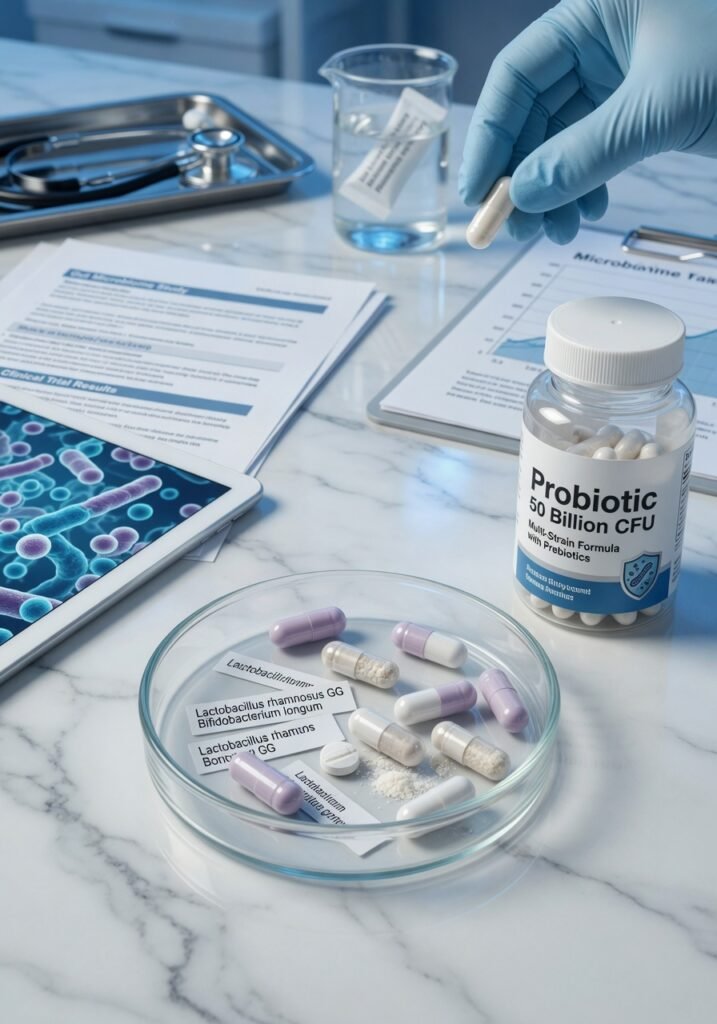

Do Probiotics Actually Work, or Are You Just Feeding Your Bacteria Expensive Yogurt?
Sarah, a 42-year-old accountant, came to my office frustrated. She’d been taking three different probiotic supplements for six months—spending nearly $200 monthly—because her gastroenterologist mentioned they “might help” her bloating. When I asked her what specific changes she noticed, she paused. Nothing concrete, really. Just hope. The truth is more complicated than the marketing on those bottles suggests, and after 20 years in clinical practice, I’ve learned that most patients deserve straight answers about what probiotics supplements actually do, when they’re worth taking, and when they’re honestly just waste.
Key Facts About Probiotics Supplements
- The NIH estimates that 3.9 million American adults use probiotics regularly, yet only 5-15% of ingested organisms actually colonize the intestinal tract long-term
- Lactobacillus acidophilus and Bifidobacterium longum are the two strains with the most robust clinical evidence, but effectiveness varies by individual based on existing microbiome composition
- Most probiotics require proper storage between 35-46°F; room-temperature bottles may lose 50-80% of viable organisms within 3 months
- A 2023 JAMA study found probiotics reduced antibiotic-associated diarrhea risk by 25-35%, but showed minimal benefit for IBS symptoms in patients without prior antibiotic use
- The average probiotic supplement contains 1 billion to 100 billion CFU (colony-forming units), but clinical effectiveness typically requires 10-20 billion CFU daily for therapeutic benefit
Understanding How Probiotics Actually Work in Your Body
Here’s what genuinely happens when you swallow a probiotic capsule. Those live bacteria travel through your stomach acid—and yes, many die in that hostile environment—then reach your small intestine and colon. The survivors attempt to establish themselves alongside your existing microbiota, which is already occupied by roughly 37 trillion resident organisms. Think of it less like repopulating a vacant lot and more like asking a new person to find a seat at a completely packed dinner table.
The beneficial effects come from several mechanisms. Probiotics produce short-chain fatty acids like butyrate, which strengthen your intestinal barrier. They also compete with pathogenic bacteria for nutrients and space, and some strains produce antimicrobial compounds. But here’s the clinical insight most wellness websites skip: whether any of this matters depends entirely on your baseline microbiome. If your gut dysbiosis comes from specific pathogenic overgrowth, certain strains help. If your dysbiosis comes from a generally depleted ecosystem, probiotics alone might accomplish little without dietary changes supporting all microorganisms.
Who Truly Benefits—And Who Doesn’t
The evidence strongly supports probiotics for one specific situation: antibiotic-associated diarrhea prevention. When you take antibiotics like amoxicillin or ciprofloxacin, they demolish your protective bacteria, allowing Clostridioides difficile or other harmful organisms to flourish. Saccharomyces boulardii (a yeast probiotic) and Lactobacillus rhamnosus GG have shown 25-35% risk reduction when started during antibiotic treatment.
Beyond that narrow window, the evidence becomes murkier. Patients with irritable bowel syndrome report mixed results. Some strains help certain people’s bloating, but placebo response rates hover near 40-50% in IBS trials. Inflammatory bowel disease presents a different picture—probiotics haven’t replaced standard treatments like mesalamine or biologics, though some gastroenterologists recommend specific strains as adjuncts. For generally healthy people? The scientific justification essentially evaporates.
One commonly overlooked risk factor deserves mention: immunosuppression. If you’re taking immunosuppressive medications for organ transplant, severe rheumatoid arthritis, or other conditions, probiotics carrying certain strains have rarely caused bacteremia or fungemia. Your doctor should approve before starting any supplement.
What You Actually Experience When Taking Probiotics
The honest patient experience varies wildly. Some people notice reduced bloating within 3-5 days. Others feel nothing after months. Some experience temporary gas or mild abdominal discomfort as their microbiota shifts—what I call the “adjustment week.” Others struggle with unpredictable changes in bowel frequency.
Early signs that a probiotic might be helping include more stable digestion patterns, reduced gas compared to your baseline, and improved regularity. But here’s what catches people off-guard: probiotic effects often take 2-3 weeks to manifest meaningfully, not days. If you’re evaluating effectiveness, commit to at least one month before deciding.
One overlooked early sign of probiotic difficulty: worsening bloating or diarrhea beyond one week. This occasionally signals that the specific strain doesn’t suit your existing microbiome composition, and continuing helps nothing.
Testing and Evaluation—What Actually Helps
Here’s where I’ll be blunt: stool microbiome testing marketed to consumers (Thorne, Viome, Everlywell) provides interesting data but minimal actionable guidance. The commercial lab results tell you what organisms are present, but they don’t reliably predict which probiotic will help you specifically. Microbiome testing genuinely serves research purposes and can occasionally guide clinical decisions in severe dysbiosis, but for most people considering probiotics, it’s informative theater.
More useful? Keeping a simple symptom diary for one week before starting probiotics, tracking bloating severity, bowel frequency, energy, and mood on a 1-10 scale. After three weeks, you can objectively compare changes. This low-tech approach beats any expensive lab test for determining personal probiotic efficacy.
If you’re experiencing persistent digestive symptoms, your doctor should first rule out genuine pathology—celiac disease, inflammatory bowel disease, food sensitivities, and infection all masquerade as dysbiosis sometimes.
Which Probiotics Actually Merit Your Money
Not all supplements are created equally. Here’s what research supports:
- Saccharomyces boulardii CNCM I-745: Most robust evidence for antibiotic-associated diarrhea. Dose typically 250-500 mg twice daily during and after antibiotics.
- Lactobacillus rhamnosus GG (Culturelle): Second-best evidence for antibiotic prevention and mild IBS symptoms. Requires at least 10 billion CFU daily.
- Bifidobacterium longum: Some evidence for IBS-related constipation. Less studied than the above but shows promise in specific populations.
- Multi-strain formulas: Most marketed products contain 5-10 different organisms. The research on combination effects remains limited, and they cost more without proven superiority.
Avoid any probiotic claiming to treat serious conditions like autoimmune disease or cancer. Avoid those stored at room temperature without verified cold-chain documentation. Third-party testing by USP or NSF International provides some quality assurance, though it’s not mandatory.
Practical Strategies for Taking Probiotics Successfully
Timing matters. Take probiotics with food, ideally fat-containing meals, which buffer stomach acid and improve survival rates. Empty-stomach dosing reduces effectiveness substantially.
Storage is non-negotiable. Refrigerate your probiotics immediately after purchase. Many people buy expensive supplements, leave them on kitchen counters, and wonder why they feel no benefit. Within three months at room temperature, viable organism counts drop 50-80%.
Support them with fiber. Probiotics work better when you’re consuming adequate fiber (25-30 grams daily for women, 35-40 for men). The fiber feeds your beneficial bacteria, helping them establish themselves. Without this, probiotics alone struggle.
Give them genuine time. Three weeks minimum before evaluating effectiveness. Most people quit after five days expecting miracles.
Pair with dietary changes. If you’re taking probiotics for general gut health, simultaneously reducing ultra-processed foods and added sugars yields better results than probiotics alone. Sugar feeds pathogenic organisms faster than it feeds beneficial ones.
Prevention and Long-Term Considerations
The most effective “prevention” strategy isn’t buying expensive probiotics—it’s not destroying your microbiome unnecessarily. Use antibiotics only when medically indicated, not for viral infections where they accomplish nothing. If you must use antibiotics, discuss probiotic supplementation with your physician.
For people undergoing chemotherapy or serious medical treatment that damages the microbiome, probiotic discussion with your oncologist or specialist makes sense. But for healthy adults simply wanting “better gut health,” the evidence for prevention through probiotics is remarkably weak. A diet rich in diverse plant foods, adequate sleep, and stress management do more for microbiota health than most supplements.
One caveat: if you’ve had C. difficile infection previously, the recurrence risk is 20-30%, and certain probiotic strains combined with standard medical therapy show promise in reducing that risk. This is genuinely worth discussing with your infectious disease specialist.
Frequently Asked Questions About Probiotics Supplements
Do I need to take probiotics forever if I start them?
No. Most ingested probiotic organisms don’t permanently colonize your gut—they’re shed within 1-3 weeks after you stop taking them. If you’re taking probiotics for acute situations like antibiotic-associated diarrhea, you stop once the antibiotics finish. For chronic conditions, you’d continue only as long as you’re experiencing benefit and your doctor agrees it’s warranted. Continuous lifelong supplementation rarely makes clinical sense.
Are fermented foods like yogurt or kombucha better than supplements?
Fermented foods contain live organisms and offer nutritional benefits beyond probiotics, so they’re not wasted money. However, yogurt typically contains far fewer CFU than therapeutic supplements (usually 1-10 billion versus 10-100 billion in supplements), and kombucha’s probiotic content varies wildly. If you enjoy fermented foods, include them, but don’t expect them to replace probiotics when actual clinical benefit is needed.
Can probiotics cause serious side effects?
In healthy people, genuine probiotic side effects are rare. Temporary gas and bloating during the first week occur frequently but resolve. In immunocompromised patients, however, certain strains have caused infections, though this remains exceptionally uncommon. Discuss probiotic use with your doctor if you’re on immunosuppressive medications, have severe neutropenia, or have had central line infections.
How do I know which probiotic strain is right for my specific condition?
Research the specific condition you’re addressing—different strains have evidence for different problems. For antibiotic-associated diarrhea, use Saccharomyces boulardii or Lactobacillus rhamnosus GG specifically. For IBS, trial-and-error with Bifidobacterium or Lactob
Sources & Medical References
HealthTopics.com articles are based on peer-reviewed medical research and guidance from the NIH, CDC, and WHO. See our editorial policy for full sourcing standards.