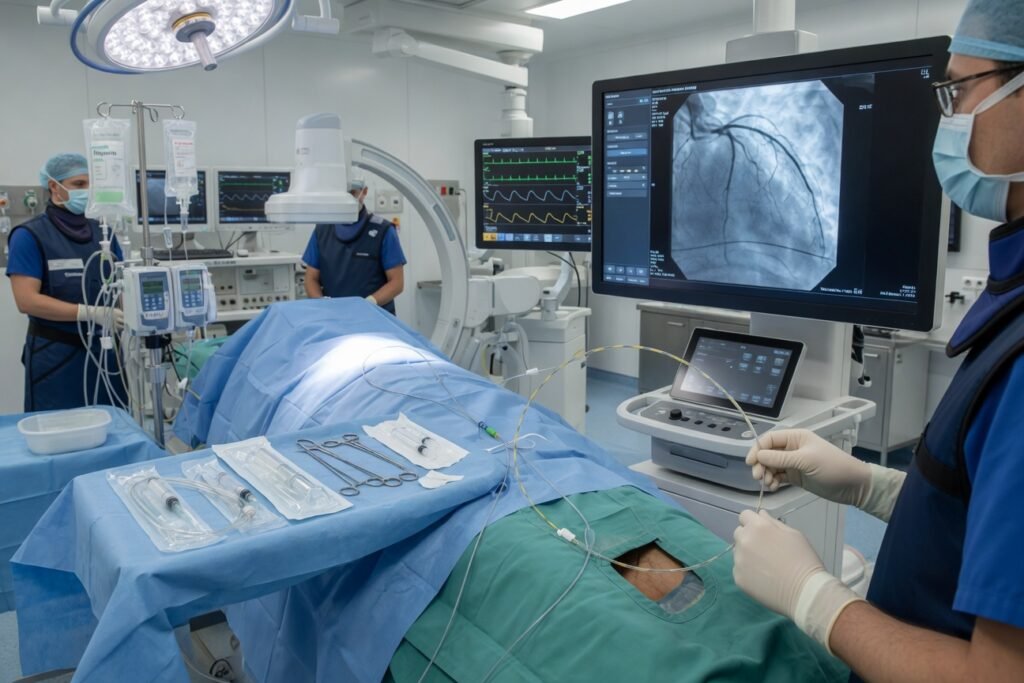

Will the cardiologist find something dangerous during my heart catheterization?
That’s the question running through most patients’ minds before they wheel into the cath lab. The honest answer: maybe, maybe not—and that uncertainty is precisely why your doctor ordered the procedure. Cardiac catheterization is part detective work, part intervention tool. A thin tube called a catheter threads through your blood vessels while real-time X-ray imaging lets your cardiologist see exactly what’s happening inside your coronary arteries. Sometimes they find blockages that need stent placement. Sometimes they find nothing. Either way, you get answers.
Key Facts About Cardiac Catheterization
- Approximately 1 million cardiac catheterizations are performed annually in the United States, according to the NIH National Heart, Lung, and Blood Institute
- The procedure takes 30 to 60 minutes on average, though complex cases may extend to 2+ hours
- Serious complications occur in fewer than 2% of diagnostic catheterizations, but rise to 3-5% when interventional procedures like stent placement are performed simultaneously
- Most patients go home the same day or next morning; overnight hospitalization is standard protocol
- A single stent placement during catheterization costs $15,000 to $35,000 depending on stent type and facility, while diagnostic-only catheterization ranges from $5,000 to $15,000
Understanding Cardiac Catheterization: What Actually Happens
Let me walk you through this step by step because the procedure makes more sense when you visualize it. Your cardiologist punctures an artery—usually the radial artery in your wrist or the femoral artery in your groin. They thread that plastic catheter up through your arterial system like a tiny plumbing snake. Once it reaches your coronary arteries (the vessels feeding your heart muscle), they inject contrast dye and take rapid X-ray images. The dye lights up your blood vessels on the monitor, revealing any narrowings, blockages, or anatomical quirks.
Here’s what separates this from other imaging: it’s dynamic and interactive. Your cardiologist isn’t just looking at a still image. They’re watching blood flow in real time, assessing how severely a blockage restricts flow, and immediately deciding whether intervention makes sense. If they spot a tight lesion, they can often deploy a stent right then—a tiny mesh tube that props the vessel open. The whole thing happens while you’re awake but sedated, feeling pressure but not pain.
The cardiac catheterization procedure also gives your team information that CT coronary angiography or stress testing cannot: intravascular ultrasound (IVUS) imaging, fractional flow reserve (FFR) measurements, and the ability to assess collateral circulation. These details matter when deciding whether a 60% blockage needs intervention or can be managed medically.
Who Needs Cardiac Catheterization: Risk Factors and Indications
Your cardiologist typically recommends cardiac catheterization for one of three reasons: you had a positive stress test or imaging study suggesting blockages, you’re having acute chest pain with ECG changes suggesting a heart attack, or you’re scheduled for heart surgery and need a roadmap of your coronary anatomy first.
Certain risk factors make cardiac catheterization more likely in your future. Diabetes increases your risk substantially—diabetic patients have narrower vessels and more aggressive plaque buildup. Smoking causes endothelial damage that accelerates atherosclerosis. High blood pressure damages vessel walls over time. High cholesterol is obvious. Male sex and advancing age matter too. Family history of early heart disease (before age 55 in men, 65 in women) predicts your own risk.
Here’s the overlooked factor: chronic kidney disease. Most health articles skip this, but patients with reduced kidney function metabolize contrast dye poorly, face higher radiation exposure risk, and have steeper complication rates during catheterization. If your creatinine is elevated or your GFR is below 30, your cardiologist needs to plan differently—often with extra hydration, different contrast agents, and potentially holding metformin beforehand.
Before the Procedure: What to Expect and How to Prepare
The days leading up to your catheterization involve specific preparation. You’ll stop aspirin and other blood thinners per your cardiologist’s instructions—typically 3 to 5 days before, though this varies. You’ll likely continue beta-blockers and statins. The night before, you’ll fast after midnight (water is fine until 2 hours before). Arrive early; the team needs IV access, baseline ECG, and labs checked.
Mentally prepare for the sensation. You’ll feel pressure in your groin or wrist as they puncture the artery—not pain, but definite pressure. Once the catheter advances, you feel nothing. When they inject contrast dye, you may feel a warm flush radiating through your chest or neck. That’s normal and temporary. Your heart rate might increase slightly. Anesthesia keeps you sedated but awake enough to follow commands like “take a deep breath” or “cough.”
Bring a list of all your medications and supplements. Certain herbal products interact with contrast dye or blood thinners, so your cardiologist needs complete information.
During and After: Recovery and Activity Restrictions
The actual procedure takes 30 to 60 minutes, though you’ll be in the cath lab area for 3 to 4 hours total including setup and initial recovery. After the catheter is removed, manual pressure is held on the puncture site for 10 to 15 minutes. Many facilities now use closure devices (like Angio-Seal or Perclose systems) instead of manual compression, which allows faster ambulation and lower infection risk.
You’ll spend 2 to 4 hours in post-procedure recovery. Blood pressure, heart rhythm, and groin bleeding are monitored closely. Most patients go home the same day if everything looks stable. A few need overnight observation if complications arise or if significant intervention was performed.
Activity restrictions matter. For the first 24 to 48 hours, avoid heavy lifting (anything over 10 pounds), strenuous exercise, and driving. Keep the puncture site dry. If bleeding starts at the groin site, lie flat and apply pressure immediately—then call your cardiologist. Bruising and minor oozing are normal; significant bleeding is not.
Medications and Medical Management After Catheterization
If your cardiologist placed stents, dual antiplatelet therapy is non-negotiable. You’ll take aspirin 325 mg daily indefinitely, plus clopidogrel (Plavix) 75 mg daily for at least 12 months—longer if you received a drug-eluting stent for complex lesions. Missing even a few doses dramatically increases stent thrombosis risk (clotting inside the stent), which can trigger a heart attack within days.
Your lipid-lowering regimen likely intensifies. High-intensity statins like atorvastatin 80 mg daily or rosuvastatin 40 mg daily target LDL below 55 mg/dL if you have significant coronary disease. Some cardiologists add ezetimibe 10 mg daily to block intestinal cholesterol absorption, or PCSK9 inhibitors like evolocumab for patients who can’t reach LDL targets with statins alone.
Beta-blockers (metoprolol, carvedilol) reduce your heart’s workload and oxygen demand—essential after catheterization, especially if ejection fraction is reduced. ACE inhibitors (lisinopril, enalapril) protect heart muscle and improve prognosis in coronary disease. These aren’t optional; they’re foundational.
Daily Life and Self-Management Strategies
After cardiac catheterization, your daily routine changes. This isn’t vague advice about “being more active”—here’s what actually works. Schedule cardiac rehabilitation if your insurance covers it. Supervised exercise with cardiac nurses present builds confidence and proves your heart tolerates activity better than you think. Typically three times weekly for 12 weeks, monitoring vital signs throughout.
Track your medications obsessively. Use a pill organizer, phone reminders, or an app. Dual antiplatelet therapy only works if you take it consistently. Missing Plavix doses is the #1 modifiable risk factor for stent failure.
Measure your salt intake. Aim for under 2,000 mg daily—hard to do without checking labels constantly, but sodium drives fluid retention and blood pressure elevation. Check your weight daily. A 3-pound gain in one day signals fluid accumulation; report this to your cardiologist.
Monitor your groin site for infection signs: increasing redness, warmth, pus-like drainage, or enlarging hematoma. Call your cardiologist immediately if these appear. Small bruises and mild swelling are expected; infection is not.
Prevention: What Evidence Actually Shows
The JAMA Cardiology journal published data showing that aggressive LDL cholesterol lowering in post-catheterization patients reduces repeat events by roughly 25% over two years. This isn’t about hitting arbitrary targets—it’s about slowing plaque progression in your remaining coronary vessels.
Blood pressure control matters equally. Systolic pressures consistently above 130 mmHg accelerate atherosclerosis. This means checking at home, not just at office visits. Home readings are often 10 to 20 points lower than office readings due to white coat effect, so you need your personal numbers.
Smoking cessation isn’t negotiable. Your cardiologist can prescribe varenicline (Chantix) or bupropion (Wellbutrin SR) as pharmacologic aids alongside behavioral support. Nicotine replacement alone has lower success rates than combination therapy.
Diet shifts should be specific. Mediterranean-style eating with emphasis on olive oil, fish, legumes, and vegetables shows evidence of reducing recurrent cardiac events. Avoid trans fats completely—zero is the target. Ultra-processed foods drive inflammation systemically.
When to Seek Immediate Care
Call 911 if you experience chest pain similar to what triggered your original catheterization, severe shortness of breath, fainting, palpitations lasting more than minutes, or sudden weakness on one side of your body. These suggest possible stent thrombosis, heart attack, or stroke.
Call your cardiologist urgently (same day) for bleeding from the groin site that doesn’t stop with 10 minutes of pressure, fever above 101°F, signs of infection at the puncture site, or legs becoming suddenly swollen or discolored.
Frequently Asked Questions
Is cardiac catheterization dangerous?
No, it’s relatively safe when performed at experienced centers. Major complications occur in 1-2% of diagnostic procedures. Your risk varies by age, kidney function, and complexity of your coronary anatomy. Centers with high catheterization volume (over 1,000 annually) have lower complication rates than those performing fewer procedures.
Will I feel pain during cardiac catheterization?
No significant pain, though you’ll feel pressure when the artery is punctured and again when the catheter is advanced. Sedation keeps you comfortable. Many patients report the warm flush from contrast dye injection is the most noticeable sensation, but it lasts seconds.
How long does the radiation exposure last?
Effective radiation dose varies widely—
Sources & Medical References
HealthTopics.com articles are based on peer-reviewed medical research and guidance from the NIH, CDC, and WHO. See our editorial policy for full sourcing standards.