Upper Endoscopy: What Patients Actually Need to Know Before Their Procedure
Marcus, a 54-year-old accountant, spent three months convinced his persistent heartburn meant he was having miniature heart attacks. His cardiologist cleared him, his primary care doctor prescribed omeprazole, but the burning sensation in his upper chest persisted. When his doctor finally recommended an upper endoscopy, Marcus panicked—he’d read online that the procedure involved being put under anesthesia and would leave him unable to work for days. In reality, his 12-minute procedure found a hiatal hernia easily treatable with medication adjustment, and he was back at his desk the next morning, fully recovered.
Let’s start with what endoscopy absolutely is not: It’s not a major surgical procedure. It doesn’t require general anesthesia in the way abdominal surgery does. You won’t wake up confused or groggy for eight hours. Most people describe the experience as uncomfortable rather than painful, and many sleep through the entire thing thanks to conscious sedation.
Here’s what endoscopy actually is: An upper endoscopy (also called esophagogastroduodenoscopy or EGD) is a diagnostic and therapeutic procedure where your gastroenterologist threads a thin, flexible tube called an endoscope down your throat to directly visualize your esophagus, stomach, and the first part of your small intestine. It’s the gold standard for examining these structures when imaging or symptoms suggest something might be wrong. The procedure typically takes 5 to 20 minutes, and you go home the same day.
Key Facts About Upper Endoscopy
- According to the American Society for Gastrointestinal Endoscopy (ASGE), approximately 18 million upper endoscopies are performed annually in the United States, making it one of the most common procedures in medical practice.
- The diagnostic accuracy of endoscopy for detecting peptic ulcer disease is greater than 95%, compared to only 60-70% for upper GI X-ray studies.
- Serious complications occur in fewer than 1 in 1,000 procedures—roughly 0.1% of patients experience bleeding or perforation, according to NIH data.
- You must have someone drive you home because of the sedation used; you’re not cleared to drive for 12 to 24 hours after the procedure, even though you may feel alert.
- The endoscope itself is roughly the diameter of a pinky finger (about 8-10 millimeters) and extremely flexible, allowing your doctor to navigate curves and bends in your esophagus without trauma.
Understanding How Upper Endoscopy Actually Works
Think of your upper digestive tract as a dark, winding cave system that your doctor needs to explore. For decades, physicians could only send X-rays or CT scans to look at the general landscape from the outside. Endoscopy is different—it’s like your gastroenterologist putting on a headlamp and walking directly into that cave, seeing every surface in crystal-clear detail in real time.
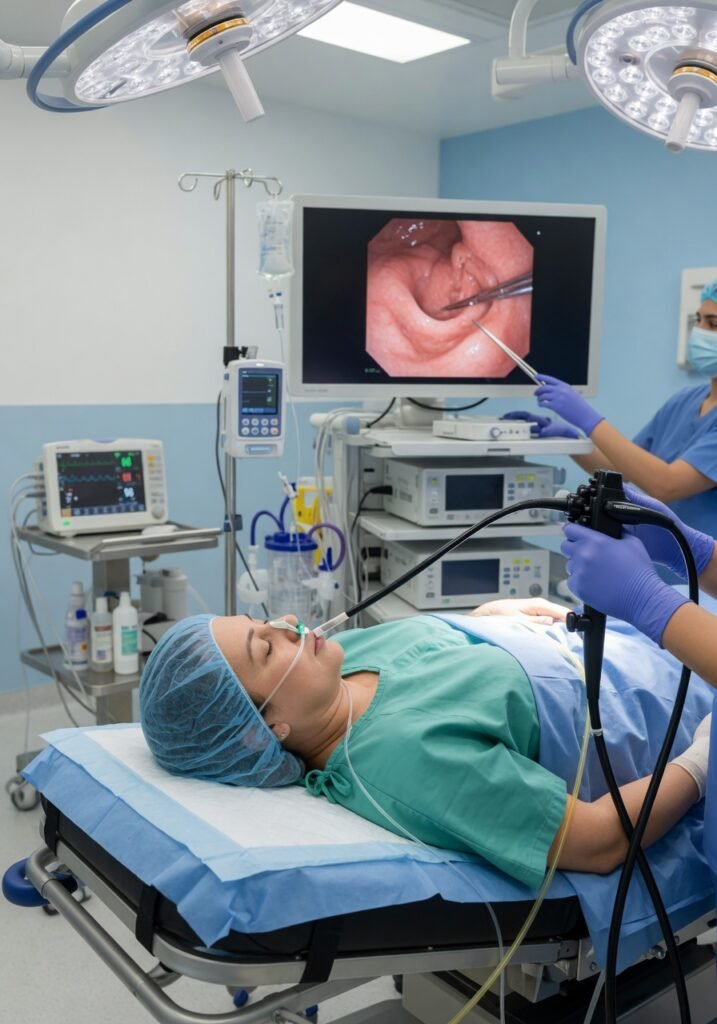
The endoscope contains fiber-optic technology and a high-definition camera at its tip. As it travels down your esophagus, the camera sends live images to a monitor your doctor watches continuously. But this isn’t a passive observation tool. Your doctor can also pass instruments through a channel inside the endoscope—biopsy forceps to collect tissue samples, electrocautery probes to stop bleeding, snares to remove polyps, or even small baskets to extract foreign objects.
You receive conscious sedation (typically propofol or midazolam intravenously) and local anesthetic spray in your throat. This combination keeps you relaxed and essentially sleeping through the procedure, but your airway remains open and you can be roused if needed. Your oxygen levels and heart rate are monitored continuously. The whole experience happens in a controlled medical setting—not your kitchen or some urgent care clinic—with trained endoscopy nurses standing beside you the entire time.
When and Why Your Doctor Orders an Endoscopy
Your gastroenterologist doesn’t order an endoscopy on a whim. Several clinical situations warrant the procedure. Persistent heartburn unresponsive to proton pump inhibitors like omeprazole or pantoprazole warrants investigation—you might have a hiatal hernia, Barrett’s esophagus, or esophageal stricture rather than simple reflux. Difficulty swallowing solid food (dysphagia) requires visualization to rule out malignancy, strictures, or achalasia. Vomiting blood or black tarry stools (melena) signal upper GI bleeding that needs immediate evaluation and often treatment during the same procedure.
Chronic abdominal pain localized to the epigastrium often gets evaluated with endoscopy to identify peptic ulcers, gastritis, or early cancer. Anemia without obvious cause sometimes stems from chronic bleeding in the upper GI tract—endoscopy can identify the source. Patients with a family history of gastric cancer in certain ethnic groups (particularly East Asian descent) often undergo surveillance endoscopy even without symptoms.
Here’s a less-commonly-discussed risk factor that matters: your medication history. Anticoagulants like warfarin or direct-acting anticoagulants (dabigatran, rivaroxaban, apixaban) must be managed carefully before endoscopy, especially if your doctor anticipates biopsies or therapeutic intervention. Similarly, antiplatelet agents like clopidogrel and dual antiplatelet therapy complicate management. Aspirin alone typically doesn’t require stopping, but the combination of aspirin plus clopidogrel does. Your cardiologist and gastroenterologist need to coordinate this beforehand—continuing anticoagulation poses bleeding risk, but stopping it poses clot risk. It’s a genuine clinical judgment call that varies case by case.
What You’ll Actually Experience: Symptoms and Sensations
Before your endoscopy, you might be experiencing symptoms that prompted your doctor to recommend the procedure. Persistent heartburn radiating from your lower chest through your upper abdomen. A sensation that food is sticking partway down your throat, like something’s caught below your Adam’s apple. Epigastric pain (just below your rib cage) that comes and goes, sometimes worse after eating, sometimes worse when your stomach’s empty. Nausea without clear cause, or vomiting that doesn’t fit a pattern of food poisoning or viral illness.
Some patients notice they’re swallowing more saliva than usual, or they feel the need to belch frequently but can’t quite do it effectively. Others describe a sensation of something pressing upward from their stomach into their chest. Many patients don’t associate these symptoms with their upper GI tract at all—they think they’re having heart problems, lung problems, or anxiety-related symptoms.
During the procedure itself, after the sedation takes effect, you’ll feel the endoscope entering your mouth and throat. You might gag briefly, though most patients report this sensation is minimal because of the local anesthetic. Once the tube passes your vocal cords, you won’t feel much of anything—the esophagus and stomach lack pain receptors for most sensations. Some patients describe feeling pressure or mild discomfort as air is insufflated (pumped) into your stomach to expand it for better visualization, but “discomfort” is the operative word here, not pain.
The Diagnostic Process: What Happens Step by Step
Your doctor will see you in the pre-procedure area where you’ll sign consent forms and have an IV placed (usually in your arm). They’ll ask detailed questions about your symptoms, your medications, any allergies, and past anesthesia experiences. A nurse will apply cardiac monitoring patches and a pulse oximeter to your finger.
You’ll be moved to the endoscopy suite—a specialized room with the endoscopy tower (the equipment stack with monitors), suction equipment, oxygen, and an emergency crash cart nearby. The room itself looks like a hybrid between an OR and a high-tech clinic. A technician will spray local anesthetic (typically lidocaine 4% spray) in your throat. It tastes bitter and slightly numbs your gag reflex.
Once the sedation enters your IV, you’ll feel drowsy. Your doctor will ask you to swallow as they guide the endoscope into your mouth. The next thing many patients remember is waking up in recovery with the procedure already complete. Some patients remain somewhat aware during the procedure—they can hear their doctor’s voice, follow basic commands—but they won’t remember the details clearly afterward.
Your doctor performs a systematic examination: examining your esophagus for inflammation, erosions, strictures, or Barrett’s changes; evaluating the gastric mucosa for ulcers, gastritis, or tumors; and assessing the duodenum carefully. If they identify a bleeding source, they can inject epinephrine, apply a clip, or use electrocautery to stop it right then. If they see a polyp, they remove it with a snare. If they see suspicious tissue, they obtain biopsies. Everything gets documented with photos.
Treatment Options and What Endoscopy Can Accomplish
Upper endoscopy isn’t just diagnostic—it’s frequently therapeutic. If your doctor identifies a bleeding ulcer, they can inject epinephrine 1:10,000 directly into the ulcer base to cause vasoconstriction and stop the bleed. They can apply hemoclips (metal clips that compress bleeding vessels) or use electrocautery probe technique (applying heat that coagulates the bleeding vessel). These interventions succeed in controlling bleeding about 85-95% of the time, preventing the need for emergency surgery.
For esophageal or gastric varices (dilated veins from portal hypertension), your doctor can perform endoscopic variceal ligation, placing rubber bands around the bleeding vessels. This reduces rebleeding risk substantially. For esophageal strictures (narrowed areas from scarring or caustic injury), your doctor can perform dilation using progressively larger dilators, restoring swallowing function. For gastric polyps, removal during the procedure prevents future malignancy—polyps can’t develop into cancer if they’re gone.
Barrett’s esophagus (precancerous intestinal metaplasia in the esophagus from chronic reflux) can be managed with radiofrequency ablation performed during endoscopy, where thermal energy destroys the abnormal tissue, reducing cancer risk. For foreign body ingestion (someone swallowed a coin or battery), endoscopy removes it safely, preventing perforation or chemical burns.
Achalasia (a motility disorder where the lower esophageal sphincter won’t relax properly) causes dysphagia but requires specialized endoscopic treatment: botulinum toxin injected into the sphincter relaxes it temporarily, or peroral endoscopic myotomy (POEM) is a newer technique where your doctor creates a tunnel in the esophageal lining and divides the sphincter muscle from inside. These aren’t standard endoscopies—they’re performed at specialized centers by experienced interventional endoscopists.
Preparing for Your Procedure: Practical Steps
Clear liquids only starting at midnight before your procedure—this means water, black coffee, clear broth, apple juice, ginger ale, but absolutely no milk or cream in your coffee and no red-colored liquids (they can be confused with blood). Stop eating solid food 8 hours before the procedure. If you take a morning medication that’s critical for your heart or blood pressure control, take it with just a sip of water, but ask your doctor first about specific medications.
If you take aspirin daily for heart disease, keep taking it unless your doctor says otherwise. If you take warfarin or a direct-acting anticoagulant, talk to your gastroenterologist and cardiologist—the plan depends on your indication for the drug and whether your doctor expects to do biopsies or remove polyps. If you have diabetes and take insulin or metformin, ask your doctor about adjusting doses on procedure day since you won’t be eating.
Arrange transportation beforehand—you genuinely cannot drive yourself home, and rideshare drivers aren’t really prepared for someone who’s had sedation. Wear loose, comfortable clothing. Don’t wear jewelry or dentures into the procedure room (your mouth needs to be accessible). Plan to stay home the rest of the day—you won’t feel terrible, but your