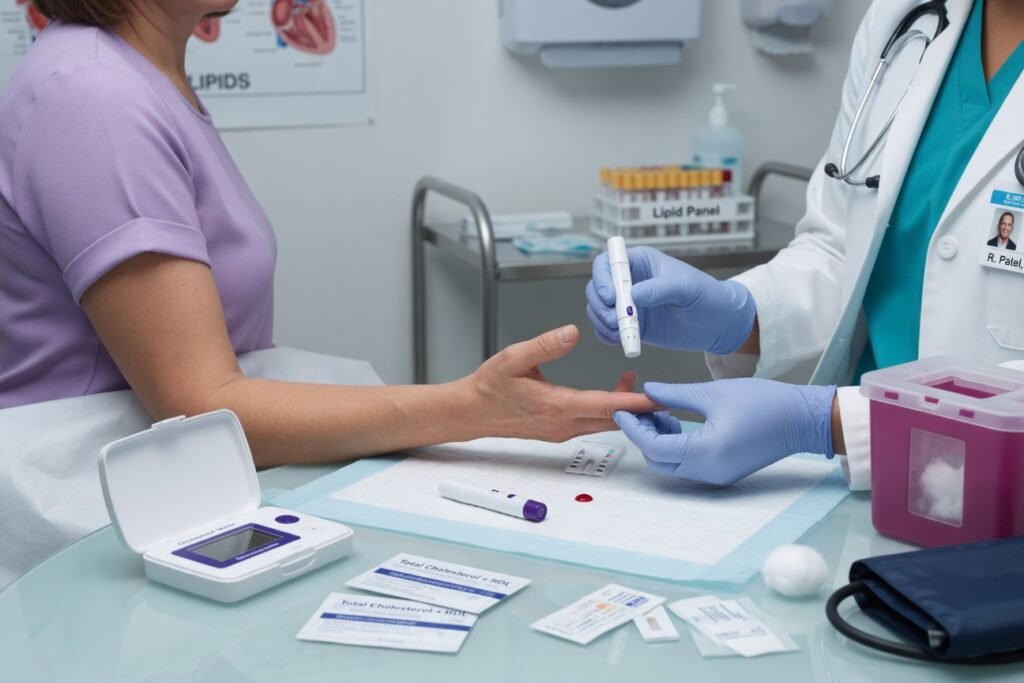

Why Do You Need Cholesterol Testing If You Feel Perfectly Fine?
That’s the question Sarah, a 47-year-old accountant, asked herself for years. She exercised regularly, maintained a healthy weight, and felt great. Then her doctor ordered a routine lipid panel—and discovered she had an LDL cholesterol level of 186 mg/dL, along with a family history of early heart disease her siblings had never disclosed. Sarah had been walking around with significant cardiovascular risk and absolutely no symptoms to warn her. This is precisely why cholesterol testing isn’t optional for most adults—it’s one of the few ways your doctor can see inside your arteries before something goes wrong.
Key Facts About Cholesterol Testing
- According to the CDC, about 93 million American adults have total cholesterol levels above 200 mg/dL, yet only one in three have it under control
- A lipid panel typically includes four measurements: total cholesterol, LDL cholesterol (the harmful kind), HDL cholesterol (protective), and triglycerides—each telling a different story about your cardiovascular health
- Adults age 40 and older should have lipid testing at least once every 4-6 years; those with risk factors need testing every 1-2 years
- Non-fasting lipid panels have become standard since 2010 and are equally accurate as the traditional 9-12 hour fasting tests for clinical decision-making
- A 10-year cardiovascular risk assessment using the Framingham Risk Score or ACC/AHA calculator can predict heart attack or stroke risk more accurately than cholesterol numbers alone
How Cholesterol Testing Actually Works
Think of cholesterol like a delivery system. Your liver manufactures cholesterol constantly—you don’t actually need to eat it to have it in your bloodstream—and your body packages it into lipoproteins that act like little trucks carrying cargo through your arteries. The problem isn’t cholesterol itself; your body needs it to make hormones and cell membranes. The problem is traffic congestion.
LDL cholesterol particles are the delivery trucks that move cholesterol from your liver into tissues. But when too many of these particles are circulating, and especially when they’re small and dense (a type called pattern B), they tend to get stuck in artery walls like trucks piling up at a toll booth. Over years, they oxidize and trigger inflammation, and your immune system responds by trying to clean up the mess. This cascade creates the fatty deposits called plaques. HDL cholesterol, by contrast, is the cleanup crew—it takes excess cholesterol back to your liver for disposal.
When you get a lipid panel blood test, the lab is measuring these different particles and their cholesterol content. The test itself is straightforward: a phlebotomist draws blood from your arm, usually in the morning, and the lab uses enzymatic analysis to separate and quantify each type. Within 24-48 hours, you have numbers that give your doctor a snapshot of your cardiovascular risk.
Risk Factors That Actually Matter Most
Not everyone with elevated cholesterol has the same risk. Your genetics load the gun; your lifestyle pulls the trigger. About 1 in 500 people have familial hypercholesterolemia (FH), a genetic condition that causes dangerously high LDL levels regardless of diet and exercise. If your parent had a heart attack before age 55, or your mother before 65, your cholesterol matters more than it does for someone without that history. But here’s what most articles skip: your cholesterol particle number (apoB) matters more than your LDL-C number alone.
You can have an LDL cholesterol of 130 mg/dL with relatively low risk if you have large, fluffy LDL particles. You can have an LDL of 100 mg/dL and be at higher risk if you have many small, dense particles. Unfortunately, standard lipid panels don’t measure this directly. The less-discussed risk factor? Lipoprotein(a), or Lp(a), an inherited lipoprotein variant that increases heart attack and stroke risk independent of other cholesterol levels. If no one in your family has ordered an Lp(a) test for you, ask for it—it’s not standard screening, but it costs about the same and can clarify your true risk.
Other major drivers include smoking (which damages artery linings and makes cholesterol more likely to stick), untreated hypertension, diabetes or prediabetes, sedentary lifestyle, and obesity. Inflammation markers like high-sensitivity C-reactive protein (hs-CRP) also predict risk. Age and sex matter too—men typically develop high cholesterol earlier; women’s risk rises sharply after menopause.
What High Cholesterol Actually Feels Like (Or Doesn’t)
Here’s the cruel reality: high cholesterol produces zero symptoms. No pain, no fatigue, no shortness of breath—nothing. You could have an LDL level of 300 mg/dL and feel fantastic. This absence of warning signs is why you hear cardiologists call it the “silent killer.” You won’t feel anything until the day your artery becomes critically narrowed or a plaque ruptures and triggers a clot.
The early warning signs you might notice are actually unrelated to cholesterol itself but to its consequences. A family member might mention they had “high cholesterol” on their last checkup, prompting you to ask your doctor about yours. You might develop tendon xanthomas—yellowish nodules on your Achilles tendon or knuckles—which signal familial hypercholesterolemia. You might have a brief episode of chest discomfort with exertion that resolves, signaling early coronary narrowing. Some people notice corneal arcus, a grayish ring around the iris, which can indicate elevated cholesterol in familial cases.
But most people? They walk around with high cholesterol for decades without a hint. That’s precisely why your doctor’s recommendation for testing shouldn’t feel aggressive or alarmist—it’s preventive medicine at its most valuable.
The Diagnostic Process: What Actually Happens
Screening begins with your doctor deciding you need a lipid panel. If you’re 40 or older without prior testing, or younger with risk factors, you’ll be scheduled for a blood draw. You don’t necessarily need to fast anymore, though some doctors still prefer it for consistency with older reference ranges. The phlebotomist draws about 5-10 milliliters of blood into a tube, and the specimen goes to the lab.
Results typically arrive within one to two business days. Your report shows: total cholesterol (ideally under 200 mg/dL), LDL cholesterol (ideally under 100 mg/dL, or under 70 if you’ve had a heart attack or stroke), HDL cholesterol (ideally 60 mg/dL or higher), and triglycerides (ideally under 150 mg/dL). Some labs also calculate the ratio of total cholesterol to HDL, which some cardiologists find more predictive than LDL alone.
If results are borderline or elevated, your doctor may order additional testing: apoB levels (particle count), Lp(a), hs-CRP, or lipoprotein(a) subtypes. They’ll also calculate your 10-year cardiovascular risk using validated tools like the ACC/AHA Risk Calculator or Framingham Risk Score. This personalized risk assessment determines whether you need medication, intensive lifestyle change, or continued monitoring.
Treatment: Medication and Beyond
Statins are the first-line medication for cholesterol management because they reduce LDL cholesterol by 25-55% depending on the specific drug and dose. Atorvastatin (Lipitor) and rosuvastatin (Crestor) are high-intensity statins that lower LDL more aggressively. They work by blocking HMG-CoA reductase, the enzyme your liver uses to manufacture cholesterol. Most people tolerate them well; muscle aches affect perhaps 5-10% of users meaningfully.
For patients who can’t tolerate statins or need additional LDL reduction, ezetimibe (Zetia) blocks cholesterol absorption in your intestines and typically lowers LDL by another 15-20%. For those with very high LDL or familial hypercholesterolemia, PCSK9 inhibitors like evolocumab (Repatha) or inclisiran (Leqvio) are game-changers—they inhibit a protein that normally degrades LDL receptors, allowing your cells to absorb more LDL from the bloodstream and lowering levels by 40-70%.
Bempedoic acid (Nexletol), an older metabolic pathway being repurposed, is another option. For elevated triglycerides, icosapent ethyl (Vascepa), a high-dose fish oil derivative, can lower triglycerides by 25-35% when combined with statins.
Medication choice depends on your LDL goal, which itself depends on your cardiovascular risk. Someone with no prior cardiac events and low risk might aim for LDL under 100 mg/dL with lifestyle change alone. Someone who’s had a heart attack? LDL goal is often under 70 mg/dL, sometimes under 55 mg/dL with high-intensity statin therapy.
Daily Management: Strategies That Actually Work
Dietary change matters, though people overestimate its impact. Reducing saturated fat and dietary cholesterol lowers LDL by about 5-15%—meaningful, but not usually sufficient alone. Effective strategies include replacing saturated fats (butter, fatty meat, full-fat dairy) with unsaturated fats (olive oil, nuts, avocados) and increasing soluble fiber (oatmeal, beans, apples) to 10-25 grams daily, which can lower LDL by another 3-5%.
Plant sterols found in fortified foods or supplements can lower LDL by 5-15%. Eating fatty fish like salmon or mackerel twice weekly provides omega-3 fatty acids that improve triglycerides. Weight loss of 5-10% of body weight significantly improves cholesterol profiles, especially in people with insulin resistance or metabolic syndrome.
Exercise matters more than most realize. Aerobic activity of 150 minutes weekly can raise HDL cholesterol by 3-9% and improve triglycerides. Strength training helps indirectly by improving body composition and insulin sensitivity. Smoking cessation immediately improves HDL and reduces LDL oxidation.
Stress management deserves mention: chronic stress elevates cortisol, which can worsen lipid profiles and promote visceral fat accumulation. Sleep quality affects cholesterol too—poor sleep is associated with higher triglycerides and lower HDL.
Prevention: What the Evidence Actually Shows
Cholesterol testing itself isn’t prevention—it’s detection. True prevention means reducing your risk of developing abnormal cholesterol in the first place. The Nurses’ Health Study and Health Professionals Follow-up Study, published by NIH researchers over decades, show that maintaining a healthy weight, regular exercise, not smoking, moderate alcohol intake, and a diet rich in plant foods and omega-3 fats prevents most cases of abnormal cholesterol.
But here’s the nuance: lifestyle change alone works well for people with genetic predisposition to normal cholesterol. For those with familial hypercholesterolemia or strong family history, good lifestyle doesn’t prevent high cholesterol—it just blunts how bad it becomes. These patients typically need medication regardless of how impeccably they eat or exercise.
Age is irreversible. You can’t prevent your cholesterol from gradually rising as you get older. Women’s cholesterol rises sharply after menopause due to declining estrogen. So “prevention” really means lifestyle optimization combined with screening to catch problems early, before plaques develop.
Common Questions About Cholesterol Testing
Can I lower my cholesterol without medication?
<div
Sources & Medical References
HealthTopics.com articles are based on peer-reviewed medical research and guidance from the NIH, CDC, and WHO. See our editorial policy for full sourcing standards.