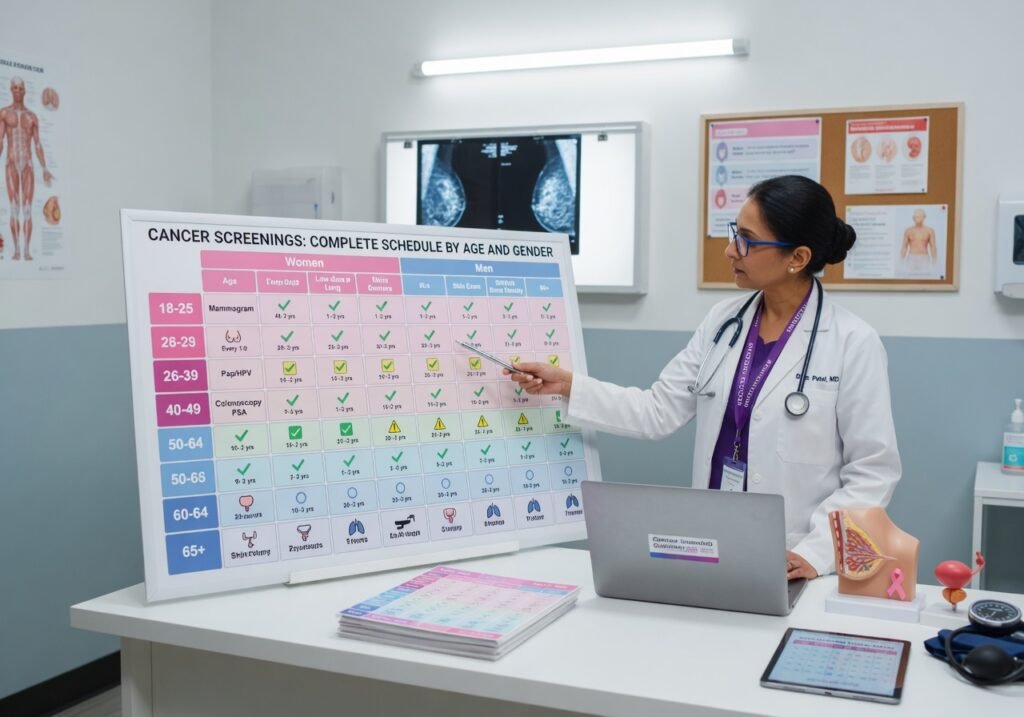
Sarah sat in her doctor’s office at 42, suddenly uncertain whether she’d had her last mammogram “recently enough.” She remembered the pink awareness campaigns and felt vaguely guilty, but nobody had ever given her a clear timeline—just conflicting advice from friends and magazines. Her doctor pulled up her chart and said something that surprised her: the screening recommendations had actually shifted in the past few years, and what mattered most was understanding her own risk profile, not just following a one-size-fits-all schedule.
Cancer Screening Timeline by Age and Gender: What Actually Matters
Cancer screening is probably the most misunderstood prevention tool in medicine. People think it’s about following a rigid checklist, but that’s incomplete. The truth is messier and more individual. Your actual risk factors, your family history, and emerging research should shape your screening decisions far more than a generic “turn 50, get a colonoscopy” timeline.
Key Facts About Cancer Screening
- According to the CDC, colorectal cancer incidence in adults under age 50 has increased by approximately 1-2% annually over the past two decades, prompting earlier screening discussions for some individuals
- The American Cancer Society reports that mammography screening reduces breast cancer mortality by roughly 15-20% in average-risk women ages 40-74, though this benefit must be weighed against overdiagnosis rates of 10-20%
- Cervical cancer deaths have declined by 70% since Pap smears became routine, representing one of the most successful screening interventions in medical history
- Approximately 35-40% of adults over 50 are not up-to-date with colorectal cancer screening, despite its proven mortality benefit
- For lung cancer, low-dose CT screening reduces mortality by 15-20% in heavy current and former smokers—but screening in low-risk individuals causes harm through false positives and unnecessary biopsies
Understanding How Cancer Develops: Why Screening Timing Matters
Cancer doesn’t appear overnight. Think of it as a conversation that goes wrong. Your cells normally follow strict rules—divide when needed, die when instructed, stay in their designated area. Cancer happens when mutations accumulate over years, and cells start breaking those rules. They ignore stop signals, replicate without limits, and eventually escape to other parts of your body.
This is why screening works for some cancers and not others. Cervical cancer and colorectal cancer develop slowly, giving us time to catch precancerous changes before they become deadly. Lung cancer in smokers can progress faster. Pancreatic cancer often hides deep in the body until it’s advanced. The timeline varies dramatically, which is why a one-schedule-fits-all approach fails.
Risk Factors That Actually Change Your Screening Plan
Age is obvious—most cancers increase with years lived. But here’s what many articles skip: your screening urgency depends on multiple factors working together, not just your birthday.
Colorectal cancer risk: Inflammatory bowel disease (Crohn’s or ulcerative colitis) accelerates risk dramatically. If you have IBD, colonoscopy screening should typically start around age 8-10 years after diagnosis, far earlier than average-risk people. Family history matters too—if a parent or sibling had colon cancer before age 60, you should discuss starting screening at 40, not 45.
Breast cancer risk: BRCA1 and BRCA2 mutations increase lifetime breast cancer risk to 45-87%, pushing screening into the 20s or 30s with MRI imaging added to mammography. But here’s the overlooked factor: dense breast tissue (identified on mammography itself) increases cancer risk and makes mammography less sensitive. If your breasts are dense, supplemental ultrasound or MRI significantly improves detection.
Cervical cancer risk: HPV vaccination status matters now. If you received the Gardasil 9 vaccine before age 27, your cervical cancer risk dropped substantially, and some experts argue screening intervals could be lengthened. Conversely, if you’re unvaccinated and sexually active, risk remains real regardless of age.
The overlooked factor—race and ethnicity disparities: Black men develop prostate cancer at higher rates and younger ages than white men, with higher mortality. Black women face significantly higher breast cancer mortality despite similar screening rates, partly due to differences in tumor biology and access to treatment. Latinx populations have higher rates of colorectal and cervical cancers. Asian Americans face elevated liver cancer risk due to hepatitis B prevalence. These differences mean a 45-year-old Black woman and a 45-year-old white woman may need different screening conversations, yet most generic guidelines ignore this.
Signs You May Have Missed During Early Stages
Here’s what patients actually report: often, nothing. That’s the whole point of screening—finding disease before symptoms emerge. But some early signals do appear, and they’re often dismissed as minor.
With colorectal cancer: changes in bowel habits lasting more than a few weeks matter—not just a single loose stool, but a persistent shift. Unintentional weight loss of more than 5 pounds over months. Blood in stool that looks dark or tar-like, not bright red (bright red is usually hemorrhoids, but don’t assume).
With breast cancer: new lumps or thickened areas, usually painless. Nipple discharge without squeezing. Skin dimpling or puckering. Redness or scaling on the nipple itself. Many women find these during routine showers—not during formal self-exams, which studies show don’t improve outcomes, but through casual familiarity with their own bodies.
With lung cancer in smokers: persistent cough lasting over two weeks, especially if it changes character. Coughing up blood. Hoarseness. Chest pain that worsens with deep breathing. The problem: these symptoms overlap with bronchitis, smoking-related inflammation, and other benign conditions, so they get missed.
The Screening Process: What Happens and What to Expect
Colonoscopy is often the gateway screening. You fast the day before, drink a bowel-cleansing solution (unpleasant but necessary), and undergo a procedure where a flexible tube with a camera visualizes your entire colon. Most take 15-30 minutes. Sedation usually puts you to sleep. Your gastroenterologist can remove polyps immediately, preventing progression to cancer. If polyps are found, follow-up timing depends on size, number, and type—not a fixed schedule.
Mammography involves compression of breast tissue between two plates while X-rays are taken. It’s uncomfortable for many women but lasts seconds. Digital mammography and 3D mammography (tomosynthesis) provide clearer images than older film techniques. If suspicious areas appear, ultrasound or MRI may follow for clarification.
Cervical cancer screening now typically uses either HPV testing (looking for the human papillomavirus that causes most cervical cancers) or Pap smears (looking for cellular changes). HPV testing is more sensitive and has longer screening intervals—every 5 years—because negative HPV results predict very low cancer risk for years ahead.
Low-dose CT for lung cancer involves a quick scan without contrast. Results can show nodules requiring follow-up scans, which causes anxiety and sometimes leads to biopsies of benign findings. This is why it’s only recommended for current or former heavy smokers with significant exposure history.
Treatment When Cancer Is Found Early
Early-stage cancers typically respond better to treatment with fewer side effects. Colorectal polyps are simply removed during colonoscopy—no surgery needed. Early cervical cancer changes (CIN 2 or CIN 3) are treated with loop electrosurgical excision procedure (LEEP), which removes the abnormal area with excellent cure rates exceeding 90%.
Early breast cancer detected by screening is often treated with lumpectomy (breast-conserving surgery) plus radiation, rather than mastectomy. Hormone receptor-positive early breast cancers may be treated with tamoxifen or aromatase inhibitors like letrozole or anastrozole, rather than chemotherapy, reducing side effects significantly.
Early-stage colorectal cancers found by colonoscopy may not require chemotherapy at all—surgery alone often suffices. More advanced screening-detected cancers might receive 5-fluorouracil-based chemotherapy (5-FU), but the prognosis remains substantially better than when cancer is found due to symptoms.
Managing Your Screening Schedule in Real Life
Write your screening due dates somewhere visible—your phone calendar, your doctor’s portal, a notebook. Don’t rely on providers to remind you; many patients fall through cracks between visits. When you have a screening test, ask specifically: “When should I schedule the next one, and under what circumstances would that change?” Different polyp findings, for example, trigger different repeat colonoscopy timelines (3 years vs. 10 years).
If you’ve had abnormal screening results, understand what they mean before you leave the office. “Abnormal Pap smear” means different things—HPV-positive with normal cytology is much lower risk than high-grade squamous intraepithelial lesion (HSIL). ASK for specific terminology and what it means for your next steps.
Track your own medical records. Keep copies of pathology reports, imaging reports, and screening results. If you change doctors, this documentation prevents unnecessary repeat testing and ensures your new doctor understands your actual risk category, not just your age.
Prevention: What Actually Reduces Cancer Risk
Screening isn’t prevention—it’s early detection. Real prevention means reducing cancer development. The strongest evidence supports: smoking cessation (reduces lung, bladder, and several other cancer risks), HPV vaccination (prevents cervical, anal, and oropharyngeal cancers, most effective before sexual debut but still beneficial through age 45), and limiting alcohol (each additional drink daily incrementally increases breast and colorectal cancer risk).
Physical activity reduces colorectal and breast cancer risk—roughly 20-30 minutes of moderate activity most days matters. Maintaining a healthy weight matters more than specific diets, though Mediterranean-style eating patterns show some protective associations. Fiber intake supports colorectal health but doesn’t guarantee cancer prevention. Aspirin for cancer prevention works modestly in high-risk individuals but carries bleeding risks—discuss with your doctor.
Clinical Insight: Most screening articles assume your risk is “average.” Yours might not be. If you have a parent or sibling who had cancer before age 60, if you carry relevant genetic mutations, if you have chronic inflammatory conditions, or if you belong to populations with documented disparities in specific cancer types, standard screening recommendations may not fit. Request risk assessment tools like the Gail model (breast cancer) or the colorectal cancer risk estimator. Personalized screening beats generic schedules.
Common Misconception: Screening Equals Prevention
Many patients believe that getting screened means they’re preventing cancer. Not quite. Screening detects cancer early, which is valuable—early cancers are more curable. But screening doesn’t prevent cancer from developing. It catches existing disease. True prevention means reducing your risk of ever getting cancer. These are different goals, both important, but often conflated. You can screen regularly and still develop cancer. You can make healthy choices and still need screening. Both matter.
Frequently Asked Questions
Sources & Medical References
HealthTopics.com articles are based on peer-reviewed medical research and guidance from the NIH, CDC, and WHO. See our editorial policy for full sourcing standards.