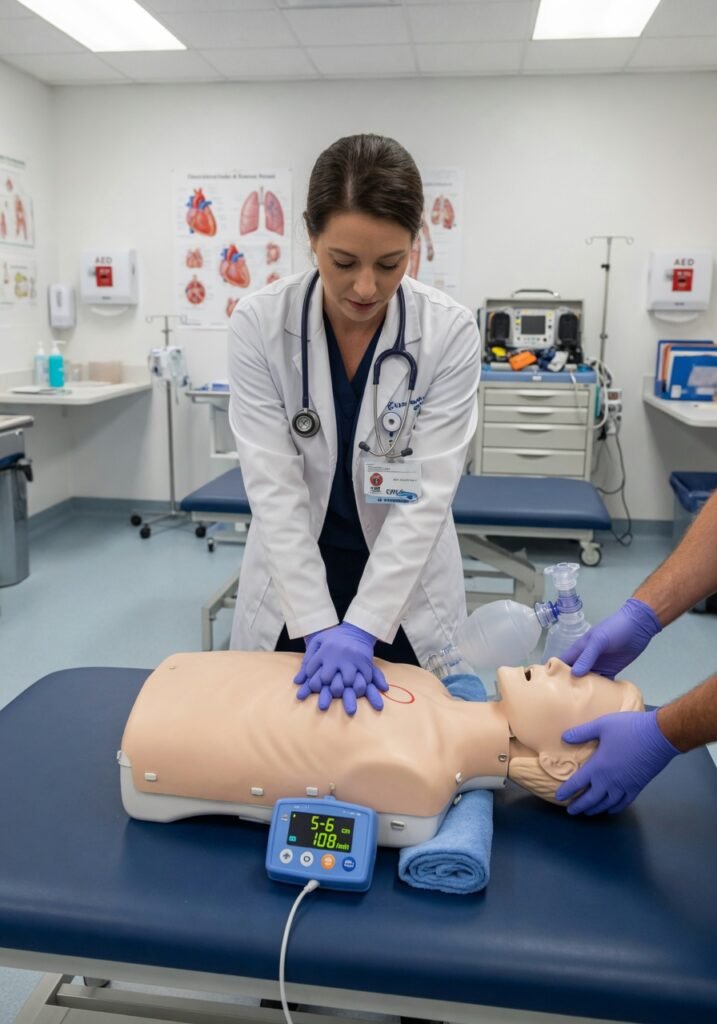
CPR: How to Perform and Save a Life
Studies indicate that only about 10% of adults in the United States can correctly perform chest compressions at the recommended depth and rate, yet the American Heart Association reports that immediate CPR can double or triple a person’s chance of survival from sudden cardiac arrest. Last month, Sarah, a 54-year-old accountant, watched her husband collapse at their kitchen table without warning. She’d taken a CPR class five years prior but hadn’t reviewed the steps since. Her hands trembled as she started compressions. The dispatcher’s voice guided her through each motion. When paramedics arrived eight minutes later, her husband had a pulse. Six weeks of rehabilitation followed, but he survived—because Sarah remembered enough to act, even imperfectly, in those first critical minutes.
Key Facts About CPR
- Survival rates from out-of-hospital cardiac arrest drop approximately 7-10% with every minute that passes without CPR or defibrillation, according to data published in JAMA.
- Chest compressions should be delivered at 100-120 compressions per minute—roughly the tempo of the Bee Gees song “Stayin’ Alive,” which bystanders can use as a mental metronome.
- The recommended compression depth for adults is 2 to 2.4 inches (5 to 6 centimeters) into the chest—deeper than many people instinctively push, yet crucial for blood circulation.
- Hands-only CPR (chest compressions without rescue breaths) has been shown in NIH research to be nearly as effective as conventional CPR with breaths for adults in cardiac arrest.
- Women are less likely to receive bystander CPR than men, with CDC data showing a 27% difference in CPR initiation rates, a disparity researchers are still investigating.
Understanding CPR: What’s Actually Happening Inside the Body
When someone collapses from cardiac arrest, their heart has stopped pumping blood effectively. Think of the heart as a water pump: when it fails, no water moves through the pipes, and tissues downstream start dying from oxygen deprivation. The brain is the most sensitive organ—it begins sustaining irreversible damage within four to six minutes of oxygen starvation. CPR doesn’t restart the heart. Instead, it mimics the heart’s pumping action by compressing the chest cavity, creating pressure that forces blood out of the heart and into vital organs. It’s a mechanical bridge, buying time until a defibrillator can deliver the electrical shock that might actually restore normal rhythm, or until professional paramedics arrive with medications and advanced interventions.
Here’s what most people miss: CPR generates only about 25-30% of the cardiac output that a healthy heart produces. It’s not restoring someone to normal—it’s keeping the brain and heart perfused well enough that the person might survive long enough for advanced interventions. That’s why speed matters so intensely. Every compression matters because you’re literally the difference between brain cells living and dying.
Causes and Risk Factors for Cardiac Arrest
Sudden cardiac arrest can strike without obvious warning, but certain risk factors cluster together. Coronary artery disease is the most common underlying cause in adults, accounting for roughly 80% of cases in men. High blood pressure, high cholesterol, and smoking create the conditions for plaque buildup in arteries. Diabetes increases risk substantially because high blood sugar damages vessel walls and nerves that regulate heart rhythm. Obesity doesn’t just stress the heart mechanically—it promotes inflammation that destabilizes the electrical systems controlling heartbeat.
Previous heart attacks, family history of sudden death, and certain medications all raise risk. But here’s the underrecognized factor: sleep deprivation. Chronic sleep loss increases arrhythmia risk through multiple pathways—sympathetic nervous system hyperactivity, inflammatory cascade activation, and electrolyte dysregulation. A person working consecutive overnight shifts, sleeping only four hours nightly, has demonstrably elevated risk even if their traditional risk factors appear controlled. Age matters too, though cardiac arrest can occur at any age. Men have higher incidence before age 50, but after age 75, incidence equalizes between sexes.
Signs and Symptoms: What You Actually Observe
Cardiac arrest looks sudden because often it is. Someone may complain of chest discomfort or shortness of breath seconds before collapse, or they may simply fall unconscious without warning. You might witness gasping—those irregular, agonal respirations that look like breathing but aren’t coordinated gas exchange; the person is essentially drowning in their own cardiovascular collapse.
The person will be unresponsive to voice and touch. No pulse is detectable in the neck or groin. Skin becomes ashen or bluish. Pupils dilate. Sometimes there’s involuntary muscle jerking, which bystanders may mistake for seizure rather than cardiac arrest. In the first few minutes, the body may move or twitch—these are reflex actions, not signs of consciousness.
What often precedes the arrest, though, are warnings many people rationalize away: episodes of syncope (fainting) that seem unrelated, palpitations dismissed as anxiety, or chest pressure attributed to indigestion. Younger people sometimes describe sensation of heart “skipping” or racing. Older individuals might attribute shortness of breath to deconditioning. These prodromal symptoms matter because they’re opportunities for medical evaluation that could prevent arrest altogether.
Diagnosis: Recognizing Cardiac Arrest in Real Time
You don’t need an EKG machine to diagnose cardiac arrest—you need about 10 seconds of observation. The diagnosis is clinical. Check responsiveness by tapping the person’s shoulder and shouting, “Are you okay?” If there’s no response, activate emergency services immediately. Don’t waste time checking for breathing initially; assume someone unresponsive and not breathing normally is in cardiac arrest.
Advanced diagnosis—determining whether the rhythm is ventricular fibrillation, pulseless ventricular tachycardia, asystole, or pulseless electrical activity—requires an EKG monitor or defibrillator. An AED (automated external defibrillator) will analyze the heart rhythm and determine whether a shock is indicated. This is why defibrillators in public spaces matter so profoundly: they’re the diagnostic tool that tells you whether CPR alone might suffice or whether electrical therapy is needed immediately.
In the hospital, providers use continuous cardiac monitoring, blood tests measuring troponin and BNP (markers of heart damage and stress), chest X-rays, and sometimes cardiac catheterization to determine the underlying cause post-arrest. But the immediate diagnosis is simple: unresponsiveness plus absent normal breathing equals cardiac arrest. Start CPR.
Treatment Options: What Actually Restores Life
Immediate CPR is the first treatment. You—a bystander with no medical training—can begin this. Push hard and fast on the center of the chest. If you’re trained in rescue breathing, provide 30 compressions followed by 2 breaths. If you’re untrained or uncomfortable with breaths, hands-only CPR is equally effective for adults. Continue until paramedics arrive or someone takes over.
Professional rescuers bring several interventions. Defibrillation with an AED or manual defibrillator can convert certain arrhythmias back to normal rhythm. Epinephrine (adrenaline) is administered intravenously every three to five minutes, increasing coronary perfusion pressure. Amiodarone, a powerful antiarrhythmic medication, is given after defibrillation attempts if the person remains in a shockable rhythm. Advanced airway management—intubation—protects the lungs and ensures oxygenation, though guidelines have shifted away from immediate intubation in favor of early defibrillation.
Post-resuscitation, survivors are cooled to 32-36°C through therapeutic hypothermia or targeted temperature management. This dramatically reduces brain damage. Coronary angiography often follows to identify and treat the underlying cardiac blockage causing the arrest. ICU care addresses complications: pneumonia, kidney injury, cardiac dysfunction, and neurological recovery.
The honest truth: survival depends on cause, witnessed status, time to first CPR, presence of a defibrillator, and underlying organ function. Electrical causes (ventricular fibrillation) respond best. Asystole (“flatline”) has dismal prognosis. Young patients tolerate prolonged low-flow states better than elderly individuals. A 30-year-old with witnessed VF and CPR started within two minutes has substantially better odds than an 85-year-old with asystole discovered 15 minutes into arrest.
Practical Daily Management: CPR Training and Readiness
The most practical step is certification. Take an American Heart Association BLS (Basic Life Support) course. You’ll practice on a mannequin until compressions become muscle memory, not conscious thought. Recertify every two years because skills degrade—studies show retention drops significantly at the 12-month mark.
Beyond certification, keep AEDs accessible in your environment. Know where the nearest defibrillator is at your workplace, gym, or place of worship. Many shopping centers, airports, and public buildings post their locations. Download the PulsePoint app, which alerts nearby CPR-trained individuals when someone nearby needs help, creating a crowdsourced first-responder network.
At home, know your risk factors. If you have hypertension, treat it aggressively with medications like lisinopril or metoprolol. If you’re post-myocardial infarction, take aspirin and a statin (atorvastatin, rosuvastatin). These preventive medications reduce recurrent arrest risk. Wear a medical alert bracelet if you have arrhythmia history. Consider an ICD (implantable cardioverter-defibrillator) if your ejection fraction is severely reduced—your cardiologist will recommend this.
Teach family members CPR basics even if they’re not formally certified. The steps haven’t changed fundamentally in decades. “Call, push, AED” is the modern sequence. Call 911 immediately. Push hard and fast on the chest. Use an AED if available. That order, that clarity, saves lives.
Prevention: What Evidence Actually Shows Works
Primary prevention means managing the diseases that cause cardiac arrest. Hypertension control reduces sudden death risk by roughly 25%, according to data in NEJM. Statin therapy in people with prior MI reduces recurrent cardiac events by approximately 30%. Smoking cessation is perhaps the single most impactful intervention—tobacco exposure increases sudden death risk sixfold, and that risk begins dropping within hours of the last cigarette.
Weight management matters, but less dramatically than people believe. A 5-10% reduction in body weight improves blood pressure and lipids, but it’s the cardiovascular risk factors themselves that matter most. Treating sleep apnea, if present, reduces arrhythmia risk significantly.
Exercise is complex. Moderate activity (150 minutes weekly of moderate intensity) reduces risk substantially. Extreme endurance exercise—ironman competitions, ultramarathons—paradoxically increases acute cardiac event risk in susceptible individuals, though this remains rare in the general population. The sweet spot is consistent, moderate activity.
One caveat the literature often glosses over: ICD placement prevents sudden death in people with known reduced ejection fraction or prior arrest, but screening asymptomatic populations for subclinical dysfunction remains controversial. Most sudden arrests occur in people with no known prior cardiac disease, meaning primary prevention is about controlling general risk factors, not identifying every at-risk individual.
FAQ
How long should I perform CPR before stopping?
Continue CPR until paramedics arrive and take over, or until someone else can relieve you. In hospital settings, resuscitation decisions are made by physicians after 20-30 minutes of continued CPR without return of spontaneous circulation, but as a bystander, your role is to maintain compressions without interruption for extended periods. Paramedics will assess whether to continue.
Sources & Medical References
HealthTopics.com articles are based on peer-reviewed medical research and guidance from the NIH, CDC, and WHO. See our editorial policy for full sourcing standards.