
“`html
Why Does My Breathing Get Worse Some Days and Better Others—Is That Normal with COPD?
Most patients with COPD expect a steady decline, but the truth is more complicated. Sarah, a 58-year-old former smoker, noticed her shortness of breath fluctuated wildly—some mornings she could walk to her mailbox without stopping, other days climbing stairs felt impossible. Her pulmonologist explained that COPD isn’t a straight downward trajectory. Instead, inflammation in your airways waxes and wanes. Humidity, temperature, respiratory infections, and even stress trigger flare-ups that can last days or weeks. Understanding these patterns helped Sarah recognize when she needed to adjust her medication or seek care earlier, rather than white-knuckling through deterioration and ending up in the emergency room.
Key Facts About COPD
- COPD affects approximately 16 million Americans, though the CDC estimates another 24 million may have undiagnosed airflow obstruction
- Smoking accounts for 80-90% of COPD cases in developed countries, but non-smokers develop COPD too—usually from occupational exposure, secondhand smoke, or genetic factors
- The disease kills roughly one person every 2-3 minutes in the United States, making it the fourth leading cause of death
- FEV1 (forced expiratory volume in one second) below 80% of predicted value defines airflow obstruction; below 50% indicates severe disease
- Exacerbations—acute worsening episodes—account for the majority of COPD healthcare costs and significantly impact quality of life and disease progression
Understanding COPD: What’s Actually Happening Inside Your Lungs
Think of your lungs like a tree. The trunk splits into branches (bronchi), which split into twigs (bronchioles), which end in leaves (alveoli). Those leaves are where oxygen transfers into your bloodstream. COPD damages this tree in two ways simultaneously.
With emphysema, the walls between alveoli break down. You lose surface area for oxygen exchange, and the damaged tissue can’t hold its shape during exhalation—air gets trapped. With chronic bronchitis, the tubes themselves become inflamed and clogged with mucus. Most people with COPD actually have both conditions happening at once, though one usually predominates.
What’s critical to understand: this damage is partly reversible early on, but becomes mostly permanent with time. The inflammation and mucus production you experience during exacerbations can improve with treatment. The underlying structural damage cannot be reversed—but it can be slowed. That distinction matters for how you approach management.
What Causes COPD and Which Risk Factors Matter Most
Smoking is the obvious culprit, but the dose-response relationship deserves attention. According to research published in JAMA, someone who smoked one pack daily for 40 years has roughly a 50% lifetime risk of developing COPD—not everyone who smokes gets it, and that’s partly genetic. Genetic variations in protease inhibitors (the protein alpha-1 antitrypsin) predispose some people to accelerated lung decline.
Occupational exposures are underappreciated. Silica dust, coal dust, grain dust, and welding fumes damage lungs through the same inflammatory cascade as cigarette smoke. Farmers, miners, and welders develop COPD at higher rates even if they never smoked. Secondhand smoke exposure during childhood and adulthood increases risk substantially—it’s not just a minor contributor.
Here’s what most articles miss: air pollution and indoor biomass exposure matter more in developing nations, but even in the US, people living near highways or in areas with poor air quality show accelerated lung decline. And severe respiratory infections in early childhood—pneumonia, severe bronchiolitis—prime the lungs for COPD decades later, especially if combined with smoking or occupational dust.
Recognizing the Signs and Daily Symptoms
Early COPD is insidious because symptoms are subtle and people rationalize them. You notice yourself declining stairs more slowly than your spouse. You avoid walking the dog because you come back exhausted. A cough you assumed was from allergies persists for months. These aren’t the dramatic gasping for breath that comes later—they’re small erosions of your previous normal.
As disease progresses, the cardinal symptoms emerge: persistent cough (with or without mucus), dyspnea (shortness of breath) that worsens with activity, and easy fatigue. Many patients report wheezing, though not all COPD causes obvious wheezing sounds. What surprises people is the timeline—symptoms usually develop over years, not months, which is why diagnosis often comes late.
Flare-ups follow patterns. Increased sputum production, change in sputum color (from white/clear to yellow or greenish), worsening dyspnea for several days, and sometimes fever signal an exacerbation. Early recognition matters because steroids and antibiotics started within 48 hours of symptom onset reduce hospital admission rates by 20-30%.
How COPD Gets Diagnosed
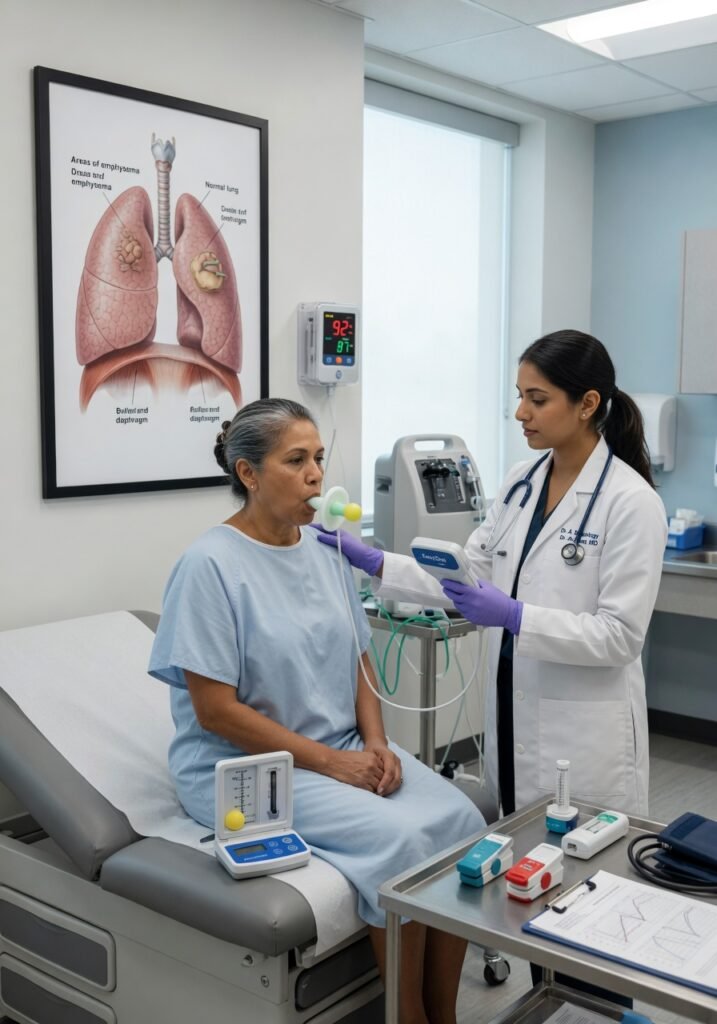
Your doctor starts with a spirometry test—the breathing machine where you blow hard into a tube. Spirometry measures FEV1 (how much air you exhale in one second) and FVC (total air exhaled). The ratio between them (FEV1/FVC) is the diagnostic key: below 70% suggests obstruction. Normal is above 80%.
The GOLD (Global Initiative for Chronic Obstructive Lung Disease) classification system uses FEV1 percent-predicted to stage severity: GOLD 1 (mild) is FEV1 ≥80% predicted, GOLD 2 (moderate) is 50-79% predicted, GOLD 3 (severe) is 30-49%, and GOLD 4 (very severe) is <30%. But here’s the clinical insight most websites skip: your FEV1 number doesn’t always predict your symptoms. Someone with FEV1 of 35% might walk a mile; someone with 50% might be housebound. That’s because the lungs’ reserve capacity varies, and psychological factors like anxiety and deconditioning play real roles.
Additional tests include chest X-ray to rule out other conditions, CT scan if diagnosis is unclear or lung cancer risk is high, and sometimes blood work to check alpha-1 antitrypsin levels (especially if you’re under 45 or have a strong family history).
Treatment: What Actually Works and Why
COPD treatment operates on a stepwise escalation. All patients benefit from smoking cessation—it’s the only intervention that slows decline. No medication, no procedure can match quitting smoking for long-term outcomes.
Medications come in two main categories: short-acting and long-acting. Short-acting beta-2 agonists like albuterol work within minutes and last 4-6 hours—these are rescue inhalers for acute breathlessness. Short-acting anticholinergics like ipratropium work differently, blocking mucus production and bronchial constriction.
Long-acting agents are where you spend most of your effort. Long-acting beta-2 agonists (salmeterol, formoterol) and long-acting anticholinergics (tiotropium, aclidinium) prevent symptoms and exacerbations. The NIH recommends starting with a long-acting bronchodilator—not waiting to add it later. Combination inhalers containing both classes, plus inhaled corticosteroids, become standard for moderate-to-severe COPD with exacerbation history.
Inhaled corticosteroids (fluticasone, budesonide) reduce inflammation and exacerbation frequency in patients with frequent exacerbations or concurrent asthma-COPD overlap. They don’t work well as monotherapy but add meaningful benefit when combined with long-acting bronchodilators.
Phosphodiesterase-4 inhibitors like roflumilast reduce exacerbations by roughly 20% in severe COPD with chronic bronchitis phenotype—a niche drug, but effective for the right patient. Theophylline is older and less popular now, but still used when other options fail.
Pulmonary rehabilitation—not just exercise, but supervised programs combining exercise training, breathing techniques, nutrition counseling, and psychological support—reduces hospitalizations and improves quality of life in randomized trials. Oxygen therapy becomes necessary when oxygen saturation drops below 88% at rest or during exertion; long-term oxygen therapy improves survival in hypoxic patients.
Daily Management: Concrete Strategies That Work
Inhaler technique matters profoundly. Most patients use inhalers incorrectly, reducing drug delivery to 10-20% of intended dose. Ask your pharmacist or nurse to watch you use your inhaler quarterly. Use a spacer device if you struggle with coordination.
Recognize your exacerbation triggers. Keep a simple log: weather changes, specific activities, times of day when symptoms worsen, foods that seem to trigger cough. Many patients notice humidity and temperature swings trigger flare-ups—cold air especially. Staying hydrated thins secretions. Pursed-lip breathing (breathing out slowly through pursed lips) recruits accessory muscles and improves ventilation—practice it during dyspneic episodes.
Nutrition affects lung function. Malnutrition worsens outcomes; overweight status increases dyspnea because it stresses the diaphragm. Weight loss if obese, adequate protein intake, and micronutrient sufficiency matter. Avoid foods that cause bloating—beans, cruciferous vegetables—because abdominal distension restricts diaphragmatic movement.
Vaccinations prevent exacerbations. Get annual influenza vaccine and pneumococcal vaccine (newer conjugate vaccines like Pneumovax 20 offer broader coverage than older versions). RSV vaccine is now recommended for older adults with COPD.
Activity pacing prevents exhaustion spirals. Don’t avoid activity entirely—deconditioning worsens outcomes. Instead, do brief activities with rest breaks. Walk to the mailbox, rest 10 minutes, continue. This maintains fitness without triggering severe dyspnea.
Prevention: What the Evidence Actually Shows
For people without COPD, the evidence is straightforward: don’t smoke, avoid occupational dusts, minimize air pollution exposure. For former smokers, smoking cessation itself is prevention—even after emphysema develops, stopping smoking slows decline by roughly 50% compared to continued smoking.
The nuance: alpha-1 antitrypsin augmentation therapy (infusing synthetic alpha-1 antitrypsin intravenously) can slow decline in patients with documented severe deficiency, but it’s expensive and only for specific genotypes. Lung volume reduction surgery helps select patients with emphysema and upper-lobe predominance, but only 25-30% of COPD patients qualify.
Environmental controls—air purifiers, avoiding secondhand smoke exposure—help but don’t prevent disease in susceptible people. Early detection through screening high-risk populations is being studied, but doesn’t yet change recommendations for asymptomatic smokers outside clinical trials.
Frequently Asked Questions
Can COPD go into remission?
No, COPD doesn’t remit because the lung damage is permanent. However, inflammation and mucus production can improve dramatically with proper treatment and smoking cessation, which makes symptoms feel like they’ve improved substantially. Some patients on optimized regimens experience minimal symptom progression for years—that’s stability, not remission, but it feels like a remission in terms of daily function.
Is COPD hereditary?
Genetic predis
Sources & Medical References
HealthTopics.com articles are based on peer-reviewed medical research and guidance from the NIH, CDC, and WHO. See our editorial policy for full sourcing standards.