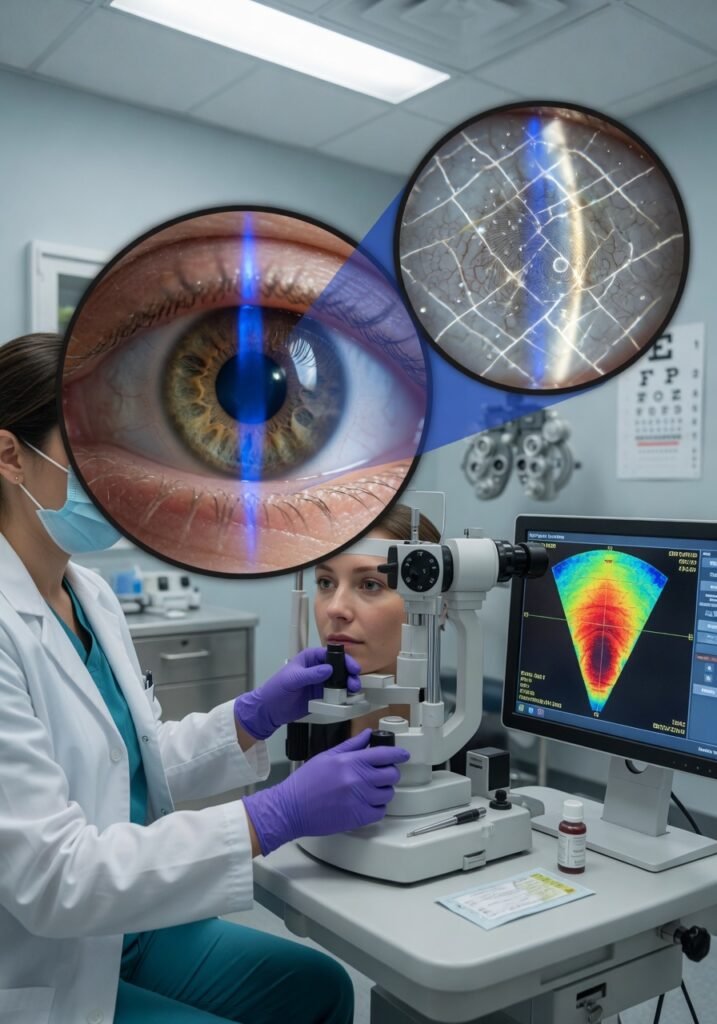
Sarah, 34, noticed her vision had become increasingly blurry over the past year, and her eyeglasses prescription kept changing—sometimes dramatically—month to month. Her optometrist mentioned something called keratoconus and referred her to a corneal specialist. Within days, she discovered her cornea wasn’t shaped like the smooth dome it should be, but rather was developing a cone-like bulge that was warping everything she tried to see. She wasn’t alone: roughly 1 in 2,000 people develop this condition, and many never realize what’s causing their progressive vision problems until they’re significantly affected.
Key Facts About Corneal Conditions
- Keratoconus affects approximately 0.05% of the global population, though rates reach 0.2% to 0.6% in certain genetic populations, according to data published in the American Journal of Ophthalmology.
- Corneal dystrophies encompass over 60 different genetic disorders, many following autosomal dominant inheritance patterns, making family screening essential once one person is diagnosed.
- The CDC reports that refractive errors stemming from corneal shape irregularities account for 4.2 million visits to eye care specialists annually in the United States.
- Corneal ectasia (progressive thinning and bulging) can progress rapidly in younger patients—sometimes advancing 1 to 2 diopters of refractive change per year during the first two decades of life.
- Corneal cross-linking with riboflavin (vitamin B2) and UVA light has been shown to halt keratoconus progression in 94% of treated eyes when performed early, per the NIH’s Corneal Cross-Linking for Ectasia trial results.
What’s Actually Happening to Your Cornea?
Think of your cornea as the transparent windshield of your eye. It’s normally shaped like a smooth dome, with precise curvature that focuses light rays directly onto the retina. In keratoconus, the corneal collagen fibers that provide structural support gradually lose their organizational integrity. Instead of maintaining that smooth dome, the cornea begins to thin and bulge outward in an irregular cone shape—almost like a contact lens that’s been stretched unevenly from the inside.
Corneal dystrophies work differently. These are inherited conditions where deposits accumulate within the corneal layers—sometimes as protein aggregates, sometimes as lipid material, sometimes as crystalline substances. Unlike keratoconus, dystrophies don’t necessarily change the overall corneal shape dramatically, but they scatter and distort light as it passes through, much like viewing something through frosted glass that gradually gets more opaque.
The critical distinction? Keratoconus is primarily a mechanical failure of corneal architecture. Dystrophies are primarily about material accumulation within structurally normal (or initially normal) tissue. This difference profoundly affects how we treat each condition.
What Causes These Corneal Problems?
Keratoconus: The Known and the Overlooked
Genetics play the largest role—about 10% of patients have a family history of keratoconus. Certain syndromes carry dramatically elevated risk: Down syndrome carries a 15-fold increased risk, while Ehlers-Danlos syndrome and Marfan syndrome substantially elevate risk as well. Eye rubbing, particularly vigorous rubbing, is strongly associated with keratoconus progression. This isn’t merely correlation; biomechanical studies show that chronic rubbing directly damages collagen cross-links in the cornea.
Atopic conditions—allergies, eczema, asthma—show a curious association with keratoconus. The inflammation and subsequent eye rubbing creates a vicious cycle. Here’s what most articles miss: certain Asian and Middle Eastern populations show keratoconus prevalence rates 10 to 15 times higher than European populations, suggesting significant genetic ancestry effects that aren’t yet fully understood at the molecular level. If you’re from these populations and have relatives with progressive vision changes, screening matters.
Corneal Dystrophies: Genetic Mutations
These are fundamentally genetic conditions caused by mutations in specific genes responsible for corneal protein production. Lattice dystrophy involves abnormal amyloid accumulation. Granular dystrophy involves protein aggregates that look granular under the microscope. Fuchs endothelial corneal dystrophy involves progressive loss of endothelial cells—the pump cells that keep the cornea dehydrated and transparent.
Unlike keratoconus, dystrophies aren’t environmental. You can’t cause them through eye rubbing or contact lens wear. You inherit the genetic predisposition, and the condition unfolds according to your genetic programming and, sometimes, environmental triggers like eye trauma or specific surgical procedures that accelerate symptom onset.
How Keratoconus and Dystrophies Actually Feel
Early keratoconus often masquerades as simple refractive error. You get new glasses, and within months they don’t work anymore. Your astigmatism—the blurring from uneven corneal curvature—keeps increasing. Frequent changes in prescription should always trigger corneal imaging, not just another lens update.
As keratoconus progresses, vision becomes unpredictably variable throughout the day. Morning vision might be decent; by afternoon, when your eyes are fatigued and your cornea slightly edematous, vision deteriorates. You might develop monocular diplopia—ghosting or doubling of images from that eye alone. Night driving becomes treacherous due to glare and halos around lights. Contact lens intolerance is common; rigid gas-permeable lenses become increasingly uncomfortable as the cone steepens.
Corneal dystrophies present differently depending on layer involvement. Anterior dystrophies cause gradual haziness and recurrent corneal erosions—painful episodes where the surface layer detaches spontaneously, often upon waking. You wake with sharp pain and photophobia (light sensitivity) that might resolve within hours or persist for days. Posterior dystrophies like Fuchs endothelial dystrophy cause gradual morning blurriness and corneal swelling that slowly worsens over years or decades. Patients often don’t notice until they reach their 50s or 60s, at which point the endothelial cell count has declined substantially.
How Your Eye Doctor Confirms This
Keratoconus diagnosis requires corneal topography—a computerized map of your cornea’s shape. The topographer shoots thousands of light points at your cornea and measures the reflection pattern, creating a color-coded map. A normal cornea shows a symmetric oval pattern; keratoconus shows a characteristic “cone” pattern, usually inferonasal (lower inner part of the eye). Pachymetry measures corneal thickness—keratoconus corneas are progressively thinner at the cone apex.
Your doctor will likely perform slit-lamp examination to visualize the cone shape directly and check for Fleischer rings (iron deposits at the cone base) and Vogt’s striae (vertical stress lines in the cornea). They’ll measure your refractive error with refraction and keratometry. If you’re considering corneal cross-linking, your doctor will measure corneal thickness with ultrasound pachymetry, because the procedure requires minimum thickness (usually 400 micrometers) to proceed safely.
Dystrophy diagnosis combines topography, slit-lamp findings (those characteristic material deposits are usually visible), and genetic testing in some cases. Confocal microscopy allows visualization of deposits within specific corneal layers without biopsying tissue. For Fuchs dystrophy specifically, endothelial cell count using specular microscopy determines whether surgical intervention is necessary before cataract surgery.
Treatments That Actually Work
Keratoconus Management
Early disease with mild refractive error: spectacles or soft contact lenses often suffice initially. As astigmatism increases, rigid gas-permeable (RGP) contact lenses become necessary—these vaulted lenses bridge over the irregular cone and provide clearer vision than any glasses could. Hybrid lenses combining a rigid center with soft skirt material offer more comfort for some patients.
Moderate to advanced disease: corneal cross-linking (CXL) has become the standard progression-halting intervention. The procedure uses riboflavin eye drops and UVA light exposure to strengthen corneal collagen cross-links. Studies show it arrests progression in over 90% of cases when performed early. The procedure takes roughly 30 minutes, and vision often remains temporarily blurred for weeks afterward, but long-term outcomes justify this. I typically recommend cross-linking when topographic changes exceed 1 diopter per year or when pachymetry shows thinning below 450 micrometers.
Advanced disease with contact lens intolerance: scleral lenses—large-diameter rigid lenses that vault completely over the irregular cornea—restore functional vision for many patients who’ve exhausted other options. These are specialized; you’ll need fitting from someone experienced with ectasia cases.
End-stage disease: corneal transplantation becomes necessary if other interventions fail. Deep anterior lamellar keratoplasty (DALK) replaces only the anterior corneal layers while preserving the patient’s own endothelium, improving long-term graft survival compared to full-thickness penetrating keratoplasty.
Corneal Dystrophy Management
Treatment depends entirely on dystrophy type and severity. Anterior dystrophies with recurrent erosion: lubricating eye drops throughout the day, ointments at night, and protective eyewear prevent friction. Bandage contact lenses worn continuously provide remarkable relief by protecting the surface from eyelid friction. Topical antibiotics prevent infection during healing. Some patients benefit from anterior corneal scraping—removing the loose epithelium—or excimer laser ablation to smooth the surface.
Stromal dystrophies with visual symptoms: topical corticosteroids can sometimes slow progression, though evidence is mixed. Phototherapeutic keratectomy (PTK) using excimer laser removes deposits and can restore vision in selected cases, though recurrence is common.
Fuchs endothelial dystrophy: early disease management is purely supportive—hypertonic saline drops and ointments (5% sodium chloride) osmotically draw water from the swollen cornea, improving morning vision. Descemetorhexis with Descemet membrane endothelial keratoplasty (DMEK) has revolutionized surgical management, providing excellent visual outcomes with minimal corneal scarring, far superior to older transplant techniques.
Daily Management Strategies That Matter
For keratoconus: Stop rubbing your eyes—I mean truly stop, even when itchy. Apply cool compresses instead. Wear wraparound sunglasses to reduce wind irritation and the urge to rub. If you have allergies, aggressive allergy management prevents itching that triggers rubbing. Use rewetting drops designed for rigid contact lens wearers if you wear lenses; standard drops may dehydrate lenses further. Stay vigilant about contact lens hygiene; keratoconus corneas are more prone to infection because of lens-related microtrauma.
Sleep position matters—avoid sleeping on your face. If you sleep prone, train yourself to sleep supine. Facial compression during sleep can theoretically worsen corneal distortion over years.
For dystrophies: Anterior dystrophies require diligent lubrication even when asymptomatic. Don’t wait until erosion occurs. Use preservative-free drops if possible; preservatives irritate already-fragile epithelium. Protective eyewear (ski goggles work) during windy conditions, low humidity, or when near air conditioning vents prevents surface drying. Humidifiers in your bedroom reduce nocturnal corneal drying.
For erosion-prone dystrophies, avoid contact lens wear unless specifically prescribed therapeutically. Mechanical trauma from lenses accelerates erosion episodes.
What Actually Prevents Progression?
For keratoconus, only corneal cross-linking has robust