Diabetic Eye Disease: What You Actually Need to Know Before Vision Loss Happens
Maria, a 52-year-old accountant with type 2 diabetes for eight years, scheduled her routine eye exam only because her primary care doctor insisted. She’d heard about diabetic retinopathy before—something about blood vessels and blurry vision—but figured that wouldn’t happen to her because her vision felt perfectly normal. Three weeks later, her ophthalmologist detected moderate nonproliferative diabetic retinopathy in both eyes. Maria had no symptoms whatsoever. She was stunned to learn that her retinas were already bleeding from damaged blood vessels, and she’d seen no warning signs.
Here’s the misconception most people believe: Diabetic eye disease only affects your vision if you have diabetes that’s “out of control” or if you’ve had diabetes for decades. Wrong. The actual truth? You can have significant diabetic retinopathy—the most common diabetic eye disease—with perfect 20/20 vision and zero symptoms. The disease progresses silently in the back of your eye while you see clearly, often until damage becomes irreversible. That’s why waiting to “notice something wrong” is genuinely dangerous.
Key Facts About Diabetic Eye Disease
- Approximately 1 in 3 adults with diabetes develop diabetic retinopathy, according to the CDC—that’s roughly 7.7 million Americans right now
- Diabetic macular edema (swelling in the macula) can develop even in early-stage nonproliferative disease and causes the most vision loss in working-age diabetics
- The American Academy of Ophthalmology reports that 75% of people with diabetic retinopathy could preserve their vision if detected and treated early
- Elevated hemoglobin A1C levels above 8% increase your risk of developing or worsening diabetic retinopathy by approximately 4% for each 1% increase, according to the Diabetes Control and Complications Trial (DCCT)
- Diabetic eye disease actually includes four distinct conditions: nonproliferative diabetic retinopathy, diabetic macular edema, proliferative diabetic retinopathy, and diabetic cataracts—many patients have more than one simultaneously
Understanding Diabetic Eye Disease: The Mechanism Most Articles Get Vague About
Your retina is basically a camera’s film—the light-sensitive tissue that captures images and sends them to your brain. It’s fed by tiny blood vessels, and those vessels are exquisitely sensitive to sustained high blood sugar. Think of it this way: when glucose levels stay elevated for years, the blood vessel walls in your retina get damaged from glycation—that’s when glucose molecules attach to proteins in the vessel wall and harden them, like caramelizing sugar on the outside of a crème brûlée. The walls become stiff, weak, and prone to leaking.
As these vessels weaken, they develop microaneurysms (tiny outpouchings that look like small blisters) and start hemorrhaging blood into the retina itself. That’s nonproliferative disease—the retina bleeds but doesn’t create new vessels yet. If blood sugar remains high, the retina becomes oxygen-starved. Desperate for oxygen, it sends out chemical signals that trigger growth of new, abnormal blood vessels in a scramble for blood supply. That’s proliferative disease, and those new vessels are architectural disasters—they’re fragile, bleed easily, and can cause scarring that pulls the retina off the back of your eye (retinal detachment). Meanwhile, swelling in the macula—the central part responsible for sharp, detailed vision—causes blurriness even when you can’t see the damage on an exam.
The brutal part? Early damage is completely silent. You have no pain, no symptoms, and no warning until either random floaters appear (blood in the vitreous), your vision suddenly blurs (macular edema or more serious hemorrhage), or an ophthalmologist catches it on screening.
Causes and Risk Factors: Including One Thing Most Articles Won’t Mention
Duration of diabetes matters—the longer you’ve had elevated blood sugar, the higher your risk. But blood sugar control matters most. Poor glycemic control, measured by hemoglobin A1C, is the strongest predictor. Hypertension accelerates retinopathy significantly because it adds pressure stress to already-damaged vessels. High cholesterol, particularly elevated triglycerides, worsens it too.
Type 1 diabetes carries inherently higher risk than type 2 simply because type 1 patients typically have less residual beta cell function and more dramatic glucose swings. Pregnancy in women with diabetes temporarily worsens retinopathy in 10-15% of pregnant diabetics through mechanisms we still don’t fully understand—likely hormonal and metabolic shifts.
Here’s the overlooked risk factor: diabetic kidney disease (nephropathy) is a powerful independent predictor of worsening eye disease. If you have proteinuria or declining kidney function, your ophthalmologic risk escalates dramatically. Why? The conditions share the same microvascular damage mechanism—what damages retinal vessels also damages glomerular vessels in the kidney. Patients with both conditions need more aggressive eye screening and stricter A1C targets.
Signs and Symptoms: What Patients Actually Experience
Early nonproliferative disease: You feel nothing. Your vision is normal. The only way to know it exists is through dilated eye examination where an ophthalmologist sees microhemorrhages and microaneurysms on the retina.
Diabetic macular edema: Mild cases cause no symptoms—detected only on optical coherence tomography (OCT) imaging. Moderate to severe cases cause blurred or wavy central vision, difficulty reading or recognizing faces, and washed-out color perception. Some patients describe it as looking through a rain-spotted windshield where the center of your visual field is smudged but peripheral vision is clear.
Proliferative disease and advanced hemorrhage: Sudden floaters (dark spots or cobwebs that move across your vision), flashing lights (photopsia), and sudden vision loss if a hemorrhage fills the vitreous. This is an ophthalmologic emergency.
Diabetic cataracts appear earlier than age-related cataracts and progress faster—patients notice gradual haziness, glare sensitivity, and yellowish tint to vision.
Diagnosis: What the Tests Actually Show
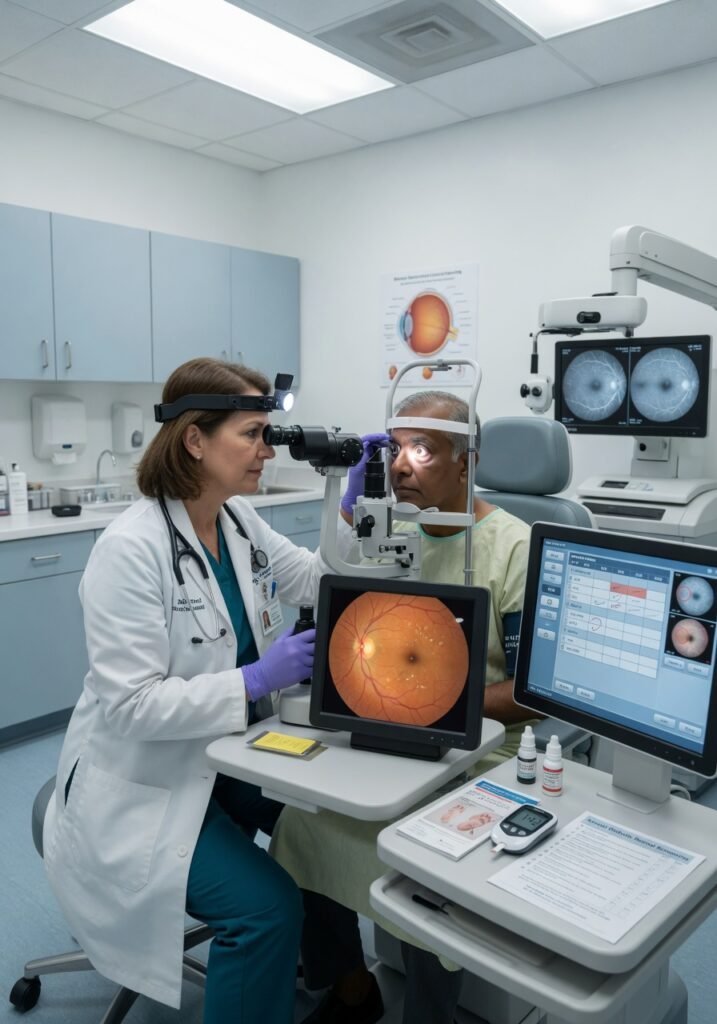
Standard dilated eye exam remains the gold standard initial screening. The ophthalmologist instills dilating drops, examines the retina directly with a slit lamp and indirect lens, and classifies what they see using the Early Treatment Diabetic Retinopathy Study (ETDRS) scale: no disease, mild nonproliferative, moderate nonproliferative, severe nonproliferative, or proliferative.
But that’s just the beginning. If you have any diabetic changes, you’ll get optical coherence tomography (OCT)—a laser imaging technique that creates cross-sectional pictures of the retina, revealing macular edema that the eye exam alone might miss. The OCT measures retinal thickness in microns and is sensitive enough to catch swelling long before it affects vision.
Fluorescein angiography—where dye is injected into your arm and photographed as it flows through retinal vessels—shows vessel leakage, nonperfused areas (regions without blood flow), and neovascularization. It’s not routine screening but becomes essential before treatment decisions.
All diabetic patients should have an initial dilated eye exam at diagnosis (or immediately if diagnosed with type 2 diabetes, since you may have had it undiagnosed for years). Then annual exams at minimum, more frequently if any retinopathy is detected.
Treatment Options: What Actually Works and For Whom
For nonproliferative disease without macular edema: Treatment focuses on glycemic control, blood pressure management, and statin therapy. No retinal procedures are indicated yet—just meticulous monitoring.
For diabetic macular edema: This is where treatment gets active. Anti-VEGF injections (bevacizumab, ranibizumab, aflibercept) are first-line therapy—these drugs block vascular endothelial growth factor, the chemical signal driving abnormal vessel growth and leakage. Patients receive intravitreal injections (shots directly into the eye—sounds terrifying, actually feels like pressure because the eye is numb) monthly or every other month depending on response. OCT imaging guides treatment decisions. Studies show these injections preserve vision in 70-80% of treated eyes versus 30% without treatment.
Corticosteroid injections (triamcinolone acetonide or dexamethasone implants) are alternatives for some patients, particularly those with concurrent inflammation or who’ve failed anti-VEGF therapy.
Laser photocoagulation—using a laser to burn areas of the retina—has been replaced by anti-VEGF injections for most macular edema cases but remains useful for peripheral retinal nonperfusion.
For proliferative disease: Panretinal photocoagulation (PRP)—laser treatment that burns 1000-2000 spots across the retina outside the macula—shrinks new vessels and prevents vitreous hemorrhage. Alternatively, anti-VEGF injections are increasingly used first, with laser as backup. Vitrectomy (surgical removal of vitreous gel filled with blood) becomes necessary when hemorrhage prevents vision and medication isn’t enough.
For cataracts: Phacoemulsification cataract surgery with intraocular lens implantation. This is standard surgery but requires careful timing—you want reasonable glycemic control first, and any macular edema should be addressed before cataract surgery.
Practical Daily Management: Concrete Actions That Actually Prevent Progression
Target hemoglobin A1C below 7% if you can tolerate it without dangerous hypoglycemia—this is the single most important factor you control. Each percentage point reduction cuts retinopathy risk substantially. Check your A1C every three months if you’ve been diagnosed with any diabetic retinopathy.
Keep blood pressure below 130/80 mmHg. This matters as much as blood sugar control for retinal disease. If your current antihypertensive regimen isn’t hitting this target, tell your doctor—you may need adjustment.
Take a high-intensity statin regardless of cholesterol levels if you have any diabetic retinopathy. Studies show this reduces progression even independent of cholesterol lowering.
Schedule dilated eye exams annually minimum. If you have macular edema or proliferative disease under treatment, you’ll go every 4-6 weeks initially to monitor response to injections or laser.
Don’t skip ophthalmology appointments because you feel fine. Maria’s mistake was assuming normal vision meant no problem. Diabetic eye disease progresses invisibly.
Prevention: What Evidence Actually Shows Works
The landmark Diabetes Control and Complications Trial (DCCT) published in JAMA in 1993 showed that intensive diabetes management reducing A1C from 9% to 7% cut retinopathy incidence by 76% in type 1 patients over a decade. Subsequent studies confirmed this applies to type 2 diabetes as well, though the effect size varies.
Intensive blood pressure control reduces retinopathy progression. The UK Prospective Diabetes Study found that tight blood pressure control prevented retinopathy by 34%.
ACE inhibitors and angiotensin receptor blockers show modest protective effects independent of blood pressure lowering—these drugs have specific anti-angiogenic properties. If you have diabetes and hypertension, these should be your preferred class.
Aspirin for primary prevention? Doesn’t prevent diabetic retinopathy, so don’t take it specifically for eye protection.
The caveat: Prevention works best before disease appears. Once moderate to severe nonproliferative or proliferative retinopathy develops, tight control